

On this page
Three separate bookings make up the day
**Plan Badaling as transport to the scenic area, admission to the wall, and an achievable ascent and descent.** A train ticket covers only the first part. A cableway product may cover a ride without admission, or admission plus a particular ride. Neither necessarily provides transport back to your Beijing hotel.
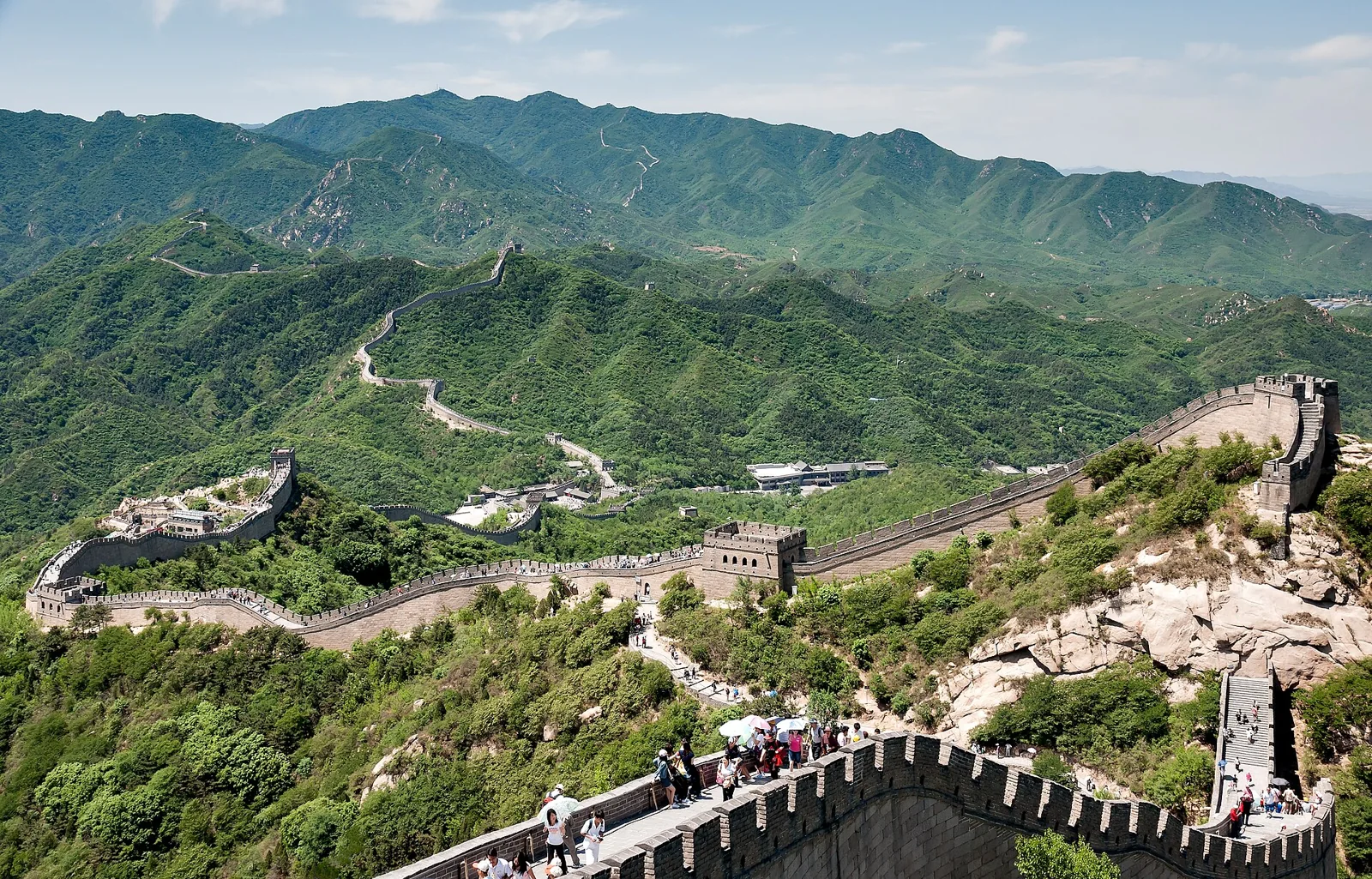
Badaling, 八达岭长城, is a developed Great Wall destination northwest of Beijing. Choose it when the managed visitor route and public-transport options fit your trip. Do not book it as a convenient substitute for Mutianyu without recalculating the journey: they are separate wall sections with different transfers and ride products. Shuiguan Great Wall and Badaling Ancient Great Wall are also separately named destinations, not alternate names for the standard Badaling admission you may be comparing.
A workable order of decisions is:
- Choose the day and check for a dated closure or ride-maintenance announcement.
- Identify the actual train arrival station or bus drop-off and the wall entrance/ride station it serves.
- Decide on a short walking visit, a longer wall walk or a ride-assisted route, including the descent.
- Buy the matching admission and any chosen ride product using the traveler’s accepted identity document.
- Secure the return transport and work backward from its departure to a sensible turnaround time on the wall.
This sequence prevents an attractive uphill product from leaving you with a descent or return journey your party cannot manage. The goal is a complete day, not reaching the highest-looking point on a booking photograph.
Choose the correct railway, station and departure point
The names **Badaling Great Wall Station, 八达岭长城站**, and **Badaling Station, 八达岭站**, refer to different railway facilities. Keep the complete station name in your itinerary and return booking.
| Rail option | What to search for | What needs attention |
|---|---|---|
| High-speed railway | A train stopping at 八达岭长城, with the actual Beijing-area departure station shown on your order | A reserved train journey and station security; Beijingbei and Qinghe are different departure points |
| S2 suburban railway | 南口 to 八达岭, using the current S2 operating notice | The transfer to Nankou and the limited number of departures; do not use an obsolete Huangtudian plan |
Swipe to see the full comparison
**S2 no longer starts at Huangtudian under the current published arrangement.** The Beijing Municipal Commission of Transport’s July 7, 2026 route information confirms the change from October 25, 2025: Huangtudian stopped operating for this line, and S2’s route was adjusted to start at **Nankou, 南口**. It lists Badaling among the stops.
The September 30 transport announcement, sourced to Beijing transport authorities, says the extra National Day trains end with the holiday arrangement. From October 8, the published pattern returns to two train pairs daily Tuesday–Thursday and three Friday–Monday. That makes a missed departure a substantial itinerary problem. Obtain the date’s timetable from 北京市郊铁路, the suburban railway’s official account, before choosing S2; this article does not turn the holiday’s five-pair service into a permanent schedule.
For high-speed services, use China Railway’s official 12306 channel to check a train that actually stops at the required station. The English site accepts valid foreign passports. Carry the same document used for the ticket. The itinerary sheet is not an admission ticket to the railway, and a search result showing a route does not establish that a seat has been issued.
Do not rely on a universal “30 minutes from Beijing” promise. The time on a particular train omits hotel-to-station travel, security, waiting and the transfer from the destination station to the wall. On the return, allow for reaching the station and completing its checks; the train’s printed departure is not the time to arrive at its outer doors.
Passport admission is available through named channels
The operator homepage currently advertises both real-name advance buying and on-site ticket purchasing. Its **外籍人购票** entry for foreign visitors opens a Trip.com attraction page. That is a route offered from the operator website; the resulting order still has the third-party seller’s product description, traveler requirements and cancellation terms.
Beijing’s official foreign-visitor service report, dated May 2024, describes passport purchases through 长城内外, Changcheng Neiwai, as well as cash, mobile-payment and foreign-bank-card facilities at the ticket office. It also identifies Chinese-and-English service windows for buying, exchanging and checking tickets. These are useful assistance channels when your passport or payment method needs staff handling.
The city’s 2026 attraction listing posts standard adult day admission at **40 yuan in April–October** and **35 yuan in November–March**. These are wall-admission references, not the price of a train, cableway or guided package. The listing describes on-site buying, while older operator instructions emphasize advance real-name buying. The operator homepage’s current combination of both channels is the practical reading: advance purchase is useful planning, but it is not documented here as the only possible channel forever.
Ask for the exact day product you need and retain the order’s entry instructions. If a platform lists “cable car,” check whether Great Wall admission is included, whether the ride is north or south, and whether it is one-way or return. A lower price can be a different product rather than a saving on the same visit.
Concession and free-entry conditions need checking against the traveler’s documents. Official listings express eligibility in different ways, particularly for foreign visitors and permanent residents. Do not assume that age alone automatically produces the same entitlement across admission, railway and ride tickets. Have staff confirm the relevant concession before paying for an expensive bundle.
North and south are route choices, not interchangeable ride labels
The north and south directions offer different wall walks from the gate area. The north-side numbered towers and the well-known Haohan Po ascent attract many first-time visitors; the south direction offers another view of the ridge and the northern wall. Neither choice removes the need to assess steps, slopes and the return.
Beijing’s March 2026 route feature identifies North Towers 2 and 4 and South Tower 2 as viewpoints, and describes ride access toward the north-side high viewpoints. Its spring blossom advice is seasonal. Use the named towers to understand a route, not as a promise of flowers on an autumn or winter visit.
For an independent walking visit, choose a modest initial target and a turnaround point. The wall’s gradient, steps and visitor flow matter more than the horizontal distance on your phone. For a ride-assisted visit, ask what remains between the upper ride station and the tower you intend to reach. A cableway station near a famous tower is not proof of a step-free connection to its viewing point.
There is also a distinction between the standard visitor route and extended historic sections. Beijing’s 2023 account of the southern extension describes small, reserved and collectively organized visits to a section retaining a more weathered condition. It does not authorize an ordinary day-ticket holder to continue along every visible ridge. Stop at the current boundary and follow staff directions even if an old route article gives higher tower numbers.
A visitor who wants to understand the defensive landscape can have a worthwhile shorter visit. From an authorized viewpoint, look at how the wall follows the ridge, how towers relate to each other and how the pass sits below. UNESCO describes the Great Wall as a defensive system of walls, towers, shelters, fortresses and passes constructed across successive periods. Badaling’s visible masonry should be understood in that larger history, rather than described as one unchanged wall built by the first emperor.
For late-2026 travel, read the northern cableway notice before committing
At this article’s source check, the **Trip.com page reached from the operator’s foreign-ticket entry** displays a northern aerial cableway notice for **October 21–December 25, 2026**, stating that operations will be suspended for a capacity upgrade. Its notice also lists southern ground-cablecar hours and a separate cutoff for selling return rides.
This is a **dated notice on the linked booking page**, not a firsthand report from Bangsai or a claim that the northern cableway is already closed on October 14. We have not obtained a matching operator-hosted maintenance notice. If your trip falls within that date range and depends on riding up the north side, confirm the current arrangement through the operator and the product seller before paying.
The practical response is to choose among an available south-side ride, a walking plan your party can complete, or another date or wall destination. Do not buy a northern return product simply because it remains among a platform’s product categories. A category’s existence is not confirmation of a specific date’s operating service.
Ask these questions before buying a ride:
- Which lower station and upper station does it use, and which wall section can I reach from there?
- Does “return” mean both journeys on the same ride, and by what time must I be back?
- How much walking and how many steps remain after the ride?
- If the ride is stopped, is the ticket refundable and what is the workable alternative for my group?
The answers determine whether a ride reduces your effort or merely changes where a demanding walk begins. Obtain the seller’s current fare and terms; this guide does not invent a uniform cableway price or treat two different systems as one interchangeable ticket.
A night visit, reduced-mobility visit or weather change needs its own arrangement
Badaling’s 2026 night-tour announcement specifies a season **April 30–October 6** and a limited section from North Tower 4 to South Tower 4, together with the cultural block. The announced season has ended by this source check. A night photograph or an old bookable tour category does not prove an ordinary October evening visit is available.
Likewise, the night announcement’s south-side uphill-only cablecar arrangement is not a general daytime return ticket. If a new night season is announced, plan its product, illuminated area and return to Beijing separately from day admission. Do not arrive after day last entry assuming your standard ticket is valid for any illuminated event.
For reduced mobility, contact the operator about the exact arrival point, assistance route and platform access. The operator’s visitor instructions recognize dedicated accessibility equipment, but this does not certify an unrestricted wheelchair journey along the historic wall. Ask whether assistance must be arranged and whether your own device can be accommodated on the selected ride. A stroller, wheelchair and visitor who can manage a few assisted steps have different needs.
The same instructions give the visitor-service number **+86 10 69122222** and state that severe weather can lead to full or partial closure. Treat a ride suspension and a wall closure as different events. If the wall stays open but a ride you rely on stops, reassess whether the remaining walking route suits your party. A booking does not make an unsuitable descent manageable.
Reserve enough of the return window to descend, reach the correct station or vehicle and pass any checks. If the return train is no longer realistic, address the booking through the railway’s applicable change process before simply assuming the next departure will accept you. The most successful Badaling visit is one you can complete comfortably with your admission, route and return all aligned.
Sources and editorial note
Individually researched from the live operator website and foreign-ticket popup, official passport service reporting, the transport commission’s July 2026 S2 update, September holiday-service notice, railway rules and UNESCO. The October 21–December 25 cableway notice was read in the details panel of the operator-linked Trip.com page; it is labelled platform evidence without an independently obtained operator notice. AI-assisted desk research, not a ticket transaction or field visit. Source review spans October 13 UTC and October 14 local time.
The linked platform maintenance notice requires date-specific confirmation; Bangsai has not booked or ridden the route. Fares quoted are posted day admission only. No guaranteed train duration, full-ridge access or complete wheelchair route is claimed.
- https://www.badaling.cn/
- https://www.badaling.cn/website/pc/index.html#/newsDetail?siteNewsId=2027
- https://english.beijing.gov.cn/travellinginbeijing/attractions/202603/t20260320_4562521.html
- https://english.beijing.gov.cn/latest/news/202405/t20240516_3685421.html
- https://jtw.beijing.gov.cn/sjtl/202111/t20211118_2540164.html
- https://news.bjd.com.cn/2026/09/30/11979910.shtml
- https://www.12306.cn/en/faq.html
- https://www.trip.com/travel-guide/attraction/beijing/badaling-great-wall-75596/
- https://english.beijing.gov.cn/travellinginbeijing/citytours/202603/t20260326_4566808.html
- https://www.beijing.gov.cn/ywdt/gzdt/202312/t20231205_3490100.html
- https://english.beijing.gov.cn/travellinginbeijing/events/202604/t20260424_4608135.html
- https://whc.unesco.org/en/list/438/