

On this page
Start with the landscape you want to experience
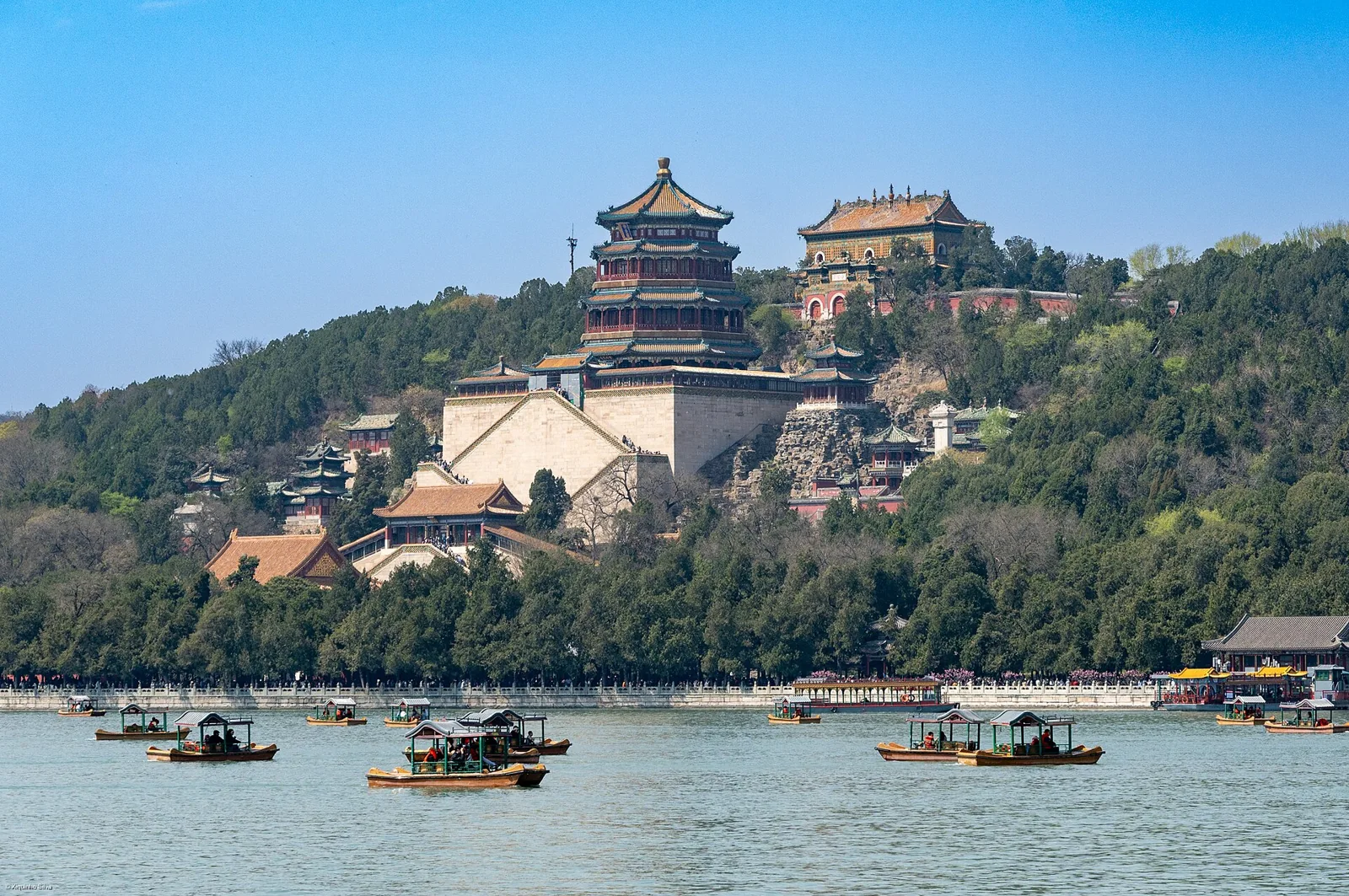
**Buy ordinary park admission for a lake-and-corridor visit. Add specific interiors or choose the combined ticket only when you intend to use them.** The Summer Palace, 颐和园, is a large imperial garden organized around Kunming Lake and Longevity Hill. It is not a single palace building with one short indoor tour.
Three plausible first visits have different demands:
| Your priority | A useful starting route | The main trade-off |
|---|---|---|
| Imperial garden scenery with less climbing | East Palace Gate, palace-side grounds, Long Corridor and nearby lake shore | You see the hill from below; a full lake circuit is unnecessary |
| A hill-and-architecture visit | Choose the north or east entrance, then make the Tower of Buddhist Incense an early priority | Steps and gradients matter; buy the relevant internal admission |
| Objects, court life and a shorter outdoor segment | Use the museum and selected palace-side areas, then a limited lake walk | Opening days of the interiors determine the date more than park hours |
Swipe to see the full comparison
These are editorial route choices, not guaranteed timed tours. Allow a dedicated half-day including travel from your accommodation if this is a major interest. A visitor who wants the lake circuit, several interiors and a boat ride can easily need more. The useful question is what to leave out, rather than how to squeeze every named place into two hours.
Also distinguish **Yiheyuan, the Summer Palace**, from **Yuanmingyuan, the Old Summer Palace**. They are separate destinations. A product, taxi pin or photograph labelled only “summer palace” deserves a second check before you pay or depart.
Work out whether the combined ticket saves you money
The current operator visitor page lists park admission at **30 yuan in April–October** and **20 yuan in November–March**. The combined ticket, 联票, is **60 or 50 yuan**, respectively. The separately charged areas are the Garden of Virtue and Harmony, Deheyuan, **5 yuan**; Tower of Buddhist Incense, Foxiangge, **10 yuan**; Suzhou Street, **10 yuan**; and Summer Palace Museum, **20 yuan**.
For a full-fare visitor, the practical comparison is:
| Planned use | April–October | November–March | Decision |
|---|---|---|---|
| Park and Long Corridor/lake shore | 30 | 20 | Ordinary admission matches the plan |
| Park plus Tower of Buddhist Incense | 40 | 30 | Separate admission costs less than the combo |
| Park plus tower and museum | 60 | 50 | Same listed total as the combo, before considering other areas |
| Park plus all four separately listed areas | 75 | 65 | The combo saves 15 yuan if those areas are open and you visit them |
Swipe to see the full comparison
The last three rows are arithmetic from the posted full fares, not new official packages. Do not treat a price advantage as a reason to rush across the garden to places you do not want to see. The combo includes park and internal-area admission; it is not evidence that a boat ride, audio device or personal guide is included.
The Summer Palace Museum is an internal museum near Wenchang Tower. The Haidian government’s March 2026 listing confirms its separate charge and the need for park admission to reach it. Some English material uses the confusing label “Palace Museum” for this internal collection space. It is **not Beijing’s Palace Museum in the Forbidden City** and does not provide admission there.
For an older foreign visitor, check eligibility before buying a full-fare ticket. A February 2026 official answer to a 64-year-old Italian traveler confirms free Summer Palace entry for visitors aged 60 and above, using a passport or other accepted identity document at the entrance. Ask separately about the particular internal areas and concession documentation you need; do not automatically extend a park-entry entitlement to every paid service.
If your foreign telephone number is rejected, use the documented assistance route
There is a concrete alternative to repeatedly editing a valid overseas number. In its June 2025 answer about this exact payment problem, Beijing’s municipal portal says Summer Palace online buying required a mainland Chinese mobile number at that time. It identifies **staff-assisted booking at the park entrance service window**, using valid documents such as a passport, as the alternative.
That is evidence of an official assistance process, not proof that the online restriction will remain forever. Try the current official channel if convenient, but do not buy under another person’s identity to bypass verification. If it fails, keep the error details and ask for assistance with your intended date and product.
Before you go to a window, prepare the original passport, the Chinese names of the ticket and entrance, and a simple request: “One park ticket,” or “One combined ticket for today.” If you need a particular interior, name it. This lets staff solve the actual purchase problem instead of guessing from a general request to visit “the palace.”
The official FAQ lists **+86 10 62881144** as the 24-hour service line, with **English service 08:30–17:00**. Use that English window to confirm the assistance arrangements when your schedule is inflexible. A documented on-site channel does not guarantee no queue, unrestricted capacity or an open interior on the day you arrive.
If a travel platform offers a more convenient foreign-language checkout, compare its named ticket, date, traveler identification and refund terms against the official product. A booking voucher is not necessarily the final admission credential. Complete any required confirmation before leaving your hotel.
Let the opening day determine your interior visit
The operator gives distinct schedules for the park and the internal areas. In April–October, park entry stops at **19:00** and the park closes at **20:00**; in November–March, those times are **18:00** and **19:00**. Internal areas stop admitting visitors at **17:30** or **16:30**, respectively, and close half an hour later. Their opening is **08:00** in the warmer season and **08:30** in the colder season.
The Tower of Buddhist Incense, Deheyuan, museum and Suzhou Street normally close on Mondays, with major-holiday exceptions stated by the operator. A lake walk can therefore be a sensible Monday plan; buying an interior-heavy itinerary without checking the date is not.
Beijing did announce extra Monday opening from July 3 to August 31, 2026, including the Tower of Buddhist Incense and Hall of Dispelling Clouds. That summer measure had an end date. It is not an October or year-round opening promise.
For an architecture-focused afternoon, put the tower or museum first and leave the broad landscape afterward. Conversely, a traveler arriving near internal closing should knowingly choose a landscape visit or return on another day. A combined ticket has little practical value if the areas you bought it for have stopped admitting visitors.
Choose the entrance for the walking task, not just the nearest station
The operator’s transport information associates **Xiyuan on Line 4** with East Palace Gate, **Beigongmen on Line 4** with North Palace Gate, and the **Xijiao line** with the west gate. Its newer visitor page also lists Line 16 at Xiyuan. These are gate connections, not instructions to use a generic map pin in the center of Kunming Lake.
East Palace Gate is a useful starting point for court-life areas and the lake-facing Long Corridor. North Palace Gate can suit someone deliberately taking the rear-hill route. It should not be selected merely because its metro access looks convenient if your party wants to avoid gradients. For a lakeside start near the Bronze Ox and eastern shore, consider New Palace Gate and check the last-mile transport separately.
Pick an exit at the same time as the entrance. A walk that ends on the opposite side of the garden may be enjoyable, but it changes your return journey. Do not discover this only when someone is tired or a booked dinner is approaching. Put the exit’s Chinese name into your map, and agree on a meeting point if the group separates for the hill or museum.
The operator’s wheelchair page offers limited free wheelchair loans at six gates and the East Palace Gate visitor center, with a **500-yuan deposit**. It describes a flatter loop of about **6.96 km** and a shorter loop of about **2.57 km that includes hill roads**. “Shorter” therefore does not mean easier, and an officially accessible landscape route does not make every historic interior step-free.
Ask staff to identify a manageable section and return point for your needs. You do not have to complete a loop to benefit from the park. Loan availability is limited; someone who relies on a particular wheelchair should not plan solely around an unreserved loan. Check where it must be returned before crossing to another exit.
Understand the garden while following a manageable route
The reason to spend time here is the relationship between buildings, water and views. UNESCO describes an imperial landscape combining political, residential, spiritual and recreational functions. Kunming Lake and Longevity Hill provide its framework; the halls and corridors form linked experiences within it.
From the East Palace Gate side, consider how a formal court setting changes into lakeside living and then a long covered walk. Pause along the Long Corridor to look both at the painted structure overhead and at the shifting lake views through its openings. The operator’s corridor history notes an eighteenth-century beginning, destruction and rebuilding in 1886. The visible ensemble carries a history of reconstruction, not uninterrupted survival of every component.
The Tower of Buddhist Incense adds a different perspective because the route rises above the shore. If the climb is the point of your visit, do it before tiredness makes the choice for you. If climbing is unsuitable, the relationship between the hill and lake can still be read from the shoreline. A meaningful visit does not require reaching every elevated viewpoint.
The Seventeen-Arch Bridge connects to the island landscape on the lake’s eastern side. Decide whether it belongs in your route before following the corridor far west. A famous winter-solstice photograph is tied to season, sunlight and viewpoint; a cloudy day at another time of year is still a valid garden visit, but it is not that guaranteed visual effect.
For interpretation, the operator’s guiding page lists English among the electronic audio-guide languages and rental points at several gates. It also identifies staffed guide consultation points outside and inside the garden. Ask about a human guide’s language, duration, route and fee before hiring. The newer operator page lists 21 audio languages, while older city material lists 19; the useful confirmed fact for this visit is that English is offered, not the marketing total.
A rented boat and a one-way ferry solve different problems
The official boat page lists six-seat self-drive electric boats at **200 yuan per boat per hour**, plus a **600-yuan deposit**. They must be returned to the original pier. This is recreation on the lake; it does not transport you to a new exit while leaving the rental behind.
Scheduled larger boats are a different product. For example, the listed Marble Boat–north side of South Lake Island route is **40 yuan per person one way**. Other named routes are 30 or 40 yuan. The Suzhou Street–Suyunyan route is specifically described as having no return service. Confirm the pier, destination and direction on the ticket rather than assuming any boat will bring you back.
Before joining a queue, decide whether you want lake time or an actual transfer. For a rental, ask how charging increments and deposit return work, and keep enough time to return to the same pier. For a ferry, identify the walking route from its landing to your planned exit. Admission, rental deposit and passenger fare are separate amounts.
The standard boat page lists operation to 17:30, with self-drive sales stopping at 16:30, and seasonal service around March–November. The homepage and detailed page differ slightly on the November endpoint. Beijing’s August 2026 evening-extension notice also says services can be adjusted for demand and weather. Use the current dock announcement for that day; do not build an essential return journey around an old late-evening service.
If wind or rain stops boats, retain a shore-based route to an open gate. A boat can improve the visit, but relying on it as the only way for a tired group to finish is an avoidable weakness in the plan. The better Summer Palace itinerary has a clear focus, an appropriate ticket and a return route that still works when an optional service does not.
Sources and editorial note
Individually researched from the live Summer Palace visitor, boating, wheelchair and guiding pages; Beijing’s foreign-phone FAQ and February 2026 senior-passport answer; the March 2026 Haidian museum listing and UNESCO. Fare comparisons are explicit arithmetic. AI-assisted desk research; no field visit, guide booking or checkout claimed.
Eligibility, capacity and date-specific service notices control purchases. The 2025 phone restriction is dated evidence rather than a permanent prediction. Boat-season endpoint conflicts and old summer extensions are not resolved into guarantees. Route duration is editorial advice.
- https://www.summerpalace.net.cn/visit.html
- https://english.beijing.gov.cn/12345hotline/faqs/all/202506/t20250620_4117980.html
- https://english.beijing.gov.cn/contactus/faqs/list/202602/t20260209_4502730.html
- https://www.summerpalace.net.cn/single/detail/505.html
- https://www.summerpalace.net.cn/single/detail/508.html
- https://www.summerpalace.net.cn/single/detail/509.html
- https://www.summerpalace.net.cn/single/detail/506.html
- https://zyk.bjhd.gov.cn/kjhd/whhd/bwg/202603/t20260326_4809803.shtml
- https://whc.unesco.org/en/list/880/
- https://www.summerpalace.net.cn/gallery.html
- https://english.beijing.gov.cn/latest/news/202607/t20260705_4747483.html
- https://english.beijing.gov.cn/whatson/events/travelling/202608/t20260813_4821315.html