

On this page
Decide which of three visits you actually want
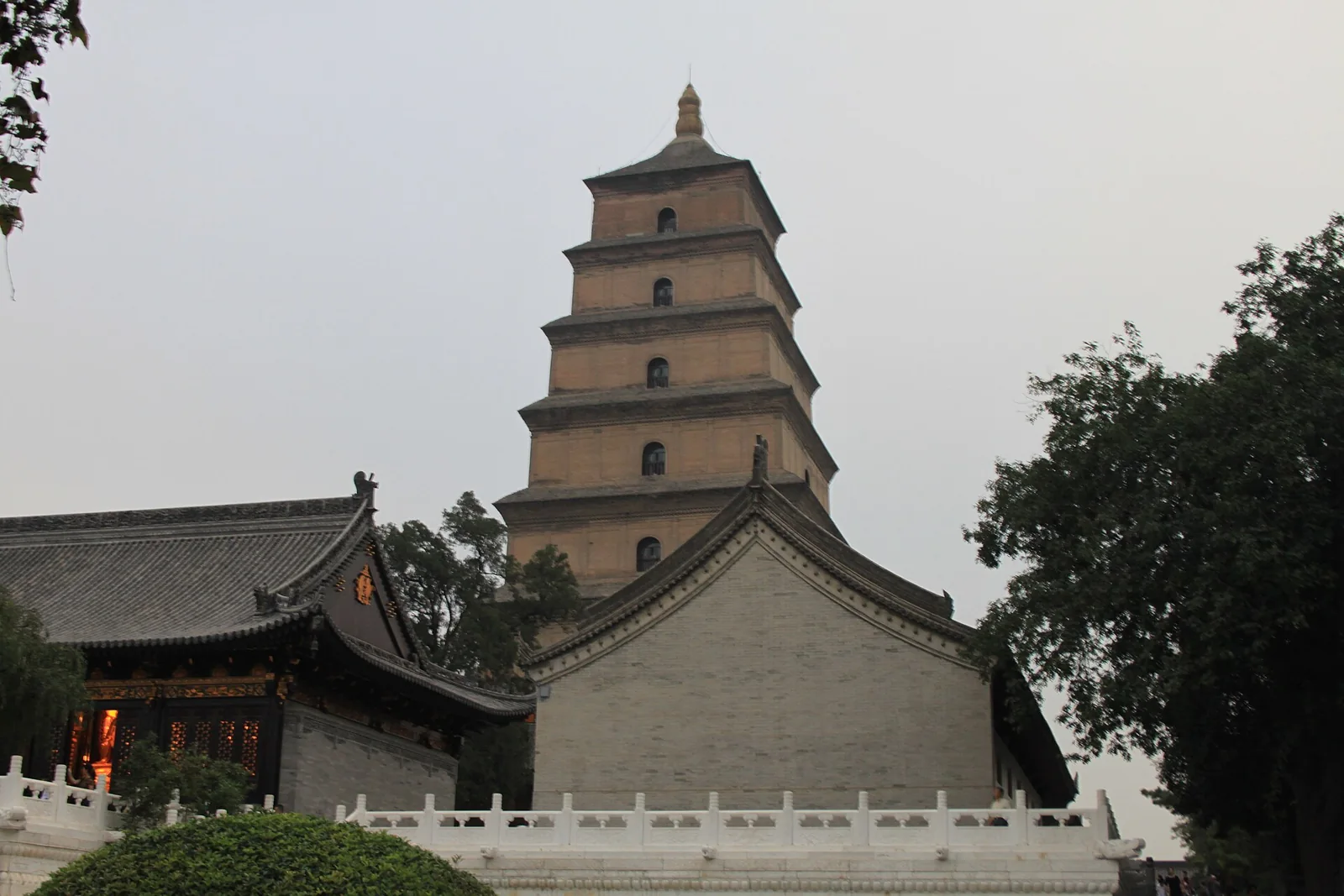
The Big Wild Goose Pagoda, or Dayanta, stands inside Da Ci’en Temple in southern Xi’an. Seeing the tower from the surrounding public spaces, entering the temple and climbing the pagoda are different visits. A temple ticket should not be read as automatic permission to ascend, and a night photograph does not establish that the pagoda is open for climbing after dark.
For historical and religious context, visit the temple during its confirmed admission hours and decide about the climb there. For the skyline and an evening walk, the exterior and surrounding squares can serve that purpose without turning the tower into a compulsory stair climb. For the view from inside, make the current tower-access conditions the first question, rather than buying a package because its title contains “Big Wild Goose Pagoda.”
The most useful route puts the time-limited interior first and the flexible exterior afterwards. Check the actual temple and tower closing times separately. Leave room for the walk around the complex: the north fountain square and the southern area leading towards Grand Tang Mall are not the same entrance or meeting point.
Read the ticket title before comparing its price
The pagoda custodian’s March 5, 2026 official ticket-printing plan identifies tower tickets at CNY 25 for a peak-season ordinary ticket, CNY 12.50 for a peak-season concession and CNY 20 for an off-season ordinary ticket. This is current-year evidence of the tower’s ticket categories; it is not a dated checkout, a concession-eligibility list or confirmation of the season boundaries for your visit.
For temple admission, the Qunar product listing retrieved during this review shows a CNY 10 adult entry product and says climbing requires a separate purchase. It also lists guided or audio bundles at different prices. Treat that CNY 10 as a seller’s displayed listing, not as a tested passport transaction or an independent operator confirmation of the gate tariff. Check the temple’s current terms and your date before paying.
These distinctions explain why a search results page can show several prices without describing the same experience. A CNY 25 guide service is not necessarily the CNY 25 tower ticket. An admission-and-audio bundle may add interpretation, while still excluding the ascent. Ask for an explicit inclusion list rather than inferring it from the highest number.
| What you want | What to establish before payment | What should remain separate |
|---|---|---|
| Temple courtyards and the pagoda exterior | Da Ci’en Temple admission for the date and document | Tower ascent and optional interpretation |
| An ascent inside the pagoda | Current ascent availability, last admission, ticket category and stair conditions | Temple access needed to reach the tower |
| A guided visit | Language, duration, meeting point, group size and included admissions | Any ascent or equipment not expressly included |
| An evening exterior walk | Public-space access and current event arrangements | A seller’s tour, costume rental or paid indoor experience |
Swipe to see the full comparison
Keep the two admission amounts separate in your budget until both are confirmed. A sum made from a seller’s listing and a custodian’s annual document is not a guaranteed combined ticket. If an ascent is unavailable, decide whether the temple visit still meets your interest before buying its entry.
Foreign visitors: a seller listing is not a passport procedure
Carry your original passport and check that any online product accepts its document type. If booking assistance is provided by a hotel or guide, ask which name and document are entered, how the final confirmation is delivered and where it is redeemed. Do not use another person’s identity to satisfy a form.
This review has not verified the temple’s current end-to-end passport checkout, advance-release window or international-phone verification. Consequently, it does not claim that every visitor can complete the same mini-program route, or that a particular number of advance days guarantees entry. Ask the temple or the intended ticket seller about your exact document and visit date.
The Shaanxi Buddhist Association’s temple profile lists its address as 1 Ci’en Road, 慈恩路一号, and a temple reception number, +86 29 8955 4298. The profile dates from 2020, so use that number as a published contact reference rather than a tested English ticket hotline. A phone conversation should settle the specific question: passport entry, current closing time or the tower’s availability.
If a booking page fails, retain the error and order details before trying another channel. First establish whether an order was created and paid; repeated attempts can create duplicate purchases. If a seller offers a substitute guided product, compare the actual inclusions and cancellation conditions instead of assuming a higher fee solves document verification.
What Xuanzang changes about the visit
The temple and tower are connected to the movement and translation of Buddhist texts. The Buddhist Association records the temple’s Tang foundation in 648 and the tower’s construction in 652 to preserve scriptures brought from India by Xuanzang. His importance here is not simply that he travelled: the materials were collected, preserved and interpreted in a religious and intellectual setting.
Approach the pagoda as a repository within a temple. Look at where it sits relative to the courtyards and halls, and compare its vertical form with the horizontal movement through the complex. The question is how a monumental tower and the surrounding religious spaces organise attention differently.
At the base, look for the interpretive material on inscriptions and Buddhist imagery where accessible. The association describes the *Preface to the Sacred Teachings* inscriptions associated with the tower. Their relationship to translation and imperial support can make the monument more intelligible than a quick skyline photograph. If a display is unavailable or a title unfamiliar, use the onsite label or a guide rather than inventing a story from a decorative motif.
This is also a living religious place. Allow worshippers to use halls and passageways, keep voices low and follow the local photography instructions. Being admitted as a tourist does not turn an altar into a portrait set. Ask before photographing people at worship and keep a group explanation clear of anyone’s access.
The present temple is not an untouched Tang complex
The Xi’an local-history office describes repeated damage and rebuilding, with surviving temple buildings altered from the Ming and Qing periods onwards. It also identifies the Xuanzang Sanzang courtyard as a modern Tang-style commemorative addition built in 2000. Style, religious continuity and the age of the physical structure therefore need separate explanations.
This distinction improves the visit rather than diminishing it. At each building, ask three questions: what function does it serve, what historical event does it commemorate and when was the current fabric built or repaired? A Tang-style roof can be part of a modern memorial. A later hall can sustain an older institution. Neither has to be mislabelled to be meaningful.
Compare the tower’s silhouette from a little distance with the brickwork and openings visible closer to its base. The broader view explains how it works as a landmark; the closer view encourages attention to construction and repair. Do not infer an exact original date for a particular brick from the date of the tower’s foundation.
The Great Wild Goose Pagoda is a component of the UNESCO-listed Chang’an–Tianshan Silk Roads network, with the component identified in UNESCO’s management-plan record. The significance concerns connected routes and exchanges, including Buddhism, rather than a claim that every neighbouring modern entertainment venue is part of the same protected monument.
Climbing is optional, and the descent is part of the effort
Make the climb conditional on current access and your comfort with stairs. Ask how far visitors may ascend that day, whether any levels are restricted and where belongings must be left. This guide does not claim a lift or a continuous step-free ascent through the historic tower.
Allow time for the descent and for people moving in the opposite direction. If a group contains somebody who will remain outside, agree on a precise reunion place before entering, with a time and a communication method. A photograph of the tower alone is not a useful meeting instruction when multiple sides are accessible.
Do not make altitude within the tower the measure of a successful visit. If your principal interest is Xuanzang, the temple’s spatial setting and interpretation may matter more than the upper view. If your goal is photography of the pagoda, being inside it cannot give you the same composition as standing outside. Choose the activity that actually delivers your intended experience.
North square, south square and the night street need their own route
Use the museum’s official transport guide to identify Dayanta as a Metro Line 3 and Line 4 station. On arrival, follow current exit signs and then navigate to the chosen entrance or square. A station called Dayanta does not mean you step directly into the temple courtyard, and a north-side arrival still leaves a walk to a southern meeting point.
For an interior-and-evening plan, allow approximately 90 minutes to two hours for a selected temple visit, adding the climb only if it is available and suitable. This is an editorial estimate, not an operator allowance. Then choose a limited exterior walk with a meal or rest break. Do not reserve a late interior arrival simply because the surrounding district stays lively after dark.
For a fountain-focused visit, obtain the current North Square programme before building the evening around a fixed time. This review has not verified a live operator timetable, so it does not repeat the inconsistent schedules circulating online. Check date, weather and maintenance changes, and agree on where to meet after a crowded show rather than trying to reunite at the busiest edge.
A city report about the outdoor symphony records a performance on September 19, 2026. That is an example of a dated event, not evidence of a nightly orchestral performance. The same discipline applies to festival videos, special decorations and seasonal street acts: find the current programme rather than assuming that a clip is today’s itinerary.
Payment help and a shorter alternative
The September Qujiang visitor-service report describes international payment support in the surrounding district, including a visitor payment-assistance centre associated with the Big Wild Goose Pagoda–Tang Paradise area. It does not establish that every temple or tower counter accepts every overseas card. Ask the actual payment point what works and keep a practical alternative.
For a wheelchair user or anyone conserving energy, separate public-space access, temple routes and tower stairs. Confirm an accessible entrance and usable exit for the intended route; a broad plaza does not prove every interior is accessible. If you need seating, toilets or borrowed equipment, arrange these with the site before committing to a longer evening.
If you reach the area too late for temple admission, keep the exterior visit and reschedule the interior instead of buying an unrelated experience under pressure. If the tower is closed or the stairs are unsuitable, use the ground-level temple visit if that still interests you. If a show is cancelled, the historical monument does not disappear; choose a manageable walk and return transport without waiting indefinitely for a promised performance.
Save three items before setting out: the exact place you mean to enter, a ticket whose inclusions you understand and a realistic evening finish. That lets the pagoda remain a place to understand Buddhist exchange and Xi’an’s changing cityscape, rather than a confusing bundle of gates, prices and photographs.
Sources and editorial note
Individually read Buddhist Association rendered temple history/contact, municipal local-history fabric account, custodian March2026 procurement ticket categories, actual seller listing and UNESCO component evidence. Seller rate labelled separately from custodian primary evidence; no completed passport checkout. Independent spatial/interpretation and route decisions. AI-assisted desk research, no field visit claimed.
Foreign phone/order success, current temple gate tariff, concession eligibility, exact season boundaries, step-free ascent, every card counter and nightly performance are unverified. Published2020 reception contact is not a tested English hotline.
- https://xadfz.xa.gov.cn/xadq/rwxa/1821383069511815170.html
- https://www.shanxifojiao.com.cn/?a=index&aid=2922&c=View&m=home
- https://www.ccgp-shaanxi.gov.cn/freecms/site/shaanxi/ggxx/info/2026/8a69c25a9c0c47e2019cbd348d20330f.html
- https://touch.piao.qunar.com/touch/detail_529467.html
- https://whc.unesco.org/en/list/1442/
- https://whc.unesco.org/document/218280
- https://www.xa.gov.cn/gk/wtly/hddt/2101846481922211841.html
- https://qjxq.xa.gov.cn/xwzx/xwdt/2097259847898689538.html
- https://www.sxhm.com/guide.html