

On this page
Decide whether you want the museum, Jinli or both
Choose Wuhou Shrine Museum if you want to understand the people and memorials of the Shu Han story. Choose a neighborhood stroll if your priority is shops and food. The museum describes three components: the historical relic area, the western area and the Jinli folk-culture district. A visit to Jinli is not evidence that you have visited the historical museum.
| Your main interest | Choose first | What not to assume |
|---|---|---|
| Three Kingdoms history | Relic-area museum visit with interpretation | That every guide product is in English |
| A short cultural introduction | Focused museum route and a few key stories | That you need the longest route |
| Shops, food and an informal stroll | Jinli as its own plan | That a food walk includes museum admission |
| Both history and neighborhood atmosphere | Museum first, optional Jinli afterward | That both use the same schedule and entry rules |
Swipe to see the full comparison
For an English-speaking first visitor, interpretation is the most useful decision after admission. Learning who Liu Bei and Zhuge Liang were makes the site easier to read than following photo locations alone.
Museum description of its historical and neighborhood areas ↗Source checked 2026-10-10 · planning advice identified in the text
Follow the ruler, the adviser and the memorial setting
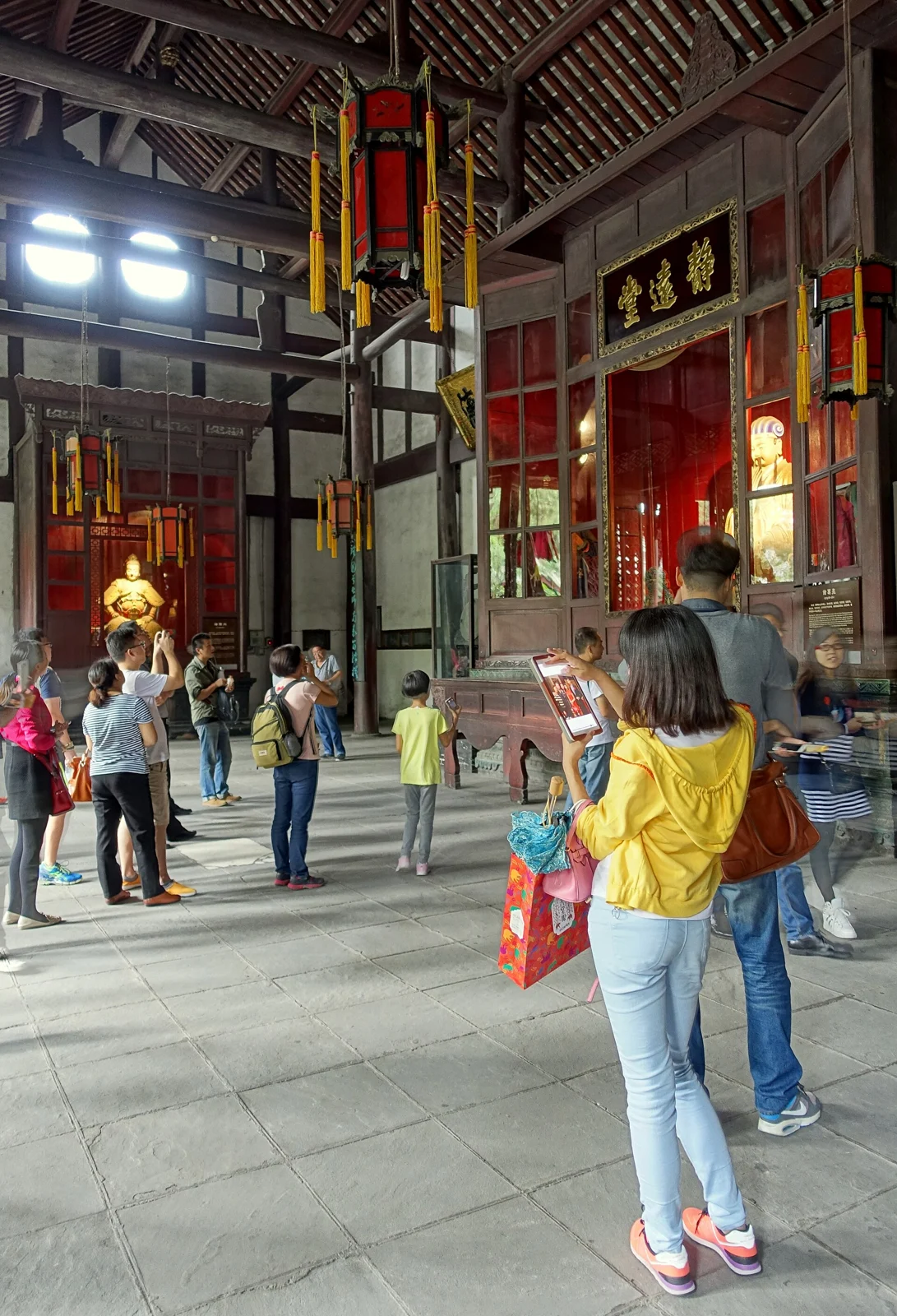
The museum commemorates Liu Bei, Zhuge Liang and other Shu Han figures. Liu Bei was the ruler; Zhuge Liang was the adviser associated with the Wuhou name. The memorial developed around Liu Bei’s burial place, Huiling, and brings the ruler-and-minister story into one setting.
Use that relationship as your thread through the visit. Look for how the halls distinguish the people being remembered, how inscriptions and objects contribute to the story, and how the tomb and memorial spaces differ from a modern exhibition gallery. This is a suggested reading of the site, not a claim that every room or exhibit will be open.
If somebody in your party knows the story through a novel, television series or game, distinguish that fictional portrayal from the museum’s historical explanation. Ask the guide which accounts are based on records and which are later cultural traditions. That makes a focused visit more useful than trying to absorb every name at once.
Museum’s historical account; editorial observation prompts ↗Source checked 2026-10-10 · planning advice identified in the text
Choose the shorter official route before adding Jinli
The museum’s online map offers reference routes of two, three and four hours. Those are the museum’s suggested route lengths, not guaranteed durations for your group. Our first-visit suggestion is to begin with the two-hour option and extend only if you still want more interpretation.
Planning example: a museum-led half day
- Confirm the date, admission category and required documents before leaving your accommodation.
- Reach the actual museum entrance and complete admission and security.
- If you want an English guide or device, resolve that near the entrance before starting the route.
- Follow your chosen map route, keeping one or two themes as your focus rather than stopping at everything.
- Return rented equipment and confirm the deposit process before leaving its service area.
- Take a break, then choose whether to continue into Jinli. End here if the group is tired.
Do not squeeze this visit around a distant panda-base trip merely because both are in Chengdu. Put the actual start point, transport and required arrival time of any second attraction beside this plan before committing.
Museum reference routes; editorial visit sequence ↗Source checked 2026-10-10 · planning advice identified in the text
Admission, interpretation and deposits are separate
The museum’s ticket page checked October 10, 2026 lists full admission at RMB 50. It also lists concessions with document and eligibility conditions. A foreign passport holder should confirm the appropriate category rather than treating every domestic senior or student concession as universal.
| Payment or record | What it does |
|---|---|
| Museum admission | Entry for the specified visitor and date |
| Human interpretation | A separately arranged language, duration and group service |
| Audio/guide device hire | Use of the chosen device; check its language before renting |
| Device deposit | A security amount with a separate return procedure |
| External tour package | Whatever transport, guiding and admission the seller explicitly includes |
Swipe to see the full comparison
Carry the original documents that support your chosen category. Check whose name the reservation uses and how passport holders complete entry. If a form or concession is unclear, use the museum’s ticketing number +86 28 85535951 rather than choosing a false identity category.
The guiding page warns that the museum has not authorized outside internet sellers to sell its own guiding tickets. That does not make every independent tour illegitimate; it means an independent seller must not be confused with the museum’s internal guide service.
Museum admission policy; separate guiding-service scope ↗Source checked 2026-10-10 · planning advice identified in the text
Arrive early enough to complete the visit you want
The published standard schedule is 09:00–18:00 Beijing time, with entry stopping at 17:00. The museum says summer extensions and special cultural activities follow its live announcements. Check those announcements for your chosen date instead of treating the standard schedule as an event timetable.
A 17:00 last-entry cutoff does not provide two hours for a two-hour route. Work backward from the end of the visit, equipment return and any onward booking. Ask about the guide or device return deadline when collecting equipment; it may matter before you decide to extend the route.
The official booking system lists maintenance between 23:00 and 01:00. If your attempt falls in that window, try again after maintenance rather than repeatedly paying through another site. Outside that window, retain the error and order state before retrying a transaction.
Published standard hours and booking maintenance window ↗Source checked 2026-10-10 · planning advice identified in the text
Use the museum’s current station and entrance guidance
The museum’s transport page lists Metro Line 10 to Wuhou Shrine (Jinli) station, exit A2, and also Lines 3 or 5 to Gaoshengqiao, exit A. These are the current published approaches checked for this guide; verify the active exit and route with the metro on the day. We have not measured the walk or audited step-free access.
Save 成都武侯祠博物馆 and its address 武侯祠大街231号. Use that museum target for a ticketed visit; a Jinli shop pin can lead to a different part of the neighborhood. From your accommodation, compare the actual transfer and walking requirements, particularly if carrying bags.
For an arranged vehicle, agree a lawful pickup location outside the pedestrian flow and send the Chinese address. Museum entry, the guide desk and vehicle meeting point are three different destinations. Reconfirm your return place before separating from the driver.
Museum public-transport and address guidance ↗Source checked 2026-10-10 · planning advice identified in the text
Steps, luggage and a manageable route
The visitor rules explicitly warn of steps and slopes in the relic area. Wheelchairs and strollers are allowed, but permission is not proof that every hall has a step-free path. Ask about the exact route, thresholds and assistance you need before choosing the two-, three- or four-hour option.
The museum’s visitor FAQ mentions self-service storage at the visitor center and staffed storage near the main entrance’s interpretation desk. It does not establish current large-suitcase capacity or every retrieval deadline. Confirm bag size, availability and collection time before planning a visit between hotel checkout and a train.
Put passports, tickets, medicines and essential valuables in a small bag you keep. If somebody becomes tired, shorten the museum route first and drop the optional Jinli extension; do not make completing both areas the condition for a successful visit.
Visitor rules and storage FAQ; access not audited ↗Source checked 2026-10-10 · planning advice identified in the text
Arrange English interpretation at the right desk
The museum publishes human guiding in English as one of its languages. Its process starts at window 1 of the interpretation reception inside the relic-area main entrance on the right, followed by equipment and deposit handling at window 2. English availability for your date and group still needs confirmation.
A free WeChat guide is listed in Chinese and English, while some other audio products are Chinese-only. Compare the format before paying: language, length, included map, device return and whether your phone and payment method can use it. Use headphones rather than playing commentary aloud in the halls.
If you want museum guiding, ask: “We are [number] English-speaking visitors on [date]. Which English service is available, what does it cost, where do we meet, and how do we return the equipment?” A translated website alone does not reserve an English-speaking guide for you.
Museum interpretation languages, desks and booking warning ↗Source checked 2026-10-10 · planning advice identified in the text
If a booking or guide arrangement is unclear
I purchased a Jinli food walk. Does it include the museum?
Only if the seller explicitly includes museum admission and the visit fits its route. Ask for the named admission product, visitor details and date; do not infer it from the neighborhood name.
The guide desk has no English guide available now.
Ask about the published English digital or device options. Choose knowingly between self-guiding and changing the visit time. Do not pay for a Chinese-only service expecting the guide to translate it later.
I rented equipment and now want to leave through another exit.
Establish the approved return location before changing exits. Keep the deposit receipt and ask staff to confirm return; leaving the site does not itself prove the deposit has been returned.
Should I choose the four-hour route?
Choose it only if that depth is your objective and your group can sustain it. For a first introduction, a shorter route with clear interpretation is more useful than extending the visit merely to cover every marker.
Interpretation service; editorial recovery choices ↗Source checked 2026-10-10 · planning advice identified in the text
Sources and editorial note
Prepared from the named operator and public-authority sources with AI-assisted drafting and source comparison. No personal visit or on-site accessibility audit is claimed. Planning examples and time allowances are editorial suggestions, not measured itineraries.
Bangsai offers a separate paid trip-planning service. Buying that service is not required to use this guide and does not include attraction tickets or transport.
- https://www.wuhouci.net.cn/about
- https://www.wuhouci.net.cn/map
- https://www.wuhouci.net.cn/pwxx
- https://www.wuhouci.net.cn/jtzy
- https://www.wuhouci.net.cn/cgxz
- https://www.wuhouci.net.cn/jjfw