

On this page
A complete first visit does not require a complete lap
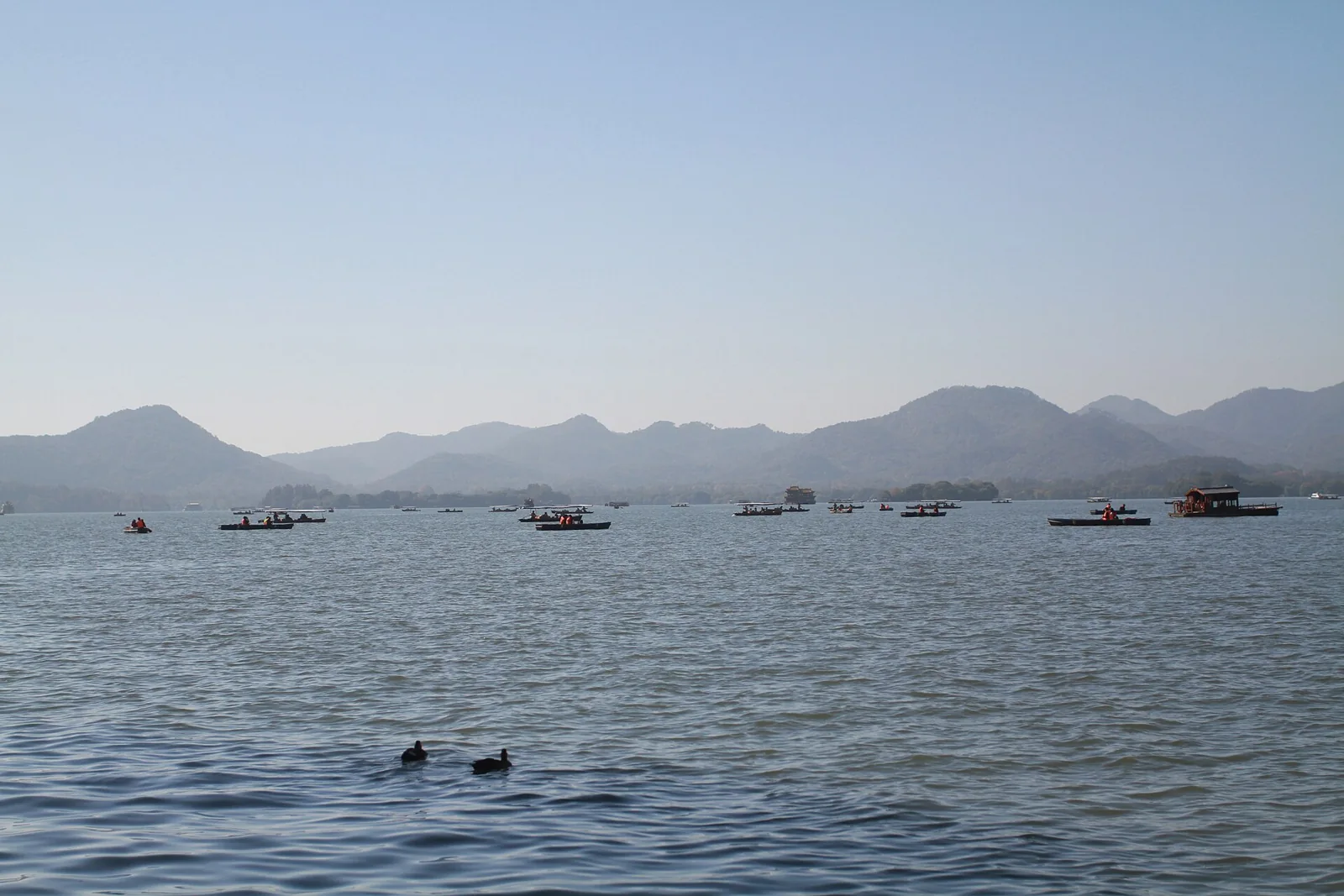
Choose a section of **Hangzhou West Lake — 杭州西湖** that fits the time and walking capacity of your party, then decide whether a boat would add something you actually want. For a shorter introduction, use the northern **Bai Causeway–Gushan** area or a stretch of the eastern waterfront. For a longer cross-lake walk, choose the **Su Causeway** and arrange how you will leave from the other end.
The ordinary public lakefront is a free visit; boats, individual ticketed sites and commercial performances are separate decisions. The city's official visitor page states free entrance while also noting that different spots have different opening times. Do not interpret “West Lake is free” as an entitlement to every island boat, pagoda or show.
If Three Pools Mirroring the Moon is your goal, ask for an **island-landing product**, not merely a cruise with a photograph of the stone towers. If you want to rest while changing shore sections, ask about a boat or bus that actually reaches the useful endpoint. An attractive circular ride may return you to the very place you intended to leave.
This guide combines official landscape descriptions and dated transport information with our own route choices. We have not bought a current boat product or verified every 2026 tariff, departure or access path on site.
Pick a start and a finish before adding viewpoints
| Your priority | A workable focus | What makes it workable |
|---|---|---|
| A short introduction to water, hills and a causeway | Bai Causeway toward Gushan | Choose an endpoint and decide whether to return on foot or continue to a road connection |
| An easy-to-shorten waterfront visit | Part of the eastern Hubin shore | Keep a clear return route and stop when the party has had enough |
| A longer, continuous walk between north and south | Su Causeway | Treat it as a crossing and reserve energy for the approach and onward journey |
| Seeing an island rather than just circling past it | A confirmed landing boat product | Verify island entry, boarding pier and the included shoreward journey |
Swipe to see the full comparison
These are editorial choices, not fixed timed tours. Opening conditions, crowds, weather and your pace determine how much you can comfortably do. A pair of good observations can be a better result than collecting every named scenic spot while watching the clock.
Use the exact Chinese place or pier in navigation. “West Lake” identifies a broad destination, not a single entrance beside every attraction. For a hired pickup, send the actual road-accessible meeting point rather than a pin in the middle of a causeway or an island. If you change the boat's landing shore, update the driver before assuming they can collect you there.
For a person who tires easily, a waterfront section with an uncomplicated return may be preferable to committing to the whole Su Causeway. Do not count a potential sightseeing cart, bus or boat as a guaranteed rescue from a route you already know is too long. Confirm the usable transport first or choose a smaller walk.
Bai and Su causeways offer different scales — and different histories
Bai Causeway is approximately **one kilometre**, while the Su Causeway heritage account gives approximately **2.8 kilometres**. Those are causeway lengths, not the complete distance from your hotel, station or final pickup. Bridges, photographs and the walk beyond each end also affect the visit.
Bai offers a shorter way of moving between a city-facing lakeside area and Gushan. Look at how the changing position separates near water from the broader lake. From an open stopping place, compare the direction toward the urban shore with the direction toward wooded hills. The landscape is different depending on where you stand and which way you face.
The familiar attribution of today's Bai Causeway to Bai Juyi is misleading. Zhejiang's 2024 historical explanation distinguishes it from **Baigong Causeway**, the embankment built under Bai's administration that no longer survives as that same feature. The present Bai Causeway has its own history of formation, improvement and rebuilding. A commemorative association and a proven construction history are different things.
Su Causeway is associated with Su Shi's Song-period work dredging the lake and using the removed material to form an embankment. Its six bridges are central to its historical and visual identity. Do not assume that every surface and tree visible today is untouched Song fabric: the cultural landscape has been maintained and changed over time.
On Su, pause where permitted to look to both sides rather than treating the crossing as a walkway to be finished. Notice the different widths of water, the alignment of a bridge and the hills behind it. Ask how a structure that manages and divides water also creates a viewing sequence. That question connects the scenic experience with the work that shaped it.
West Lake is a composed cultural landscape
UNESCO describes the combination of water, surrounding hills, causeways, islands, pagodas, temples, gardens and planting as a cultural landscape refined to create meaningful views. Its value does not depend on every element being wholly untouched nature. Human work and the surrounding landscape are part of the same story.
From a shore or causeway, build your own simple view in three layers: a nearby element, open water and a distant skyline. The nearby element might be a branch, path edge or bridge; the distant subject might be hills or a pagoda. Change your position a little and observe which relationship changes. You are learning how a view is made, not just finding the spot where somebody else's photograph was taken.
The traditional scenic names also invite attention to particular conditions: dawn, moonlight, lotus, snow, bells or cloud. They are not promises that all those conditions will happen during your afternoon. “Broken Bridge with Remnant Snow” remains a named landscape when there is no snow, and a moon-related view cannot guarantee a clear moon or a particular reflection.
If the weather is overcast, study the shape of the shore, silhouettes and the relationship between near and far rather than treating the day as a failure. If sunlight is harsh, you can shorten an exposed section and choose a shaded pause. There is no need to invent an exact “best minute” that applies to every season and viewing direction.
Yanggong Causeway belongs to another chapter of lake improvement. The city tourism bureau's account links its history to Yang Mengying's dredging and describes later loss and restoration, including work in 2003. If you explore the western landscape, avoid labelling every visible feature there an unchanged Ming original. The process of maintaining a cultural landscape is itself worth noticing.
Boats: first choose the purpose, then compare the unit of price
A **March 2025 Hangzhou Release guide**, reproduced by the city's news portal and crediting the scenic-area authority, distinguished several services. Its figures provide dated examples of pricing structure; **we have not established that every amount is unchanged in 2026**.
| Service in the 2025 guide | Published charging example | Main question before purchase |
|---|---|---|
| Island-landing sightseeing boat | 55 or 70 yuan per person by boat type, including island admission and return | Does your current product land at Xiaoyingzhou and include the onward shore trip? |
| Lake-loop service | 6 or 8 yuan per segment, or 70 for the complete route | Which stops and final departure help your itinerary? |
| Boatman-operated hand-rowed boat | 150 yuan per boat per hour, one-hour minimum; subsequent half-hour blocks | What route, duration and endpoint have you agreed? |
| Self-rowed boat | 30 yuan per boat per hour, one-hour minimum | Are you prepared to row back within the rental and operating limits? |
Swipe to see the full comparison
The examples explain why “a West Lake boat costs X” is inadequate. A per-person island ticket and an hourly whole-boat hire are not directly comparable. Likewise, **手划船** in this context means a boat operated by a boatman, while **自划船** means you do the rowing yourself. A cheap self-rowing quote is not the price of hiring someone to take you around the lake.
Before paying, confirm the posted tariff's boat type, party capacity, minimum period, billing increment, route and landing. For a shared party, calculate the whole-boat amount before dividing it among people. Include any island admission or other charge explicitly identified by the current product. Do not assume an hourly hire includes all paid shore attractions along its route.
A simple example using the **dated 150-yuan/75-yuan increment rule**: one hour costs 150 for the boat; crossing into the next half-hour block makes the example total 225. Dividing a 150-yuan boat among three travelers gives 50 each, but it does not turn the tariff into 50 per person for every group size. These are arithmetic illustrations of that published rule, not a current booking quote.
Do not select a self-rowed boat solely on price. The operator's 2025 explanation warns about visitors tiring and misusing emergency assistance as a planned tow back. Choose an operated service if rowing is not something your party can reasonably undertake. If actual weather or illness creates an emergency, seek assistance immediately; that is different from arranging your ordinary return through a rescue call.
An island ticket must explain both sides of the journey
If the island is your priority, ask the seller these questions before boarding:
- Is this an **上岛游** — island visit — or a **环湖游** — lake loop? Does it actually land?
- Which pier does the issued ticket use, and is island admission included?
- Which shore can you reach afterward, and what is the last usable return for the visit date?
- What proof must you keep for the onward trip, and what happens if weather changes the service?
The 2025 guide describes an island product with a shoreward return, but it does not replace the exact terms of the product you buy today. A city English page describing the loop's launch in **2021** is helpful for understanding the idea, not for guaranteeing today's timetable. Check the current pier information even if the older page looks official and detailed.
If you want to finish on another shore, make that condition explicit rather than assuming “return included” means any pier, any time. If the answer is unclear, choose a shore walk with a known exit or a product whose continuation you understand. Getting onto the island without understanding the last boat creates a problem your scenic itinerary cannot solve.
At the island, distinguish the view of the small stone towers in the water from the island's own paths and gardens. A close photograph of towers and a walk through a landscaped island are different experiences. Follow the permitted paths and current access instructions; a currency-note composition or historical photograph does not authorize a particular position on a boat or bank.
Record an hourly hire as an order, not a loose verbal promise
A **2023 Hangzhou Daily report**, hosted by the municipal political-consultative website, documents the **泛舟西湖** QR-order system. The reported process identifies the boat, lets the visitor and boatman establish an order, and records service start and end. We have not tested its present interface, but the underlying practical lesson remains: keep the agreed service and timing visible.
At the current pier, ask staff which official process is used. Check the boat identity, charging unit and start time before departure. If a quoted amount differs from the posted tariff, ask for the reason and product details before accepting it. A longer route, different boat or extra product should be explained as such, not hidden inside a vague “special price.”
If there is a disagreement, keep the order, boat number, posted price and timing evidence. Use the current operator complaint channel or the number on the official pier notice. The 2023 report lists **0571-87027884** as the water-management supervision contact; verify that it remains the relevant contact rather than depending only on an old article's phone number.
We do not promise that every foreign payment card, phone number or translated screen will work. If a payment or order step fails, resolve it with the pier staff before boarding rather than proceeding without knowing the service terms. An issued boat order is a clearer basis for the journey than a screenshot of a promotional page.
Leave room to change the plan without losing the day
For a short visit, keep one shore section and a reliable way back to the city. For a longer day, combine one causeway with one confirmed activity and a meal or rest. Do not add an island, a long lake crossing, a distant temple and an evening show simply because each appears individually possible on a map.
A **2025 city English feature** identifies buses 51 and 52 as clockwise/counterclockwise lake-loop options. Check their current route and stops if using them today. A land connection can be more appropriate than a scenic boat if its endpoint is what you need; the purpose is to reach your next place comfortably, not to buy every form of sightseeing transport.
If considering Lingyin, research its own reservation and entry rules separately. It is not an automatic extension of walking around the public lake. Likewise, a sunset near a pagoda does not require admission to that pagoda, while entering it is a distinct product with its own hours.
For limited mobility or a pushchair, assess the chosen shore, bridges, approaches and any boarding step as one continuous route. Ask staff about the particular pier and boat instead of assuming all boats are equally accessible. In poor weather or temporary controls, shorten or change the walk and follow the local direction; free public access is not a guarantee that every path stays open under all conditions.
The main result to aim for is a route you can comfortably complete and one landscape relationship you can explain. You might understand how a causeway changes a view, why a cultural landscape contains maintained artificial features, or how an island product differs from an hourly hire. Those decisions let West Lake remain a place to observe rather than a list you must race to finish.
Sources and editorial note
Independent lake-route and boat-unit guide. UNESCO1334actuallandscapeaccount,cityENfree/spotshours;2024ZhejiangpublichistoricalBaiarticlefullbrowserreadcorrectBaigongdifferent;SongheritageSu2.797km;2025authoritycreditboatguide datednotcurrenttariff,2023actualreportQRorderstart/end;2021waterbus launchnotcurrenthours;2025cityloopbusdatequalified. No boat purchase or site visit.
Complete2026boatprices/departures/foreignpay/currentQRinterface/continuousaccess not tested. Weather/flower/moon/snow/crowdconditions notguaranteed,freepubliclake!=allticketsfree. Oldphonequalified.
- https://whc.unesco.org/en/list/1334/
- https://www.ehangzhou.gov.cn/2021-03/29/c_276780.htm
- https://z.hangzhou.com.cn/2021/syjy/content/content_8115752.html
- https://zjnews.zjol.com.cn/zjxc/202402/t20240229_26681377.shtml
- https://wgly.hangzhou.gov.cn/art/2021/9/9/art_1229564260_58938248.html
- https://hznews.hangzhou.com.cn/chengshi/content/2025-03/26/content_8960700.htm
- https://www.hzzx.gov.cn/cshz/content/2023-04/11/content_8510742.htm
- https://www.ehangzhou.gov.cn/2021-11/11/c_278642.htm
- https://ehangzhou.gov.cn/2025-08/21/c_294739.htm