

On this page
One village, two pools and a system worth following
Give a first Hongcun visit a clear sequence: **South Lake, 南湖 → an open lane with a visible water channel → Moon Pond, 月沼 → a publicly open historic interior**. The purpose is to compare the village at three scales: its broad southern waterfront, the water threaded through streets and its smaller enclosed domestic spaces.
This is a suggested reading route, not a compulsory one-way circuit or a promise that every lane and house is open. Check the day’s entrance map and follow any local direction. If one interior is unavailable, keep the water-and-street comparison and ask which alternative interior is open rather than entering an unmarked private doorway.
Hongcun, **宏村**, is in **Yi County, 黟县**, in the Huangshan area of Anhui. Check those Chinese names when choosing a rail connection or lodging; a place sharing a romanised name elsewhere is not this village. It is also a different visit from climbing Mount Huangshan. A mountain ticket does not establish village admission.
The UNESCO property is “Ancient Villages in Southern Anhui – Xidi and Hongcun”, inscribed in 2000. Its account emphasises the relationship between streets, houses, decoration, commercial wealth, clan organisation and water. That is a good reason to look beyond the familiar reflected roofline. It does not make Xidi and Hongcun one admission area or place every nearby modern hotel inside the listed property.
At South Lake, read the village edge before crossing it
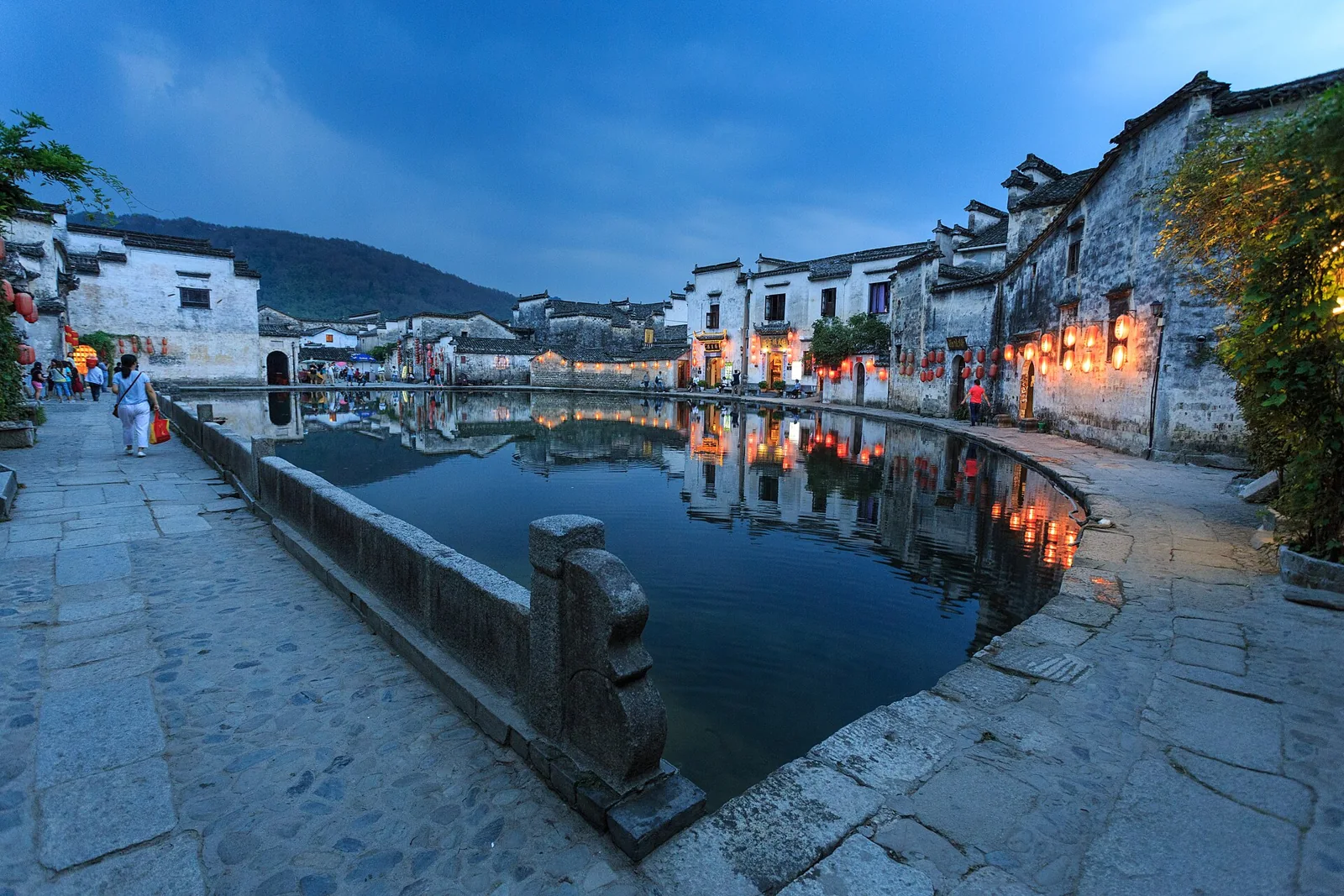
Start from a permitted lakeside position where you can see the built edge and the water together. Follow the line of roofs with your eye, then the corresponding reflection. Which buildings make a continuous frontage and where do lanes or openings interrupt it? The reflection is useful because it makes that edge legible, not because a still mirror surface is guaranteed.
Look from a second public position if crowding permits. The same frontage can appear compressed from one angle and reveal depth from another. An apparent wall of houses is a different experience from the lanes you will subsequently walk through.
The **South Lake Academy, 南湖书院**, is a useful interior choice if open. The county’s public visitor introduction, published in October 2023, identifies the academy, Moon Pond and Chengzhi Hall among Hongcun’s features. Use the academy’s interpretation to establish its educational role and history. Do not infer that every visible desk is an original fitting or that a visitor display remains a functioning historical classroom.
Before entering, compare the lakeside setting with the interior passage. Where does the route turn away from the open view? Where does a court bring sky or light back into the building? A school or academy and a house may both contain enclosed courts, yet those spaces serve different kinds of activity. Their labels and arrangement give you a basis for that distinction.
When a bridge or narrow lake-edge path is busy, treat it as a crossing rather than a place to hold a long photograph session. Take the broader comparison from a position that leaves access clear. A less famous viewing angle can show the village edge just as well.
The channel connects the postcard scenes
The county’s January 2025 account of annual water-channel maintenance explains the use of a river barrier and the land’s fall to bring water through artificial channels, into Moon Pond and South Lake, and onward. It describes more than 1,200 metres of village watercourses and residents and businesses participating in cleaning. The January operation was the twenty-seventh consecutive annual clearing recorded in that report.
That is evidence of a maintained system, not water flowing unchanged for centuries without attention. A canal can be heritage infrastructure and still require contemporary labour, clearing and management.
On the walk toward Moon Pond, stop where a channel is visible from the public lane. Compare its level with the walking surface and a nearby entrance. How does a pedestrian cross it? Where is it open, and where does it disappear under a cover or building edge? Identify what you can actually see rather than assuming every hidden section’s exact course.
If the channel turns, follow the next open public part. You are not trying to retrace every metre or test the hydraulic system. A short sequence of visible turns can establish how water and streets are related, whereas an uninterrupted photograph of a pool conceals that connection.
The common “ox-shaped village” explanation treats the channels as intestines and larger pools as parts of the animal. Use it as a spatial mnemonic, then look at the actual route. It should not replace the physical explanation of gradient, connections and maintenance, or imply that all construction happened in one campaign.
Clear-looking water is not proof it is safe to drink. Nor does a historical account of domestic water use establish that tourists should wash possessions in the channel today. Observe from the path, keep litter out and leave working access for people maintaining or using the street.
At Moon Pond, distinguish a shared centre from a scenic backdrop
Moon Pond is the smaller central water space. Compare it with South Lake: the surrounding façades are closer to the water, the enclosure is more immediate and the walking route relates to a different kind of edge. The useful question is what changes when water occupies the centre rather than the village boundary.
Choose a safe place to examine one doorway across the pond. Does its frontage continue a lane, address the water directly or sit behind another structure? Then locate a public route that lets you see the space from another side. The changing relationship between doorway, water and passage is more revealing than repeatedly seeking an empty frame.
If an ancestral hall is open and identified on the current map, use its interpretation to distinguish collective lineage space from a private house or commercial shop. UNESCO’s account explicitly identifies clan-based organisation and trading wealth in the villages’ development. That context helps explain why important spaces concern a wider group than one household.
A hall’s historic social role does not prove that a ceremony is happening today. If a real activity occupies it, follow the access guidance and ask before photographing participants. A staged interpretation, a community observance and a souvenir business are different things; keep the description tied to what is actually identified.
The pond’s edges, nearby thresholds and channel crossings also deserve attention underfoot. A beautiful reflection is not a reason to step backwards without looking. If the area is congested, continue to an interior or a quieter public lane and return only if doing so still fits your exit connection.
Inside Chengzhi Hall, look at what carving does to a room
The county visitor introduction singles out **Chengzhi Hall, 承志堂**, for its elaborate carving. If it is open, choose it as a more substantial interior stop rather than adding many houses without time to understand any of them.
Begin with the room’s organisation. Where does the main hall face? Which passage leads further inside? Where does a court admit light? Find those relationships before looking closely at decorative scenes. You will then know whether a carving is encountered at a threshold, above the principal room or along a secondary route.
Choose one carved element whose label or guide identifies its subject. First look at the overall composition, then the smaller figures, objects or layers. How is depth created? Which part is easiest to see from your permitted viewing position? A carving can be visually intricate without every figure’s meaning being obvious to an unprepared visitor.
Use the interpretation for the material and story. A translation app can assist with a label, but a guessed figure is not an established identification. Ask a guide to explain one particular scene and its placement instead of accepting only “very rich family” as the answer to the entire house.
Compare the decorative work with the building element that carries it. A beam, panel, bracket and screen perform different jobs; a picture of ornament alone can remove that architectural context. Equally, a repaired or restored element needs its own explanation. Age of the house does not date every visible finish to the same year.
An elaborate residence can show how wealth was expressed, but it should not be used to claim that everyone in the village lived at the same standard. Compare its room sequence with another open, more modest interior if your time and the current map allow. That comparison offers more than collecting another ornate doorway.
Keep to the visitor route, avoid touching carved surfaces and ask about photograph restrictions. A house-shaped building is not automatically a public house. Shops and guesthouses may occupy historic premises, while other doors still lead to private living space.
Admission and an overnight room answer different questions
The actual county visitor page gives **CNY104 per admission** in its **October 2023** information and lists age and document-based concessions. It also tells visitors intending to stay, eat or shop within the scenic area to buy admission first. **This is a dated public reference, not a verified October 2026 paid order.**
The same page’s “24 hours” opening field should not be read as a promise that every historic interior operates all night. Build a house-and-academy visit around their actual opening, and use any permitted evening access for the exterior route it provides.
Before purchasing a current product, resolve these points with the seller or scenic-area service:
- The visit date, product name and named places included.
- Whether your passport is accepted in that booking route and how it is checked at entry.
- The period of validity, whether repeat entry is included and any registration required to use it.
- Whether an unused ticket can be cancelled, and whether leaving or using one component changes that right.
Those questions should be answered for your actual product. Do not transfer Mount Huangshan’s three-day mechanism to Hongcun merely because both are nearby. This research did not complete Hongcun passport checkout or establish a universal current refund rule.
For lodging, request an explicit statement of whether the room price includes scenic admission, for which guests and dates. If it does not, compare the room and admission separately. If it does, ask what credential permits a return after an outside excursion. An offer to meet you at the entrance does not itself confer admission.
The county page lists **0559-5541158** for scenic-area enquiries; confirm the number and your intended product when using this dated contact. Bring the reply and order details with you. For a language requirement, ask whether the relevant ticket or guide service can handle it; the existence of an English travel article does not prove an English-speaking employee is available at every window.
For a room inside the lanes, clarify where vehicles stop, who can help with luggage and whether there are stairs before the bedroom. A renovated bathroom does not establish step-free access from the gate. If mobility is important, ask for the actual access route and threshold information rather than accepting “ground-floor room” as the whole answer.
Decide the return connection before adding a second village
A **February 13, 2026 city transport guide** identifies connections between Hongcun and **Yixian East station, 黟县东站**, **Huangshan North station, 黄山北站**, the mountain’s South Gate and Tunxi. It provides “黄山旅游官方平台” and “黄山长运出行” as booking or enquiry routes for different services. The guide is explicitly for Spring Festival: its departure times and temporary adjustments are not this October’s timetable.
Use the exact rail-station name on your ticket to choose the onward service. “East” and “North” are not alternative translations of one station. Likewise, the mountain’s South Gate connection takes you to the mountain approach, not directly to an upper cableway station.
Check the current departure for your travel date in the appropriate service or with the operator. Save the pickup point as a map pin and Chinese name. The coach station, scenic entrance and guesthouse doorway can be different places; luggage and a late arrival make that difference matter.
Then work backwards from your return booking. Include the walk to pickup, waiting or boarding, the road journey and the railway connection. A village with overnight occupants does not guarantee a late public coach for day visitors. If a late service cannot be confirmed, choose an earlier departure or arrange an alternative before depending on it.
Adding Xidi can be worthwhile when you want a deliberate comparison of settlement layout and houses. It also introduces another entrance, product and road connection. If you have only enough time for South Lake, Moon Pond and a rushed interior, deepen that Hongcun visit instead of spending the remainder in transit for a second shallow visit.
A half-day starting budget for a focused Hongcun walk is an editorial suggestion, not a measured queue-free itinerary. An overnight stay adds time to revisit the water edges under different light, but it does not guarantee empty streets or open houses at dawn. Choose the stay when that slower pace matters to you.
Leave with three answers: how a visible channel links larger water spaces, how a public interior differs from a domestic one, and how the carving belongs to the room around it. Those answers turn the familiar village image into a place you can understand.
Sources and editorial note
Independently authored village water/streets/interiors guide. Actual browsercountyOct2023portal and Jan2025watermaintenance, Feb2026citytransportguide and UNESCO1002 primary read. Officialoperatorhongcun.com.cnrefusedconnection; exactcurrentproductpassportcheckout nottested. No fieldvisit, residentinterview or originalbuildingclaims invented.
CurrentOctoberfullfare/validity/refunds/reentry/passportdocumentroute notverified. No speculativecurrrentclosure fromold2025filmingnotice. Onlypublicopenlanes/interiorsrecommended; houseage notallmaterialdate. Historicalphoto doesnotestablishcurrentwaterquality.
- https://whc.unesco.org/en/list/1002/
- https://www.huangshan.gov.cn/site/tpl/4636?id=19779&type=scenic
- https://www.huangshan.gov.cn/zxzx/qxdt/8409035.html
- https://www.huangshan.gov.cn/zwgk/public/6615714/12001518.html