

On this page
Begin with where you will come down
For a first Huangshan visit, choose **a feasible walking route between named transport points**, then add viewpoints that fit it. Do not begin with a list of every famous summit. The mountain has stairs, changes in elevation and transport departures that a small phone map does not express adequately.
If you are staying in **Tangkou, 汤口**, plan the South Gate connection explicitly. If a driver, car or stored suitcase is waiting at another gate, make that gate part of the exit plan. “Huangshan” can mean the mountain, the wider city or a transport destination; those meanings are not interchangeable.
The authority’s July 9, 2026 guide map is a better starting reference than an old diagram listing only earlier entrances. The committee confirmed East Gate and Donghai cableway opening on June 11, 2026, introducing the fourth gate. **Tanjiaqiao, 谭家桥**, is the new eastern approach, not another name for Tangkou.
A cableway removes part of an ascent. It does not establish that the walking between its upper station and your chosen view is flat, short or suitable for a wheelchair. Before buying transport, trace that remaining section and the return to a working descent point.
Two South Gate cableways lead to different places
The committee’s transport description, published before the eastern opening, distinguishes Yungu, Yuping, Taiping and the West Sea canyon vehicle by their actual locations. Yungu and Yuping serve different approaches. Taiping connects Songgu with the area near Paiyun Pavilion; the West Sea canyon vehicle connects the canyon with Tianhai. That last vehicle is not a road connection to your hotel in Tangkou.
At the southern approach, distinguish **Yungu, 云谷**, from **Yuping, 玉屏**. If you take a mountain shuttle, use the service for the cableway or walking entrance you reserved. The station names should match the route, not merely the word “South.”
The authority’s Yuping account places the Guest-Greeting Pine and Yuping viewpoints in that area. It describes a walking connection from the Yungu side through Beihai and Tianhai toward Yuping. That is a connection across mountain terrain, not a brief platform transfer.
A Yungu-up, Yuping-down plan can give a substantial cross-mountain visit. It also commits you to reaching a different upper station before its actual cutoff. If your group is already tired early in the walk, the shorter return toward the ascent station may be more sensible than insisting on finishing the named combination.
| What you have chosen | What the route still needs |
|---|---|
| Yungu ascent and descent | A loop or out-and-back whose farthest point leaves enough walking time to return |
| Yungu up, Yuping down | A realistic cross-mountain connection and a Yuping descent ticket |
| Taiping as an exit | A confirmed North Gate onward connection, especially if luggage is elsewhere |
| A West Sea canyon descent | A way back out of the canyon that you can complete; its internal vehicle is a separate segment |
| East Gate return | A working Donghai descent, with time for the walk and queue |
Swipe to see the full comparison
Those are planning choices, not guaranteed operating combinations. Confirm current path and cableway notices before committing. A coloured line in a guide map can show geography without promising that its whole length is open today.
East Gate changes the transport problem, not the mountain terrain
The committee’s **June 8, 2026 opening notice, reproduced by Huangshan Release** states there is no walking ascent between East Gate and Donghai cableway’s upper station; the cableway is the means of entering or leaving **that gate section**. Its published June 11–November 30 timetable is 07:00–17:10 on weekdays and 06:30–17:40 on weekends and short holidays, subject to adjustments shown by the official booking platform. The notice requires reservation by identity, time and entrance direction, and warns weather can suspend operation.
If you intend to return to East Gate, allow for the upper-station approach and its queue. Arriving somewhere on the mountain at the published closing time is not arriving in time to descend.
That local no-walking constraint should not be expanded into “anyone entering East can only exit East.” A June 12 report by a named local newspaper journalist describes onward walking toward Beihai and connections to other exits. A cross-gate route can be possible, but it changes the distance, ticket segments and road transfer. Check the actual open route and destination transport; do not assume all four gates sit close together.
The same report describes Donghai seasonal single journeys at CNY125 and CNY100 and a limited opening promotion ending July 10. Those are **dated reported prices**; the expired promotion is not an October discount. Get the current product price for your direction and date before comparing it with a southern route.
If the eastern service is suspended before you ascend, follow staff advice and reconsider the whole route. An unmarked track cannot replace the missing walking entrance. If service changes while you are on the mountain, ask staff for the permitted alternative rather than improvising a descent from an overview map.
Admission, transport and another day are separate decisions
The committee’s **December 23, 2025 price notice for 2026** was actually read in the browser. For **January 21–December 19, 2026**, it lists full admission at **CNY190**, half admission at CNY95; Yungu and Taiping single cableway journeys at CNY80, Yuping at CNY90 and the West Sea canyon vehicle at CNY100. It does not include the subsequently opened Donghai line in that table.
A full-admission visitor using Yungu up and Yuping down would therefore have CNY190 + CNY80 + CNY90 = **CNY360** in those three listed components. This is arithmetic, **not a complete day price**: road transport, any canyon vehicle, meals, accommodation and other chosen services remain separate. Using an internal canyon vehicle as well would add its actual product rather than replace the exit cableway automatically.
The notice also explains a three-consecutive-day admission window activated by **successful first-day validation**, not by reservation alone. For a later entry, it instructs visitors to select “多次进山门票,” the repeat-entry product, and wait for approval. Its direction list predates East Gate, so ask how the current platform handles an eastern repeat entry instead of copying those old options literally.
An unused first-day reservation does not start the entitlement. A three-day admission window does not supply three days of cableway rides. Nor does it reserve a hotel room, guarantee Tiandu access or make a closed path available.
Check eligibility before choosing a half-price or zero-price product; do not select one simply because its price is lower. This research did not submit passport details, buy a ticket or test an international payment card. If the official form does not accommodate your document, contact the operator for its current identity-handling route before arranging an irreversible trip around the reservation.
Tiandu is an optional summit with its own permission
The city’s April 2026 reopening report confirms Tiandu’s winter maintenance ended and reopening began April 7, with online reservation. Reopening after maintenance does not prove it remains available on every later date.
The authority’s Tiandu visitor guidance explains the steep, exposed nature of the path and identifies people for whom this ascent is unsuitable. Treat that as a substantive route decision, not a dare or a compulsory way to prove you visited Huangshan.
Use the current **“黄山旅游官方平台”** Tiandu process and confirm that you have an allocated summit reservation, as well as main admission. Entering names or seeing an application submitted is not equivalent to a confirmed place. The exact current release window, document verification and activation requirements should be checked in that process; this guide has not completed it on a traveller’s behalf.
If no place is confirmed, remove Tiandu from the day’s essential route. Keep a reachable open viewpoint in the area you are already visiting. Do not make the summit a reason to rush the cross-mountain walk or miss the descent service. Likewise, seeing Lotus Peak on a map or in a photograph does not establish permission to climb it; check its separate status.
Read granite shapes before searching for their nicknames
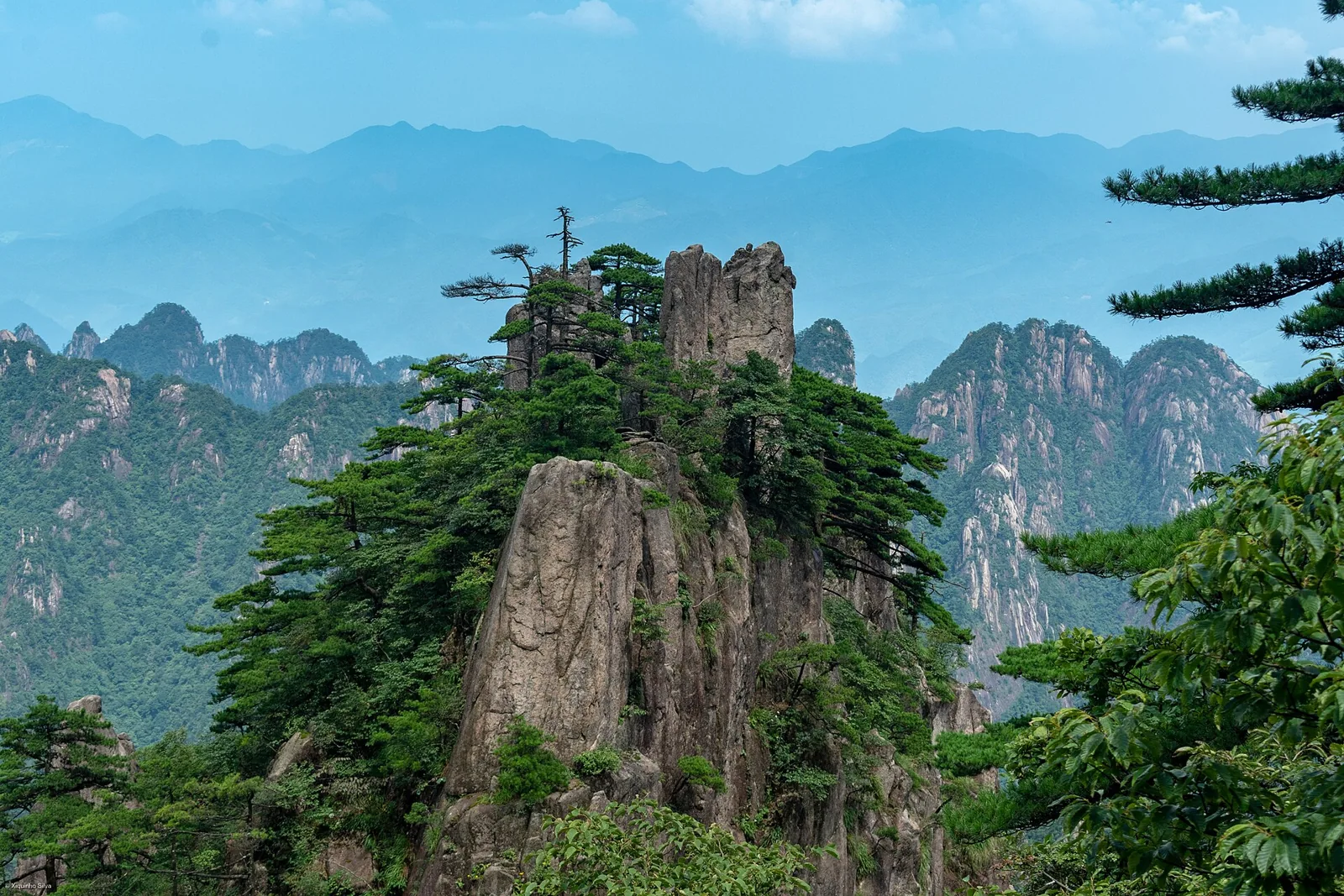
UNESCO’s geopark account describes granite formed below the surface, later exposed by uplift and erosion, with intersecting joints contributing to varied shapes. It also says the interpretation of possible past glaciation remains scientifically debated. A dramatic rock should not be assigned one certain glacial explanation from its appearance alone.
At a permitted viewpoint, choose two nearby masses. Is one rounded while the other has a narrow crest? Can you distinguish a major separation from a shadow on the surface? Then look at the depth between them. A small movement along the public viewing space can change whether the masses appear joined or separate.
That exercise needs no off-path scrambling or touching a cliff. Use the view you can safely reach and the site’s explanation for the geological account. A photograph of a crack cannot diagnose whether a rock is stable today.
If a formation has an animal or human nickname, compare the silhouette from the intended viewpoint and another safe position. What disappears when the angle changes? The name can be a way of seeing, not evidence that the stone was carved into that subject.
For a pine, compare its trunk, crown and setting together. The interesting relationship is not only an isolated branch’s outline but how the tree occupies a ledge or frames a view. Keep to barriers and designated viewing positions; a photograph is not improved by crowding the tree’s protected space.
Cloud and clear weather reveal different landscapes
The World Heritage account connects Huangshan’s granite, pines and cloud effects with its long influence on landscape painting and literature. That cultural association does not require a guaranteed cloud sea or a sunrise photograph.
In clear weather, examine the layering of the land itself: nearby rock edges, a middle ridge and a distant skyline. In broken mist, notice which layer is concealed and which appears briefly. Wait at a safe viewing area if the route permits; do not chase a shifting gap along an exposed path.
A sea of cloud can turn a peak into an apparent island, but low cloud can also remove the long view entirely. If visibility stays poor, give attention to nearer rock, vegetation and inscriptions visible from the permitted route. There is still something to understand without inventing a view the weather has hidden.
If sunrise is the main reason for an overnight stay, ask the hotel which **open** viewpoint is reachable from it and how the pre-dawn walking route is managed. A room on the mountain does not mean you can step outside onto every famous sunrise platform. The forecast, sunrise time and actual walking distance should determine the departure, not a copied year-round “wake at five” instruction.
An overnight stay buys more opportunity and a different pacing option. It does not buy a weather outcome. Keep the second day’s exit connection viable even if the sunrise is obscured.
Set a turning point before the walk becomes a deadline race
At the start of the mountain walk, agree on the next decision point: a named junction or service area where the group will compare progress with the intended exit. Include the time still needed for walking, queuing, descent and the road connection. That is more useful than treating the last cableway departure as the time to leave a viewpoint.
If progress is slower than expected, remove the optional canyon or summit before sacrificing the exit margin. Descending into a canyon adds a return problem; downhill metres are not free distance. A route that is mostly downhill can still be difficult for knees or unsuitable for someone who cannot manage repeated stairs.
For a mobility requirement, request a segment-specific answer: entrance to boarding point, upper station to the desired view, toilet access and return. An elevator or accessible cabin in one place does not establish a continuous accessible mountain itinerary. If the answer is incomplete, choose a shorter confirmed segment or a different activity rather than accepting “there is a cableway” as the whole assessment.
The opening notice gives **0559-2590999** for scenic-area help and **0559-5563333** for emergency rescue. In a problem, state the Chinese name on the nearest sign, your intended gate and whether anyone cannot continue. Follow local instructions; phone navigation and a historical guide map are not rescue-route authorities.
The successful plan is the one that lets your group look carefully, understand what it sees and reach the chosen exit with enough margin. An omitted summit is a sensible result when the reservation, weather or walking requirements do not fit.
Sources and editorial note
Independently researched exit-led mountain guide. Actual browser committee December2025 notice for2026 prices and repeatentry, July2026 official guide map viewed. June2026 opening and formal June8 notice, prior authority cableway endpoints/Yuping, UNESCOWorldHeritage/geopark primary and named newspaperJune12 report separated. No onmountain experience or passport order.
No passport checkout, paid booking, exactcurrentTiandureleasewindow, accessibilityaudit, sameDayweather/cableway or wholetripquote verified. Julyguidegeography isnotallpathsopen. Oldheaderforecastnotcurrentweather. Routechoicesconditionalonstaff/notices.
- https://hsgwh.huangshan.gov.cn/bzzx/jqdt/9333422.html
- https://hsgwh.huangshan.gov.cn/zwgk/public/6617641/11966846.html
- https://www.huangshan.gov.cn/zxzx/bmdt/8421709.html
- https://api.app.anhuinews.com/appcontent/9317981.html
- https://hsgwh.huangshan.gov.cn/zwgk/public/6617641/11352697.html
- https://hsgwh.huangshan.gov.cn/zjhs/ldjq/ypjq/8665906.html
- https://www.huangshan.gov.cn/zxzx/zwyw/8420348.html
- https://hsgwh.huangshan.gov.cn/xwzx/tzgg/9185241.html
- https://whc.unesco.org/en/list/547/
- https://www.unesco.org/en/iggp/huangshan-unesco-global-geopark
- https://finance.sina.com.cn/jjxw/2026-06-12/doc-inicaeni3897076.shtml