

On this page
Is Jingshan a good stop after the Palace Museum?
**Yes, if you still have energy for the hill and want to see how the palace fits into the city.** Jingshan Park, 景山公园, stands outside the Palace Museum’s northern side. It is independently ticketed. A Forbidden City visit does not include park admission, and a Jingshan ticket does not let you enter the palace from its north gate.
The natural connection is to finish the Palace Museum’s authorized route, leave through the northern exit and then approach Jingshan’s **south gate, 南门**, using the signed pedestrian crossing arrangement. Do not walk into traffic just because the park entrance looks close. The palace exit, the roadway crossing and the park entry are distinct steps.
This combination has a useful interpretive sequence: inside the palace, you experience courtyards and buildings one after another; from Jingshan, you can read their alignment and scale together. It also has a practical limit. After a long palace walk, a further stair climb can be the wrong choice for a tired group. Decide at the park entrance rather than assuming every palace itinerary must finish at the top.
For a focused hilltop visit, allow about **45–90 minutes as a planning estimate**, depending on pace, pauses and crowding. This is not an official climb time. More time is appropriate if you want all five ridge pavilions or the separate historic courtyards. A short park-level visit can still be enjoyable, but it will not reproduce the panoramic photograph from Wanchun Pavilion.
Foreign-passport visitors have an on-site buying option
Beijing’s June 2025 answer specifically about Jingshan booking says advance reservation is not required for the park and identifies ticket windows at the **east, west and south gates**. It lists cash in yuan, WeChat, Alipay and foreign-bank-card payment, including Visa and Mastercard or cards supporting UnionPay.
The same answer describes advance buying through the bilingual 畅游公园, Visiting Beijing Parks, account, mini-program or official website. Online purchasers enter using the QR code and the valid identity document for their booked date and period. A separate March 2025 municipal answer explicitly confirms same-day window buying with a passport or other accepted document.
This matters because the city’s older-style park guide still contains a contradictory instruction requiring foreign visitors to telephone in advance and refusing unreserved on-site buying. **Use the dated park-specific answers as evidence of the newer assistance process**, and ask the park if your circumstances require confirmation. Do not rearrange an entire palace visit around the old phone-only wording without checking it.
If you are arriving from the Palace Museum, keep the original passport accessible and ask the south-gate window for that day’s park ticket. If buying online, confirm the order exists rather than relying on a payment screen alone. If the app cannot accept your document or number, use the documented window route; there is no need to turn a simple park visit into an unverified email reservation.
The city visitor guide lists ordinary adult admission at **2 yuan**, with different prices during cultural seasons. Treat that as the published baseline, not a promise that every exhibition date or special product costs 2 yuan. Read the date-specific price at the window or official checkout. A nighttime event in a courtyard can be a separate purchase even when the park itself remains inexpensive.
The March 2025 official answer identifies free park entry for seniors aged 60 and above and for qualifying young children with valid documents. Check the applicable entitlement and proof at entry instead of assuming the entire park is free for every traveler. For clarification, the operator website lists **+86 10 64038098**, a 24-hour visitor-service line.
Know what the hilltop view actually shows
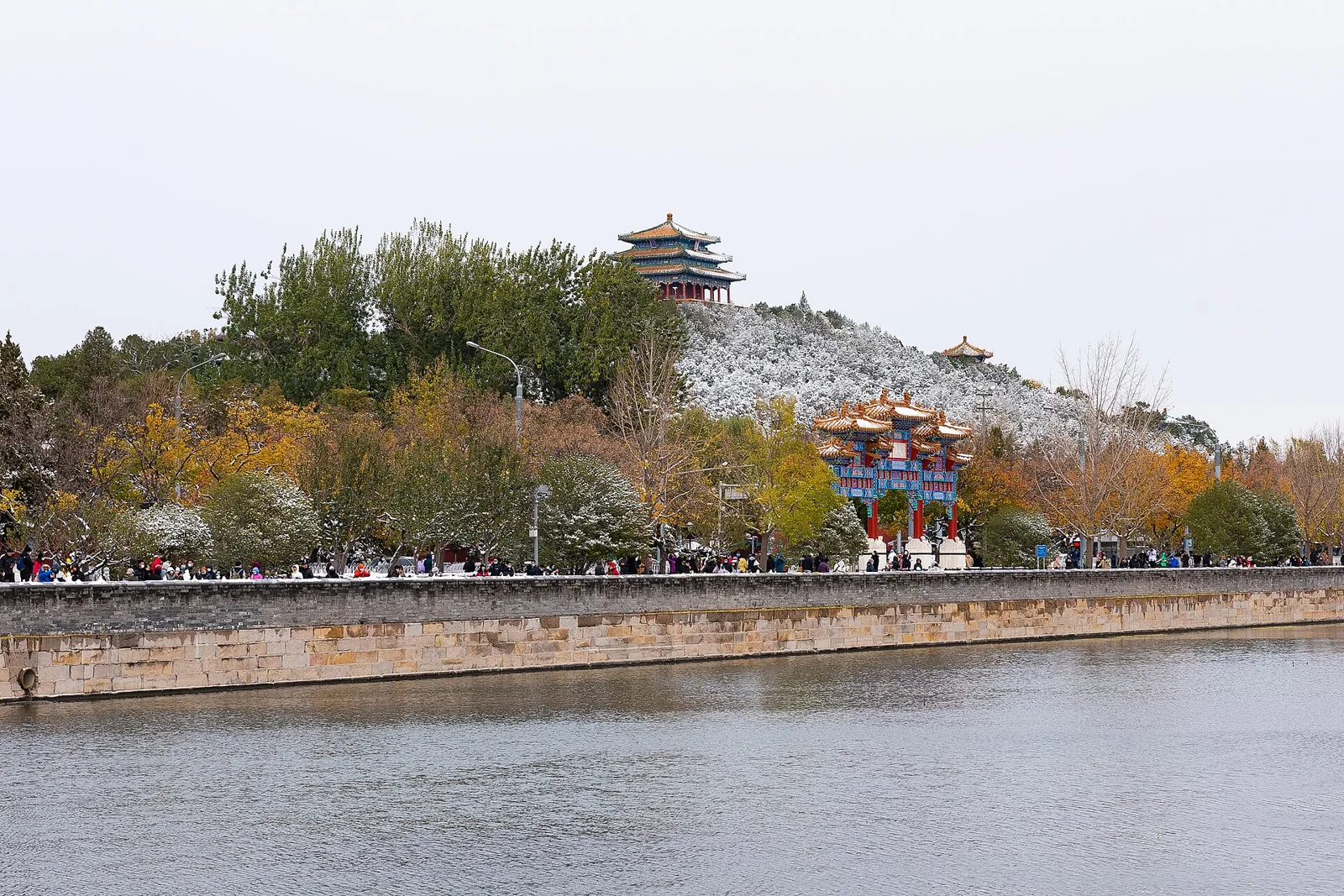
The main panoramic destination is **Wanchun Pavilion, 万春亭**, on the central peak. The city’s description identifies five pavilions along the hill and Wanchun as the central-axis viewpoint. The east and west entrances have stair approaches; follow the current signs for the pavilion rather than expecting a flat route across the whole park.
At the top, start by looking **south** toward the Forbidden City. Try to identify the line of large halls and the repeated courtyards. Their arrangement is easier to understand as a sequence of spaces than as a collection of isolated roofs. Turn **north** to extend your reading toward the Drum and Bell Tower direction, then **west** for the Beihai landscape, as described in the city’s viewpoint introduction. The city’s Central Axis questions and answers identifies the southward palace panorama as the key view from Wanchun.
The larger significance comes from urban planning. UNESCO’s 2024-inscribed Beijing Central Axis property includes Jingshan among the historic elements of a north–south ensemble of palaces, gardens, ritual and civic buildings. Its interpretation emphasizes symmetry, balance and an inherited capital-city order. From the pavilion, ask how the palace’s geometry relates to the axis through the city. That question adds depth to a visit without requiring every distant landmark to be visible.
A panorama is weather-dependent. Low cloud, haze or rain can reduce detail, and the viewing area can be crowded. If the view is poor, a useful alternative is to look closely at the nearer palace roof pattern and the park’s own composition instead of waiting indefinitely for a clear skyline. The heritage value does not depend on reproducing a social-media photograph.
Plan sunset around light, the climb and the descent
Jingshan is a plausible sunset stop, but there are three clocks: **sunset**, **last park entry** and **your own time to climb and descend**. They are not interchangeable. Look up sunset for the actual Beijing date, then arrive with enough daylight to find the route and reach your chosen viewpoint. The posted evening closing time does not indicate when the strongest photographic light will occur.
The published seasonal park schedule is **06:00–21:00, last entry 20:30, April–October**, and **06:30–20:00, last entry 19:30, November–March**. In winter, sunset can occur well before park closure. A traveler arriving near the ticket cutoff may have missed the light even if entry is still possible.
Do not budget the climb as a fixed ten-minute transfer. Pace, stairs and people stopping for photographs can change progress. If a member of your group needs rests, leave room for those rests rather than treating them as a delay to the picture. Choose shoes suitable for stairs and keep a clear route for visitors who are passing through.
For photography, decide whether your priority is the whole palace geometry or a tighter view of roofs. Make room for others at the viewpoint and respect signs about equipment. This guide does not verify tripod, professional-shoot or drone permissions; ordinary park admission is not an authorization for those activities.
After the light changes, descend while you can follow the allowed route comfortably. If you have a later dinner or transport reservation, set a departure time from the viewpoint. Staying until the last possible photograph can leave a tiring final descent and an avoidable scramble outside the gate.
The historic courtyards are a different visit from the viewpoint
**A Monday hill visit does not establish Monday entry to Shouhuang Hall or Guande Hall.** The operator’s September 1, 2026 notice restores Monday closure for Shouhuang Hall, Guande Hall and the northwest science cottage, except important holidays. It explains that the summer period has ended and courtyard maintenance resumes. This is a restriction on the named spaces, not an announcement closing the entire park every Monday.
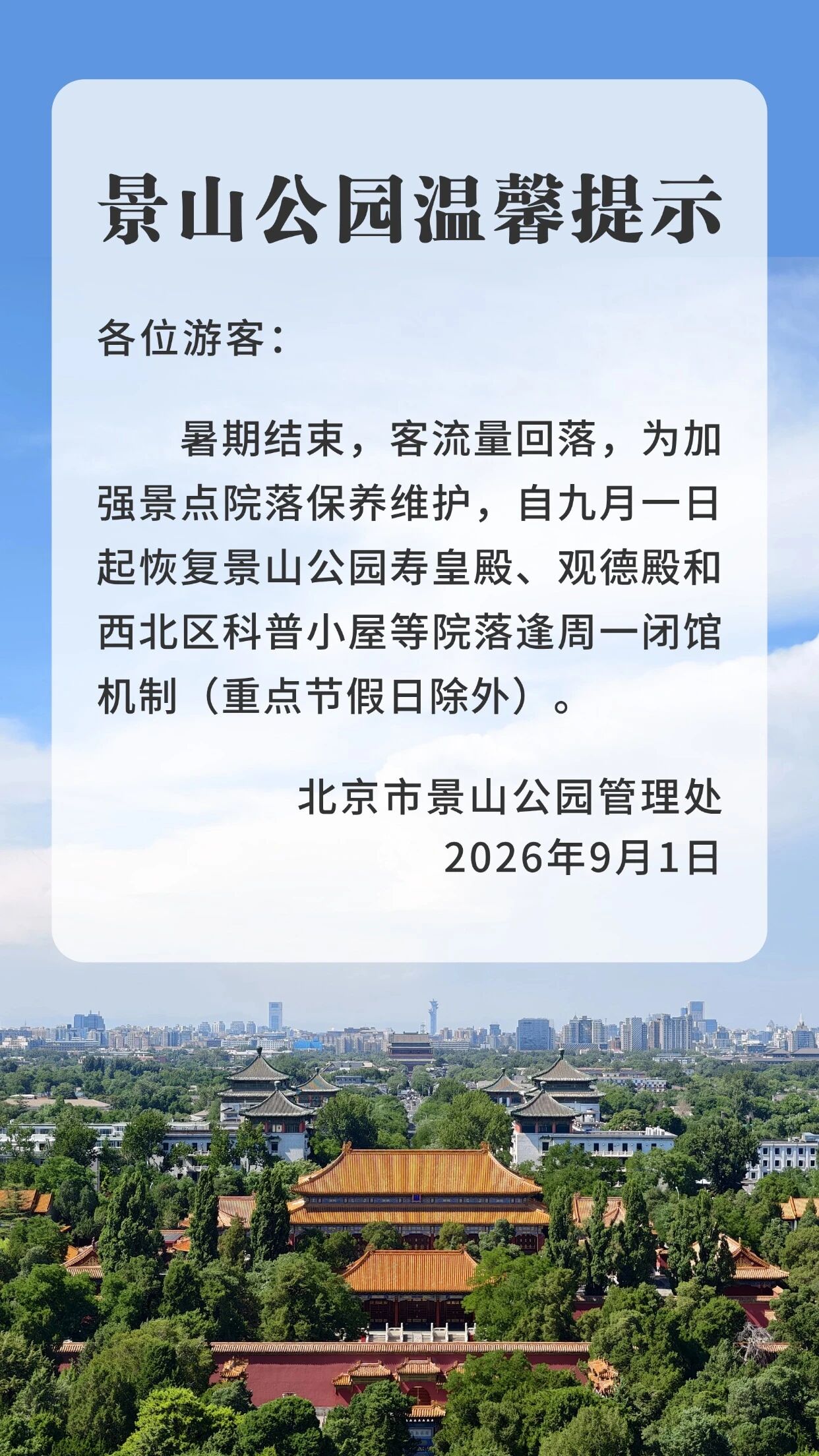
Shouhuang Hall relates to Qing imperial ancestor remembrance; Guande Hall is another historic complex that can host displays. They can enrich a longer visit, but their admission arrangements and hours must be checked separately. The older city route also labels Shouhuang as needing advance reservation. This guide has not verified an unchanged 2026 courtyard-reservation process, so it does not turn an old instruction into a confirmed current booking recipe.
The park management center’s courtyard schedule, published in 2024, closes the warm-season historic courtyards at 18:00, with last entry at 17:30. It is a useful reminder that an evening park walk and a courtyard visit are different windows; check current notices if those interiors are your priority.
A sunset plan therefore usually needs a choice: visit an available courtyard earlier, or focus on the hill and accept that the enclosed spaces may be shut. A limited-period night event also needs its own date and product check. Do not treat a holiday announcement or a museum-style display as a permanent extra included in every park ticket.
Choose a realistic version for your party
The viewpoint requires hill access. This article does not certify a step-free route to Wanchun Pavilion, a lift to the summit or an unrestricted wheelchair route across the ridge. If mobility needs determine the visit, contact the park about the specific entrance and feasible route before making the panoramic view the day’s essential goal.
For a tired family after the Forbidden City, the useful options are straightforward: climb together at a slower pace; let some members remain on the park-level route with an agreed meeting point; or finish with a shorter park visit. Keep each traveler’s entry credential and identity needs in mind if separating, and do not make a child or someone requiring assistance wait alone while the rest of the party goes up.
For onward travel, identify the gate before descending. The south gate reconnects you with the Palace Museum side; the east or west gate can better suit another route. The apparent closeness of Beihai or the Drum Tower on a map does not mean you can add either without more walking and another admission decision.
Jingshan works particularly well when you give it one clear purpose: a new perspective on the palace, an evening view of the axis, or a slower historic-garden visit. Choose that purpose, carry the passport needed for entry and adapt to the day’s light and open areas. You will get more from the place than by treating it as a compulsory last photograph after a long day.
Sources and editorial note
Individually researched from dated Beijing passport-ticket answers, the operator’s September 1, 2026 image notice read visually, city view and schedule pages, and UNESCO’s Central Axis inscription. The old phone-only booking instruction is compared with newer park-specific answers. AI-assisted desk research; no field visit, tested mobility route, ticket transaction or professional photography permission claimed.
Posted baseline admission can differ during cultural seasons and separately sold events. The current courtyard booking process and step-free summit access remain unverified. Route times are editorial estimates; views depend on weather.
- https://english.beijing.gov.cn/12345hotline/faqs/all/202506/t20250620_4117974.html
- https://english.beijing.gov.cn/12345hotline/entrance/202504/t20250403_4055800.html
- https://english.beijing.gov.cn/specials/parktours/guidevisitors/jingshanpark/index.html
- https://www.bjjspark.cn/
- https://www.bjjspark.cn/u/cms/www/202609/68d616b30d084e2dac30b8f84484b21b.jpg
- https://english.beijing.gov.cn/specials/cyclingroutes/route6/along/202306/t20230609_3128995.html
- https://whc.unesco.org/en/list/1714
- https://english.beijing.gov.cn/specials/centralaxis/qaonthecentralaxis/
- https://english.beijing.gov.cn/specials/summerinbeijing/nighttours/202107/t20210729_2451039.html
- https://gygl.beijing.gov.cn/xxgk/xxgk_gyxx/202403/t20240329_3605792.html