

On this page
Give Jiuzhaigou a full visiting day and choose what deserves your walking time
Plan **one full daylight day inside Jiuzhaigou**, with arrival travel and overnight accommodation outside the park arranged separately. Use the scenic vehicles between distant areas, then choose manageable walking sections around the lakes and waterfalls that interest you. A full day is an editorial allowance, not a promise that you will walk every boardwalk or see every named stop.
Begin with the park's three main valleys: **Shuzheng · 树正沟** forms the approach from the entrance; **Rize · 日则沟** and **Zechawa · 则查洼沟** form the two upper branches. **Nuorilang · 诺日朗** is the central orientation point. The practical problem is deciding which branch to visit, where to return for the other and how much lower-valley walking to retain before exit.
Book admission before committing to travel. The 28 September 2026 visitor notice requires advance real-name booking, including for free or concession tickets. It gives an entry window of **07:30–14:00** and clearance at **18:00**. An entry deadline is not a sensible start time for a complete three-valley visit.
The 29 July reopening notice restores full-area operation from **30 July 2026**, following the July disruption. Do not use a 27 or 28 July temporary arrangement as the present normal route. Full-area reopening also does not guarantee that every minor path remains available in all weather; follow the current boards and staff directions.
Use the Y-shaped geography to avoid retracing the wrong branch
The operator's English map, published in 2015, shows the basic geography clearly. Use it to learn the names and branches, then obtain the day's visitor map for actual stops and path controls. Its historical walking lines are not proof that every marked segment is open now.
| Valley | Useful landmarks to recognise | Planning decision |
|---|---|---|
| Zechawa | Long Lake · 长海; Five-Coloured Pond · 五彩池 | How much of the higher branch you will visit before returning toward Nuorilang |
| Rize | Five Flower Lake · 五花海; Pearl Shoals · 珍珠滩; Mirror Lake · 镜海 | Which lake or waterfall section merits a walk rather than another brief stop |
| Shuzheng | Rhinoceros Lake · 犀牛海; Shuzheng Lakes · 树正群海 | What to retain on the lower route toward the entrance |
Swipe to see the full comparison
At each boarding point, check the destination and required transfer with staff. A vehicle heading toward one upper branch does not take you around both. If the day's loading directs you first to a different branch from your preferred sequence, adapt the order rather than spending time trying to reproduce a fixed online itinerary.
At Nuorilang, pause to establish three things: which branch you have already visited, the next boarding area and the route back toward the entrance. Those answers prevent an accidental repeat ride and make the rest of the day easier to shorten if necessary.
Before beginning a boardwalk section, identify the next usable boarding point. The decision is the distance and conditions **between two confirmed stops**, not the impression that the whole path heads downhill. A slow member of the group, wet surface or extra photography time may make a shorter section the better choice.
Similar English names conceal different lake experiences
**Five Flower Lake · 五花海 · Wuhua Hai** and **Five-Coloured Pond · 五彩池 · Wucai Chi** are different sights in different upper branches. Save both Chinese names. If you ask for “the colourful lake,” a map search or helpful person may direct you to the one you did not intend to reach.
The park's individual-site descriptions place Five Flower Lake in Rize, the small Five-Coloured Pond in Zechawa and the much larger Long Lake higher in that branch. These descriptions provide geographic and natural-history context; older details on the page are not current operating notices.
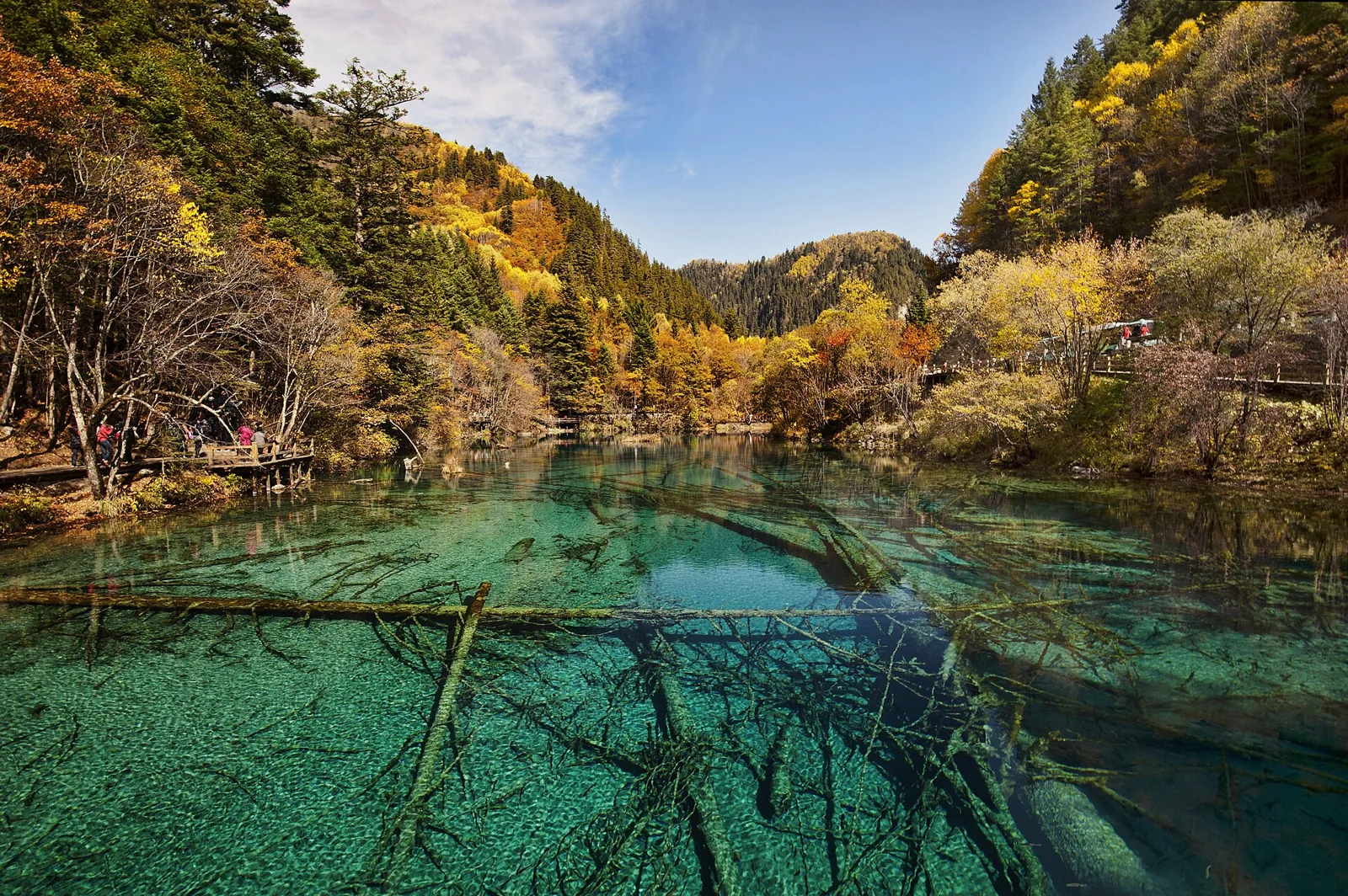
At Five Flower Lake, distinguish the bottom from the reflection
From a permitted viewpoint, look first into the water, then at the trees and sky reflected on its surface. Ask which forms seem to sit below the surface and which move or change with the reflection. That makes the colour more interesting than treating it as a single blue patch to photograph.
The site's account links the changing colours with the lake bed and aquatic life. For a visitor, the useful exercise is comparison: a shallower area, a darker area, a tree reflection and an open-water surface may look different within one view. Do not assume an intensely saturated photograph establishes the exact colour you will see at another time or in different light.
Use another permitted angle if it is available without crossing barriers. A new position can change glare and reveal a different relationship between foreground, underwater forms and reflection. It need not mean walking every shoreline path. If the viewing area is busy, finish the observation without blocking circulation.
At Five-Coloured Pond, make the smaller scale part of the visit
The pond is a compact stop rather than a second name for Five Flower Lake. Look at how its colour areas relate to the shape of the basin. The park's interpretation discusses travertine and algae; notice where the water is visible and where the surrounding slope frames it.
A smaller pool can reward patient looking more than a distant panorama. Give yourself time to compare two visible areas, then read the interpretation. You do not need an unobstructed close-up at any cost. Its protected edges are part of why the place remains worth visiting.
The connection from Long Lake to the pond still needs checking for steps and current direction. If that walk is unsuitable, ask whether there is another authorised way to visit or choose the reachable viewpoint. A sightseeing vehicle serving the branch does not prove a level path between all its attractions.
At Long Lake, read the scale instead of expecting identical colours
Long Lake presents a larger mountain-and-water relationship. Stand at the permitted viewpoint and compare the enclosed valley, tree line and open water with the smaller pond. The subject is the lake's place in the surrounding mountains, not whether it matches Five Flower Lake's close-range colours.
The park's geography lists Long Lake at about **3,100 metres**, with lower visitor areas nearer 2,000 metres. This is a material change in elevation, not a flat urban park outing. Choose the walking load accordingly and ask visitor staff about a shorter route and assistance if someone cannot continue comfortably. We do not give a medical clearance or prescribe an altitude treatment here.
Waterfalls show how the landscape is formed, not just how high water falls
The operator's geology account explains **travertine**, calcium-carbonate deposits that contribute to lake barriers and stepped flows. It describes a landscape shaped by several processes, including tectonics, glaciation and water. Avoid reducing every lake to one identical origin story.
At **Pearl Shoals · 珍珠滩**, look at the shallow spread of water before the drop. At an approved waterfall viewpoint, compare the broad lip, channels and plants with the lake scenes earlier in the day. The site's individual descriptions explain that deposition and plant material contribute to the shoals and waterfall structure; a waterfall is not simply a rock face eroding backward.
At **Nuorilang Waterfall · 诺日朗瀑布**, attend to the width and distribution of flow rather than hunting for a single highest stream. Then compare it with the smaller stepped relationships of **Shuzheng Lakes · 树正群海**. A lake edge, shallow spill and broad fall make the same water landscape legible at different scales.
These are observation prompts, not permission to approach the water. The 29 September safety notice prohibits leaving visitor boardwalks, entering shoals or taking water, and warns against stopping in hazardous rockfall or landslide areas. Keep your position within the authorised viewpoint even when an attractive composition seems to require a few steps outside it.
Do not plan around seeing a wild panda because a stop is named Panda Lake. Names, legends and wildlife-viewing guarantees are different things. Treat any wildlife encounter according to staff rules and never feed animals or fish to obtain a photograph.
Reserve with the correct document; a waitlist payment is not admission
The 3 October 2026 operator report explicitly states that passport information can be used for online ticket purchase. The current booking channel named in the September notice is **九寨沟旅游官方平台** on WeChat. Use a product with the correct passport-document selection and your own traveller details.
Carry the original document used for the order and retain the confirmation. The ticket page requires real-name identity matching. The passport-purchase report does not establish that every gate's Chinese-ID reader scans a passport; confirm the staffed or document-specific verification procedure before joining a queue designed for another credential.
If an interface shows only a Chinese identity-card field, seek the supported document option or official help. Do not have someone purchase under their own number for you. Check date, name, document and order status before arranging a nonrefundable transfer.
The August 2026 sold-out notice describes official waitlisting: returned stock can be allocated in order, and an unsuccessful waitlist is refunded to the original payment route. **A submitted or paid waitlist is still pending until it succeeds.** If your date sells out, change plans or wait for an actual confirmation rather than travelling on an unfulfilled request.
The park's September advice to book **7–14 days ahead** is a planning recommendation, not a guarantee of stock or the definition of a universal release time. Peak capacity is 41,000 visitors daily. Do not treat a day's public attendance total as the number of tickets still for sale.
Budget for admission and the scenic vehicle, with voluntary insurance separate
The current ticket-information page distinguishes the seasonal components:
| Period | Admission | Scenic vehicle | Combined arithmetic |
|---|---|---|---|
| 1 April–15 November | CNY 190 | CNY 90 | CNY 280 |
| 16 November–31 March | CNY 80 | CNY 80 | CNY 160 |
Swipe to see the full comparison
The March 2026 notice gives an additional **CNY 10 insurance charge as voluntary**. Inspect the checkout's components instead of assuming CNY 190 describes the complete vehicle-assisted visit.
For concessions, confirm the specific document-supported ticket and whether the benefit applies to admission, vehicle or both. An admission exemption is not automatically a free scenic vehicle. The current page requires advance booking of the relevant concession and presentation of supporting original documents.
The off-season listing is useful for planning, but winter can involve seasonal path or upper-area restrictions. A lower price does not promise the same access and walking conditions as October. Compare the day you want with its weather, hours and current open areas, rather than choosing a season solely from the price difference.
Some older official FAQ material still displays a different peak admission price and obsolete travel context. Use the dated 2026 notices and current ticket listing for this visit. We have not completed a purchase or tested a foreign card, so this guide does not represent an operational checkout receipt.
Start the exit calculation at the last valley stop, not at the hotel
Before the final walk, work backward from park clearance and your evening connection. Include reaching a usable boarding point, possible waiting, the vehicle journey toward the entrance and the transfer outside the park. Keep a shorter lower-valley option if upper-branch progress has taken longer than expected.
The latest notice requires **visiting inside and staying outside**. Do not adopt an old English page's camping or village-overnight description as ordinary permission to remain in the park. Book legitimate accommodation outside and check its exact location relative to your arrival and next morning's entrance.
For rail arrival, the park's February 2026 transport guidance names **Huanglongjiuzhai · 黄龙九寨站** and **Songpan · 松潘站**, with road connections to the park through **九旅悦行**. Check your actual train and connecting coach; the station name does not mean the park entrance is next to its platform.
A journey to Huanglong is another attraction transfer, not a branch of Jiuzhaigou's internal shuttle. If visiting both parks, allocate their admission, travel and physical demands separately. An afternoon rail arrival should not be marketed as enough time for an unhurried Jiuzhaigou day merely because a train duration sounds short.
Finish with an achievable route and the right service contact
Choose one or two viewing priorities per upper branch and a lower-valley section you can shorten. If crowds or conditions change the order, retain those priorities rather than pursuing a rigid sequence. Confirm the next bus stop before walking, and ask staff to identify which direction returns toward the entrance.
The September notice names **+86 837 7769999** for ticket questions, **+86 837 7739753** for tourism enquiries and **+86 837 7766016** for the scenic vehicle. Use the appropriate service for a passport problem, route question or missed connection.
Respect the current no-drone and no-overnight rules and keep to the authorised paths. The day should leave you able to explain how the three valleys fit together, why the colourful lakes are different and how water and deposits shape the scenery—not just a phone full of nearly identical lake photographs and an uncertain trip back.
Sources and editorial note
Individually authored three-valley and lake-reading article using actual rendered September2026 safety/booking and July30 reopening, October3 passport purchase report, current tickets and August waitlist. Historical2015operator map visually read only for geography; old natural descriptions selectively used, no obsolete operations/film errors propagated. Original observation questions and shortening decisions; no personal visit, transaction or medical advice.
Historical map paths and natural descriptions are not current route-access guarantees. Foreign concession documents and staffed verification require confirmation. No allboardwalks/nosteps/universalbusqueue duration, wildpanda guarantee, currentrailfare, healthclearance or testedpayment assumed.
- https://www.jiuzhai.com/news/notice/11422-2026-09-28-02-07-14
- https://www.jiuzhai.com/news/scenic-news/11437-20261003
- https://www.jiuzhai.com/news/notice/11290-2026-07-29-02-04-43
- https://www.jiuzhai.com/intelligent-service/tickets
- https://www.jiuzhai.com/news/notice/11001-2026-03-23-01-36-44
- https://www.jiuzhai.com/news/notice/11325-2026-08-11-16-26-09
- https://en.jiuzhai.com/plan-your-trip/map
- https://en.jiuzhai.com/things-to-do/sites-within-the-park
- https://en.jiuzhai.com/nature/geology
- https://www.jiuzhai.com/news/notice/11429-2026-09-29-08-10-14
- https://www.jiuzhai.com/news/notice/10929-2026-02-12-11-07-31