

On this page
Land gives close context; a boat gives the whole figure
Choose a **land visit** if you want to study the Buddha at close range and spend time in its hillside religious setting. Choose a **river-view boat product** if seeing the entire figure against the cliff is your main purpose. Buying both can add perspective, but neither ticket automatically includes the other experience.
There is an important current route change. Sichuan's official tourism account, posting on 9 October 2026, states that **Nine-Bend Cliff Path · 九曲栈道 is closed for maintenance**, while visitors can reach the feet via **Lingyun Cliff Path · 凌云栈道**. Do not plan around an old photograph of the Nine-Bend descent. The same notice places night visits to Lingyun Mountain in a maintenance closure period, with holiday arrangements to be announced separately.
Allow a substantial part of a day for your chosen experience, including the local transfer, checks and waiting. A boat can avoid the cliff descent, but its boarding point, waiting and return still need planning. A group avoiding stairs should investigate the actual pier's access rather than treating “by boat” as a guarantee of wheelchair access.
| What you want from the visit | Primary choice | Tradeoff to accept |
|---|---|---|
| See how the sculpture meets the rock and its religious surroundings | Land | Steps, controlled cliff movement and possible queues |
| Fit the whole seated figure and river landscape into one view | Daytime Buddha-view boat | You do not walk through the cliff-side route on that ticket |
| Enjoy an illuminated river scene | A confirmed Night Tour of Three Rivers product | Separate price, departure and weather dependence; no night access to the feet inferred |
| Cross between riverbanks | A specifically named ferry crossing | A crossing is not automatically a Buddha-view sightseeing cruise |
Swipe to see the full comparison
Read the Buddha as a cliff sculpture in a river landscape
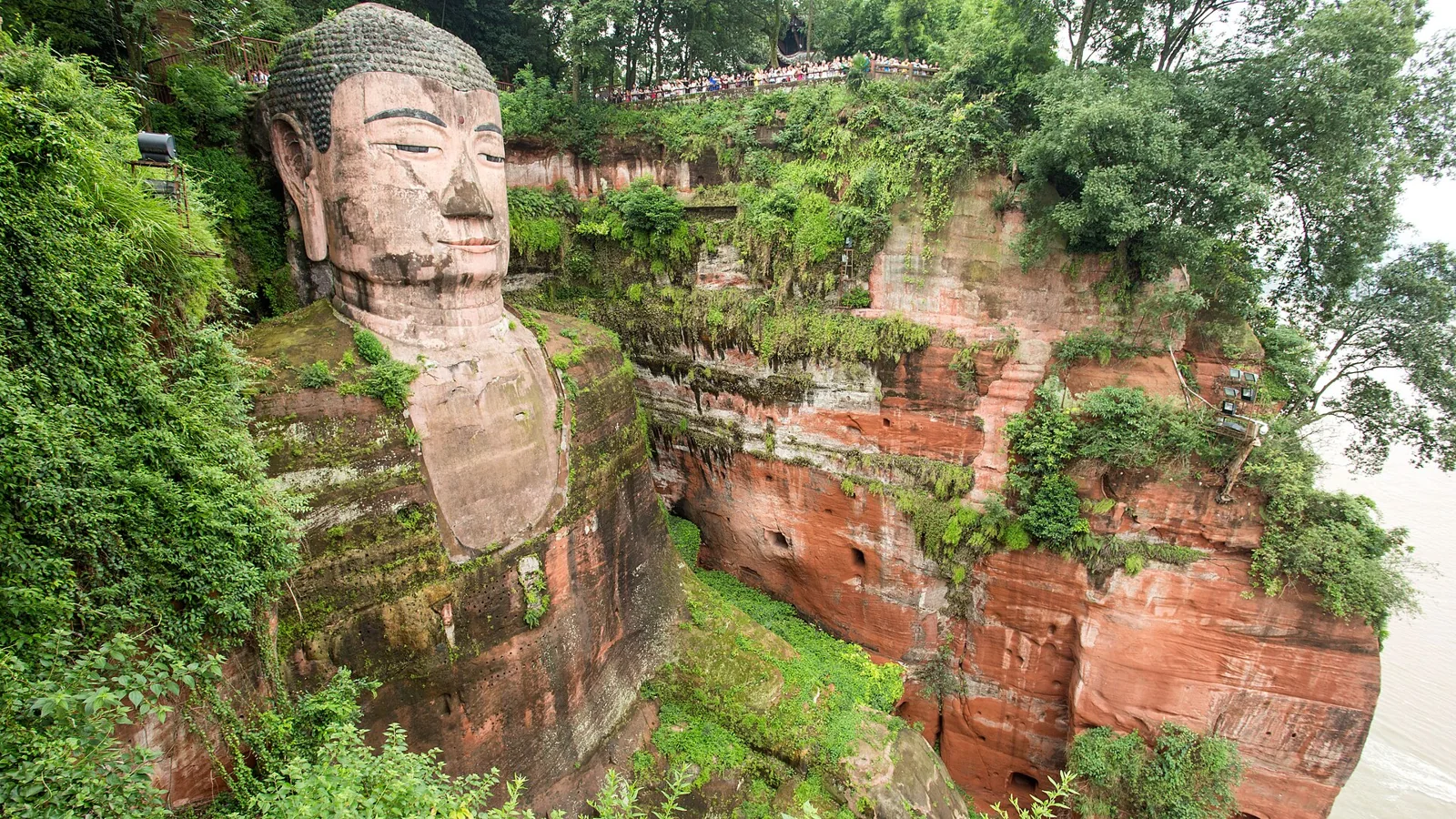
UNESCO identifies a **71-metre** sculpture carved in the Tang period above the meeting of the **Minjiang, Dadu and Qingyi rivers**. The significant comparison is not just a statue beside a river, but an enormous seated figure formed from the hillside itself.
From a permitted distant view, locate the head, shoulders, knees and feet, then find where the cliff continues around them. Ask how much of the apparent figure is shaped rock and how its proportions change when viewed from below. A close view can reveal an ear or a hand at a scale that is difficult to understand from a full-figure photograph. A distant view makes the relationship between figure and hill easier to read.
Do not expect your perspective to match every famous photograph. Water level, the operating boat route, vegetation and the accessible land position affect what is visible. Choose the view that answers your question rather than judging the whole visit by whether you reproduced someone else's frame.
The **seated Maitreya** identity also matters. This is not a giant version of every laughing-Buddha ornament found in a souvenir shop. Look for the sculpture's seated posture and hands resting at the knees, then use local interpretation to understand its religious subject. Avoid touching or marking the carving, including at the feet; getting close is not permission to make contact with the monument.
Water shaped the setting and remains a conservation problem
A 2023 specialist meeting reported by the Sichuan Cultural Relics and Archaeology Research Institute explains drainage features using hair and garment folds, with channels behind the head, shoulder and chest areas. The account also describes continuing research into water damage. Ancient drainage is an engineering feature, not proof that the monument has solved every moisture problem permanently.
At a permitted viewpoint, consider where rainfall would travel over the head and clothing, and where water could arrive from the surrounding rock. Use the interpretation to understand concealed drainage; do not attempt to enter a service opening or identify an unseen channel from a dark patch on the face.
Conservation barriers, repaired surfaces and temporary equipment belong to the site's history of care. A cleaned face and an older photograph with darker staining do not establish that the original carving has been replaced, or that every mark has the same cause. Diagnosis requires professional investigation. For a visitor, the useful distinction is between the carved form, later repair and the changing surface exposed to water and weather.
Add one surrounding monument if it improves the story
The ICOMOS evaluation describes **Lingyun Temple · 凌云寺**, **Lingbao Pagoda · 灵宝塔**, **Wuyou Temple · 乌尤寺** and the **Mahao cliff tombs · 麻浩崖墓** as different elements of this cultural landscape. Its historic descriptions are not a promise that every interior or route is open today.
Lingyun Temple adds the setting of religious buildings around the sculpture. Its old foundation should be distinguished from later rebuilding: the evaluation dates the present temple structure to the early Qing. Compare the scale of a hall and courtyard with the Buddha carved outside, and note where daily religious use changes the visitor's movement.
Lingbao Pagoda provides a different vertical form from the broad seated figure. The evaluation identifies its brick construction and thirteen storeys. Observe the exterior's stacked levels from a permitted position; this does not imply that climbing the pagoda is a visitor option.
If interested in burial history, ask whether the relevant Mahao tomb area is open and included in your chosen product. A cliff tomb and a Buddha carving are not the same kind of archaeological evidence. The tombs provide a different use of rock and a much earlier cultural context. Give that subject its own time instead of treating it as an unnamed passage between viewpoints.
Commit to the descent only after understanding the exit
At the land entrance, ask which path currently reaches the feet, where it returns and whether there is a point at which you cannot simply turn around against the visitor flow. The October notice names Lingyun as the operating approach; staff instructions and barriers determine today's permitted movement.
Before joining a long cliff-route queue, establish whether its actual wait and descent fit your return journey. A land ticket does not require you to attempt the full lower route if it is unsuitable for your group. Ask what upper viewing and temple areas remain available, and choose a shorter approved visit if that still answers your purpose.
Downward steps can be demanding even when ascent seems manageable. A narrow path is also a different task from an open plaza. Keep hands available for rails where provided and avoid stopping across the flow for a photograph. If someone in the group is uncomfortable, discuss the alternative before entering a section with controlled movement.
Ask about a **named route** for reduced mobility: arrival point, thresholds, slopes, toilet access, viewing position and return transport. For a boat, make the same inquiry about the path to the pier, boarding steps, assistance and seating. The scenic vehicle connects visitor-area stops; it does not carry you down the cliff beside the Buddha.
For an English explanation, request the attraction's authorised guiding or audio service and ask what area and language it covers. An April 2026 report describes multilingual services, but availability and hire terms still need confirming. A person offering help on the approach is not automatically the site's official guide; establish provider, scope and fee before agreeing.
Current prices and operating periods: keep each product separate
The operator's 7 October 2026 winter notice reproduced by Phoenix distinguishes the products below. The land hours and cliff-path change are independently corroborated by the official Sichuan tourism post. Confirm your visit's ticket conditions and departures, especially when river conditions change.
| Product | Published winter provision | What it does not establish |
|---|---|---|
| Daytime land visit | CNY 80; 08:00–17:30, 8 October–31 March | A suitable time to start a long descent at the closing minute |
| Daytime water-tourism product | CNY 70; boarding 08:30–17:30, sales window 08:00–17:00 | An unconditional departure or entry to the land route |
| Night Tour of Three Rivers, Wuyou route | CNY 138; scheduled 20:00 from and back to Wuyou Temple pier | Night access to Lingyun Mountain or the Buddha's feet |
| Scenic vehicle | CNY 10 per ride or CNY 15 daily unlimited rides | Transport down the Buddha's cliff path |
Swipe to see the full comparison
Daytime boat online booking is listed as opening at **18:00 for the following day**. The notice separately gives children's terms for different products: do not transfer a daytime free-child rule to the night boat. Ask the ticket service about your child's exact age, height, documentation and required ticket.
These published rates are not an all-inclusive tour quote. Add the station transfer, any extra attraction and separately ordered guiding when comparing a packaged trip with independent travel. Check whether a package contains the land visit, river product or both; a title containing “Leshan Giant Buddha” is insufficient.
Night Lingyun Mountain maintenance is separate from Night Tour of Three Rivers. A picture of an illuminated Buddha does not prove that the cliff route is open after dark. Ask the night-boat seller about the active departure, pier transfer and return rights; do not infer ordinary sightseeing transport is free from a provision tied to a particular night ticket.
Foreign visitors have a documented on-site option
An April 2026 report published by Leshan's tourism bureau account describes a new **multilingual ticket machine at the North Visitor Centre** that scans passports and supports international card and payment options. This is evidence of a passport-facing service, not a claim that we completed a transaction or that every card will succeed.
For advance purchase, start with the **大佛旅游** WeChat or Alipay mini-program named in the operator notice, or a seller whose specific product supports your document. Choose land or boat first, then inspect the traveller-document field and confirmation requirements. If the field accepts only a Chinese ID, resolve that before payment rather than inserting another person's number.
Take the original passport used for the booking and the confirmed order. Ask whether your product requires a window exchange or staffed verification, and where it occurs. The machine report does not prove that a foreign passport can be scanned at every land or boat gate in the same way.
If you cannot complete online purchase, ask the North Visitor Centre or ticket service about that day's document-supported stock. A documented on-site service does not guarantee availability at peak times. Keep **+86 833 2355557** for the ticket and operating questions named in the current notice.
The April report also describes a 15-day advance boat arrangement for overseas **groups**, with a specific response to weather cancellation. Do not apply that group service to an ordinary individual booking. Likewise, the following-day release in the October notice is more recent than April's description of ordinary same-day boat purchase.
A pier name and a sightseeing promise are different things
A November 2025 official notice suspended **Jiazhoudu pier and the named Giant Buddha cross-river project**. It should not be interpreted as a permanent shutdown of every sightseeing boat. Later October 2026 information describes a **Leshan Port–Baxiandong crossing** separately from the sightseeing products.
Before paying, obtain the actual embarkation point, sightseeing route, return point and date. For a short crossing, ask whether the boat merely delivers you to the other bank. A low crossing fare cannot be assumed to buy the same Buddha-view experience as the published daytime tourist boat.
For the night Wuyou route, the current notice names **Wuyou Temple pier · 乌尤寺码头** and a return to the same pier. For a daytime purchase, follow that actual order's pier assignment rather than navigating to an old itinerary's Jiazhoudu marker. Ask where the associated vehicle picks up, if one is included.
If a sailing stops because of water or weather, contact the original seller about the unused product. Buy a land ticket only after deciding that the permitted land route is suitable. A cancelled boat does not automatically convert to admission, except where your particular contract explicitly provides it.
The January 2026 heritage-water notice, effective 5 February, restricts unapproved swimming and fishing in designated areas and additionally bans angling there during the 1 March–30 June closed season. Do not enter the river to obtain a closer view. An operating licensed tour boat and personal access to protected water are different permissions.
Keep the station transfer and Emei visit outside the cliff-route allowance
Save the precise land entrance or assigned pier and confirm the onward pickup point. A rail arrival at Leshan still requires local travel. Ask a driver whether a quote covers waiting, the return and a different exit; a generic Buddha marker may not identify the place you need.
For a return train, count the journey from the actual exit, station approach and boarding procedures. Do not subtract only the advertised boat duration or assume the cliff queue will move at yesterday's speed. If the remaining time no longer supports the lower path, choose the approved shorter visit before committing to it.
Mount Emei shares the World Heritage inscription but is a separate mountain visit with its own transport and admission. A Leshan afternoon does not establish time for a complete Emei summit trip. Choose separate days or a deliberately limited second visit, with its return arranged independently.
A useful Leshan plan ends with four resolved choices: **which view you want, which current route or pier supplies it, how your passport is checked, and how you return from that specific exit**. The cultural reading then has room to happen, instead of being squeezed between incompatible tickets and a rushed train.
Sources and editorial note
Independent 2026 winter operator notice read and official Sichuan tourism post rendered corroboration; actual bureau-linked April inbound-service report; government pier and water notices; UNESCO/ICOMOS descriptions; Sichuan Archaeology Institute technical meeting on drainage. Original sculpture-reading and route/exit decisions. No personal visit or card transaction.
Cliff controls and boat departures can change. Reproduced operator tariffs explicitly labelled; no tested passport checkout/automatic concessions or all piers implied. Ancient drainage not permanently solved moisture; historic surrounding monuments not today's interior inventory. Boat not universal accessibility solution.
- https://whc.unesco.org/en/list/779/
- https://whc.unesco.org/document/154252
- https://www.sckg.com/cooperation/2803.html
- https://weibo.com/2/detail/5352229436659994
- https://feng.ifeng.com/c/8x3l3xj3JIJ
- https://mp.weixin.qq.com/s/uNfpdA63e8RmJ0ybG2fGXQ
- https://www.leshan.gov.cn/lsswszf/bmdt/92337825/3e865b0e7eee473a94ee6972e.html
- https://www.leshan.gov.cn/lsswszf/gsgg/90053490/760014629724229.html