

On this page
Choose the museum for objects and explanations; plan the park separately
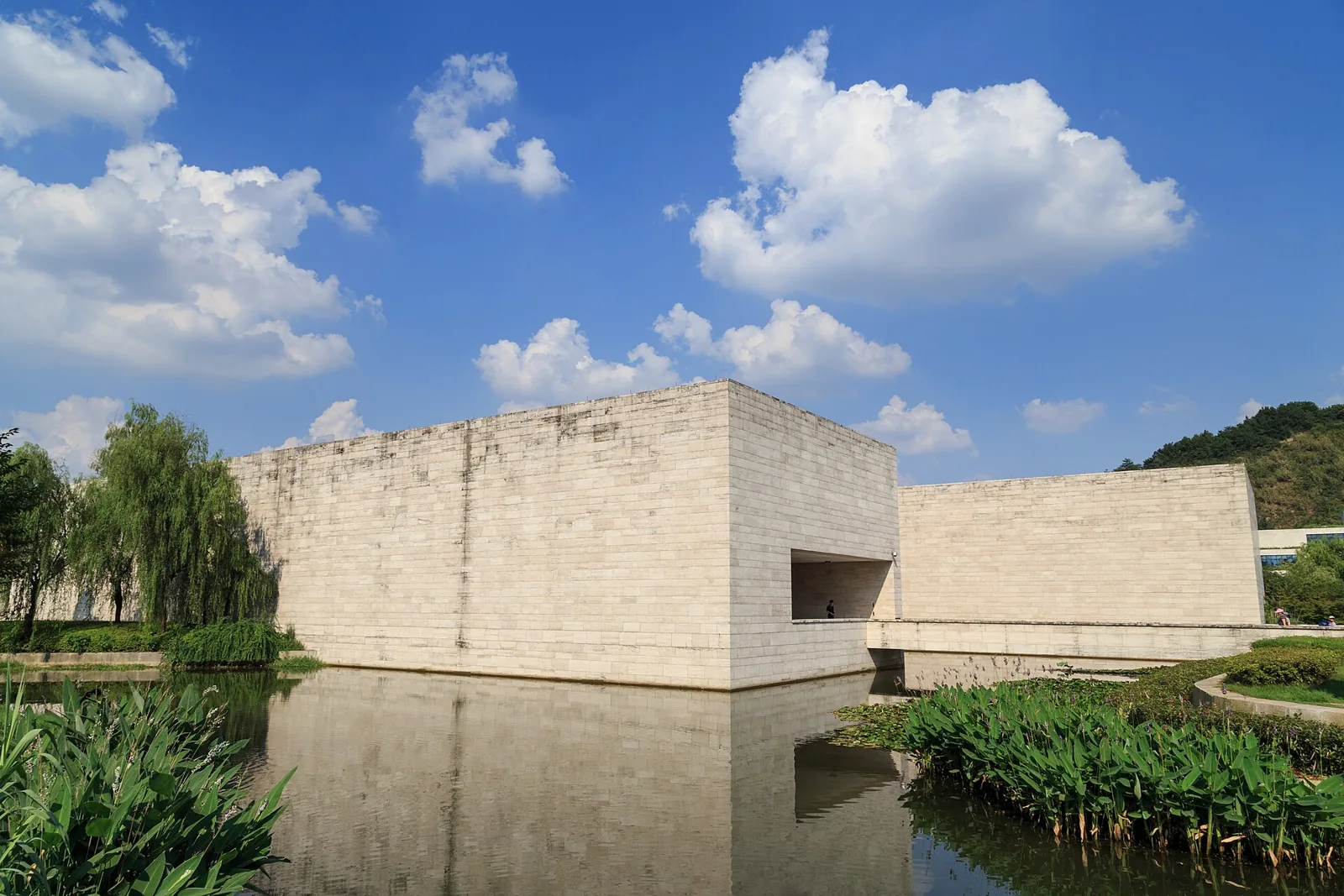
**Liangzhu Museum — 良渚博物院**, at **1 Meilizhou Road in Hangzhou's Yuhang District**, is the indoor place to study the objects and archaeological interpretation of Liangzhu. **Liangzhu Ancient City Archaeological Park — 良渚古城遗址公园** is a separate outdoor destination. Do not navigate to one, buy for the other and assume you have organized a complete visit.
For a short first introduction, choose the museum and follow a question: **what evidence connects finely worked jade to a large, organized community?** For a longer archaeology day, consider museum first and park afterward, with a separately confirmed transfer and park admission. This order is our editorial suggestion; it can make otherwise modest-looking earthworks more intelligible.
The UNESCO World Heritage property concerns the archaeological ruins, including city, water-management and cemetery areas. It is not a certificate stating that entering the modern museum covers every archaeological location. Some important sites form part of a wider protected landscape rather than an ordinary single-ticket circuit.
We have read the museum's visitor rules, current exhibition guide and a direct interview with its director, along with UNESCO's account. We have not checked in with a foreign passport or visited the museum for this article.
Admission has a general rule and a newer exhibition-specific notice
The museum's April 2024 rules state that the basic display is free. They describe real-name booking through channels including the **良渚古城** mini-program, with same-day QR booking also possible. On non-weekend, non-holiday days, the stated individual walk-in exception specifically names an identity card or social-security card. Do not silently extend that domestic-document wording to every foreign passport.
A newer **September 24, 2026** guide for the **琮谱** special exhibition says it is free, individual visitors need no reservation and may enter with a valid identity document, while groups must reserve through the mini-program. That is current, useful information for that exhibition's **September 12–November 29, 2026** run. It does not establish a permanent replacement rule for all future visits or remove every document question for a foreign traveler.
| Your situation | What the published material establishes | Useful next step |
|---|---|---|
| Visiting the 2026 琮谱 exhibition individually during its run | Its guide allows valid-document entry without reservation | Confirm the passport procedure if your document is foreign |
| Planning a general visit outside that exhibition window | The older general booking and weekday exception remain published | Recheck the latest visitor notice for your actual date |
| Bringing an organized group | Group reservation is required in both notices | Use the group application rather than assembling individual walk-in claims |
| Adding the archaeological park | Museum entry does not establish park admission | Confirm the park product, entrance and transfer separately |
Swipe to see the full comparison
Call **0571-88773875** with your date, the display you want and your document type. The exhibition guide gives consultation hours Tuesday–Sunday, **09:00–16:30**. A specific question — “Can I enter the museum's current exhibition with my original foreign passport, and where is it checked?” — is more useful than asking for a generic “Liangzhu ticket.”
For a booked visit, carry the document used and the successful QR confirmation. If a form only accepts a domestic identity number, do not insert false information or assume a park booking solves the museum problem. Ask the museum for the correct manual or supported-document procedure. This guide has not tested a completed passport reservation.
Read the civilization before focusing on the brightest jade case
UNESCO dates the archaeological city broadly to **3300–2300 BCE** and identifies an early regional state supported by rice agriculture, a water-conservancy system, planning and differentiated burials. That description links everyday production, landscape engineering and social organization. Jade is important within that system, not a substitute for understanding it.
The museum's published route map names displays on the watery environment, civilization and jade. The map is an older orientation document; use the current entrance map for access and any changed gallery layout. The three subjects nevertheless give you a useful reading sequence: **how people sustained life; how a larger community was organized; how objects expressed distinctions within it**.
When looking at a model or reconstruction, read the key before admiring the whole scene. Which parts represent excavated remains? Which show a reconstructed building or a proposal based on evidence? The difference matters especially at a prehistoric city where surviving earthworks and foundations do not preserve every original room or roof.
For a water-management display, ask where water could collect, where it could be held and where it could move. What work would be needed to build and maintain the arrangement? These are questions for the evidence and diagrams, not a license to declare that every dam served one proven purpose. A picture of an ancient landscape does not by itself establish the exact daily operation of its infrastructure.
For a burial display, compare position, scale and object combinations before treating one lavish assemblage as an average household. Social differences are part of the archaeological interpretation. A small number of remarkable objects can represent a very particular context rather than the belongings of every person who lived in Liangzhu.
A cong is a form you can inspect without pretending to solve its meaning
Start with the physical object: the relationship between its outer form and the opening through it, the way its surfaces are divided, and the placement of decoration. The Chinese name **琮**, usually rendered **cong**, identifies the object type. It does not mean that every cong was made in the same period, had the same material or served an identical purpose.
In the museum director Xu Tianjin's September 2026 interview, he emphasizes that no direct Liangzhu written account tells us exactly how these objects were used. The later textual description of ritual heaven and earth is separated from Liangzhu by millennia; using it to explain Liangzhu objects remains a research question. Competing interpretations of the imagery also remain.
Look first at what you can observe, then read the interpretation. If a label describes ritual authority or a divine motif, ask what supports that account: the excavation context, a recurring object combination, a similar image or a later text? A well-supported interpretation and a direct contemporary written description are different kinds of evidence.
Do not reduce the object to “a square meaning earth and a circle meaning heaven” and stop looking. Compare a corner with a flat face. Does a motif wrap around the corner, or sit within a repeated section? Can the same element be read from two neighboring sides? This close inspection gives substance to the visit even when the ancient meaning cannot be completely recovered.
A photographed pale surface is also not a simple measure of the original jade's color. Burial and material condition affect appearance. Read the material and condition information instead of assuming that a whiter object is older, more valuable or a different object type merely from its image.
Follow the engraving, then return to its archaeological context
The museum's April 2026 account describes the **Fan-shan Tomb M12 cong**, commonly called the “king of cong,” with eight complete human-and-animal motifs. It also discusses how jade assemblages differ across higher- and lower-status burial contexts. These are reasons to study the carvings together with the find context, not simply as decorative patterns.
If the original is available, identify one repeated motif and follow its boundaries using the displayed enlargement where provided. Which details are easy to recognize in the enlargement but hard to see on the object? Which are actual engraved lines, and which are the explanatory drawing's way of making those lines legible?
Then compare a second repeated element. Look for variations without assuming that every difference indicates a known named deity or a different workshop. Repeatability, variation and the labor needed to cut fine details are interesting observations in themselves. We do not infer a proven production organization merely from the number of lines visible.
Finally, read the excavation identifier. **M12** refers to an archaeological context, not a modern gallery position. If a neighboring object comes from another tomb, another site or another period, keep that distinction in your notes. A display case can bring things together for explanation even when they were never originally deposited together.
Ask staff about original-versus-replica status and current display if seeing one particular object is essential to your trip. An article, photograph or collection entry does not guarantee that the original is available that day. The museum's explanatory material can still support learning when conservation limits access to an object.
The 2026 cong exhibition is a comparison across time, not a room of identical Liangzhu finds
**琮谱——良渚遗址发现九十周年特展** is advertised in the museum's first-floor temporary gallery through **November 29, 2026**. Its purpose is to trace the object type across periods and places. Do not read every displayed cong-shaped object as a Liangzhu-age jade excavated locally.
Choose two pieces and record only four things from their labels: period, material, find place and holding institution. Then compare their shape or decoration. Does the similarity concern the whole form, a single surface detail or the way one was later reused? This is a manageable viewing exercise even if you cannot read every label in the exhibition.
The official guide points out an especially useful distinction: some photographs beside objects show **different** pieces, chosen for comparison or related context. Read both captions. A large image above a case does not automatically show the object directly below it, and an overseas-collection map does not mean those originals have all traveled to this room.
Use the exhibition's drawings and comparisons to see details, but keep the evidence attached to the correct object. If a label describes a later addition or change, distinguish the age of the underlying object from the age of the modification. The resemblance of a ceramic cong-shaped vase to ancient jade does not transfer the jade's original ritual context to the vase.
The director's interview explains that the exhibition presents different scholarly views rather than one settled answer for every function and motif. Take that uncertainty seriously. You can leave knowing how a form spread and changed while still having open questions about its original use or the path by which an individual object traveled.
After the exhibition closes, check the replacement programme. The advertised October holiday talks were also date-specific; they are not a promise of the same public-guiding times every week. A free temporary exhibition and a recruited workshop or lecture may have different sign-up requirements.
Arrange the journey to the museum's actual entrance
Save **良渚博物院, 美丽洲路1号** in your navigation and send it to the driver. The station named Liangzhu is not the museum entrance. The museum's transport page describes **Metro Line 2 to Liangzhu station followed by a connection**, but its undated bus list should be checked in a current route planner rather than treated as a guaranteed timetable.
For a trip from central Hangzhou, compare the entire outward and return journey before adding another large attraction. A museum visit plus a separate archaeological-park transfer is more coherent as an archaeology-focused day than as an assumed quick detour between distant appointments. For a shorter day, visiting only the museum can be a complete choice.
If you add the park, check its current entrance and the part you want to see. A World Heritage map covers a protected property, not necessarily a visitor route to every dam and cemetery. Ask which archaeological features are actually presented to the public and how transport between them works. Do not infer full access from their inclusion in UNESCO's description.
The museum's normal period is **09:00–17:00, final entry 16:30**, Tuesday–Sunday, with legal-holiday exceptions to Monday closure. Aim to arrive with enough time for the display you chose; entry at the last possible moment does not create a full museum afternoon.
For mobility assistance, contact the museum about the continuous route, lifts, seating and any chair service before you travel. An indoor museum or a floor plan does not establish that every access path meets your needs. In wet weather, ask where an umbrella can be left: the published rules prohibit taking umbrellas into galleries and specify designated places for eating.
Leave with one link between an object and the society that made it
For an adult first visit, choose one landscape or city explanation, one excavation context and one jade object. For a family, turn those into simple comparisons: a model with a plan, an object with its drawing, and two similar forms with different labels. You do not need to explain every symbol to make the visit worthwhile.
Before leaving, try to answer one concrete question in your own words. How can a model distinguish remains from reconstruction? How does a burial assemblage support a social interpretation? Why might a later cong-shaped object look familiar while belonging to a different world of use?
If you can connect that answer to the actual label or evidence, the museum has done more than provide a photograph of jade. It has given you a way to read a prehistoric society — and, if you continue to the archaeological park, a reason to look carefully at the landscape as well as the objects.
Sources and editorial note
Individually researched evidence-and-object museum guide. Actual2024Apr7rules/2026Sep24Congguide fully rendered,olderoperatorfloor-mapimageactuallyviewed,transportpageactualreadwithundatedbusqualification,2026Apr2institutionjadeinterpretations;UNESCO1592/currentdirectcuratorXuinterviewprimaryaccount qualifyfunctionuncertainty. No field visit or completedpassportcheck.
Foreignpassportacceptance/manualroute,currentobjectavailability/originalstatus,continuousstepfreeaccess and exactmodernbusfares/timetables untested. Archaeologicalinterpretationcertainfunctions/motifsdebated;museumandUNESCOparknotoneentry.
- https://www.lzmuseum.cn/ZuiXinGongGao/2024934396935.html
- https://www.lzmuseum.cn/LiangBoXinWen/2026105243109.html
- https://www.lzmuseum.cn/LiangBoXinWen/2026225052227.html
- https://www.lzmuseum.cn/CanGuanLuXian/index.html
- https://www.lzmuseum.cn/JiaoTongFuWu/index.html
- https://www.thepaper.cn/newsDetail_forward_34049250
- https://whc.unesco.org/en/list/1592/