

On this page
Daylight is the more useful first visit if you want to read the sculpture
Choose a daytime visit for your first substantial look at Longmen’s carvings, especially if you want to compare Northern Wei and Tang work. Begin with the West Hill grottoes and reserve enough time for individual caves as well as the large Fengxiansi group. The opposite bank and other included areas can add context, but rushing through four areas is not the only way to use the ticket well.
The operator currently lists ordinary admission at **CNY 90**, with a **CNY 45** concession category. Daytime access covers West Hill grottoes, East Hill grottoes, Xiangshan Temple and Baiyuan Garden. Transport and a guide are separate decisions. Do not translate a seller’s bundle price into the ordinary admission rate.
If your principal interest is an illuminated evening view, check the current night product instead. Its access is narrower. Decide whether seeing the site after dark matters more than studying sculpture and inscriptions in daylight before committing to a single visit.
Understand the four-area route before the first check
The visitor policy describes a single-direction sequence: West Hill, East Hill, Xiangshan Temple, then Baiyuan, with four checks. Keep the ticket and booked document available throughout. Passing the first gate does not make them disposable.
For a focused visit, choose a small number of West Hill stops and leave time to see the cliff across the river where the current route permits. For a fuller visit, allow for the additional East Hill and temple paths before choosing your arrival session. Xiangshan Temple is not just another flat riverside photo stop, and a broad list of inclusions says nothing about your own walking capacity.
A first-time visitor could allow roughly three hours for a considered West Hill emphasis and about four to five hours for a wider four-area plan. These are editorial estimates, including looking time and pauses, not operator guarantees. Add the approach from the service area, transport and any queue separately.
Ask staff about the permitted shorter exit if you intend to omit a later area. Do not assume you can retrace a one-direction route or re-enter because the ticket names all four places. A decision to stop early should be made while the intended exit remains clear.
Passport entry and concessions: do not copy the domestic categories
Buy for the actual date and session using a channel which accepts the document you will carry. The operator publishes real-name entry instructions but the publicly readable policy does not provide a complete tested foreign-passport workflow. Confirm the overseas-document procedure with the ticket centre before travelling, including any staffed verification or collection step. Bring the original passport and the final order record.
The concession wording is particularly important. The Chinese policy says its listed half-price categories are restricted to Chinese citizens. It also states that the height-based free category for minors at or below 1.4 metres is not limited by nationality, while other free categories have nationality restrictions; its senior category additionally mentions China’s foreign permanent-residence ID. An overseas passport alone is not equivalent to that residence document.
Consequently, do not assume an overseas student card, age over 60 or an age-only child category automatically grants the same benefit. Ask about the particular document and category before choosing the ticket. A correct full-price booking can be more useful than an ineligible concession which fails at the gate.
The operator’s contact page lists the Northeast Service Area ticket centre at **+86 379 6992 0437** and general enquiries at **+86 379 6598 0972**. State whether you need daytime or night access, the document type and any concession you intend to claim. These are published contact numbers, not a promise of an English-speaking agent.
If a payment or document check fails, establish whether an order already exists before submitting another. Keep the exact error and ask the sales channel to resolve it. Do not give somebody else’s identity number to a form simply to create a confirmation.
Day and night have different areas and different cutoffs
The dedicated opening-hours page separates ticket sales, last admission and clearance. For daytime operation, the posted seasonal arrangement is:
| Daytime season | Ticket sales stop | Last admission | Clearance |
|---|---|---|---|
| March 1–October 31, starting 08:00 | 17:30 | 18:00 | 19:00 |
| November 1–late February, starting 08:00 | 16:30 | 17:00 | 18:00 |
Swipe to see the full comparison
All times are Beijing time, UTC+8. The English website labels the seasonal tables “Daylight Saving Time” and “Standard Time”; treat these as seasonal operating arrangements, not an instruction to change your clock.
The Chinese page also publishes a night arrangement starting March 30, 2026: ticket sales 17:30–19:30, entry 18:00–20:00, clearance 21:00, with **West Hill and Xiangshan Temple only**. East Hill and Baiyuan are daytime areas. Check that the night product is offered for your date and whether it requires its own booking; a day ticket does not establish night access.
There is a conflicting hours line on the general visitor-policy page, mixing a later sales end with winter-style last entry and clearance. Use the dedicated seasonal page and the dated booking product, then confirm any unresolved difference with the operator. Arriving at a sales deadline is not a sensible plan for a several-hour route.
Three comparisons make the West Hill more than a giant-Buddha photograph
UNESCO identifies Longmen’s major carving periods from the late fifth to mid-eighth centuries, with important Northern Wei caves and later Tang ensembles. Approach a selection of works as different answers to scale, posture and patronage rather than trying to see every niche.
Binyang Central: how a court supported a religious space
At Binyang Central, orient yourself to the central figures and the cave’s arrangement before looking for the small details. Read the label for the cave’s patronage and period, then compare the way drapery and proportions organise the figures. Give yourself time to notice the relationship between the central Buddha and the surrounding attendants.
The Metropolitan Museum’s account explains that the cave was commissioned by Xuanwu in honour of his parents. Its emperor-procession relief once occupied a wall within that space. This connects royal patronage to worship, rather than making “imperial cave” merely a decorative label.
For a visitor, the useful question is how the donor images and the principal religious figures would have related to each other. A cave was a designed setting, not an arbitrary shelf of statues. Even where a work is missing, interpretation can help reconstruct that spatial relationship.
Fengxiansi: see the group, then the main figure
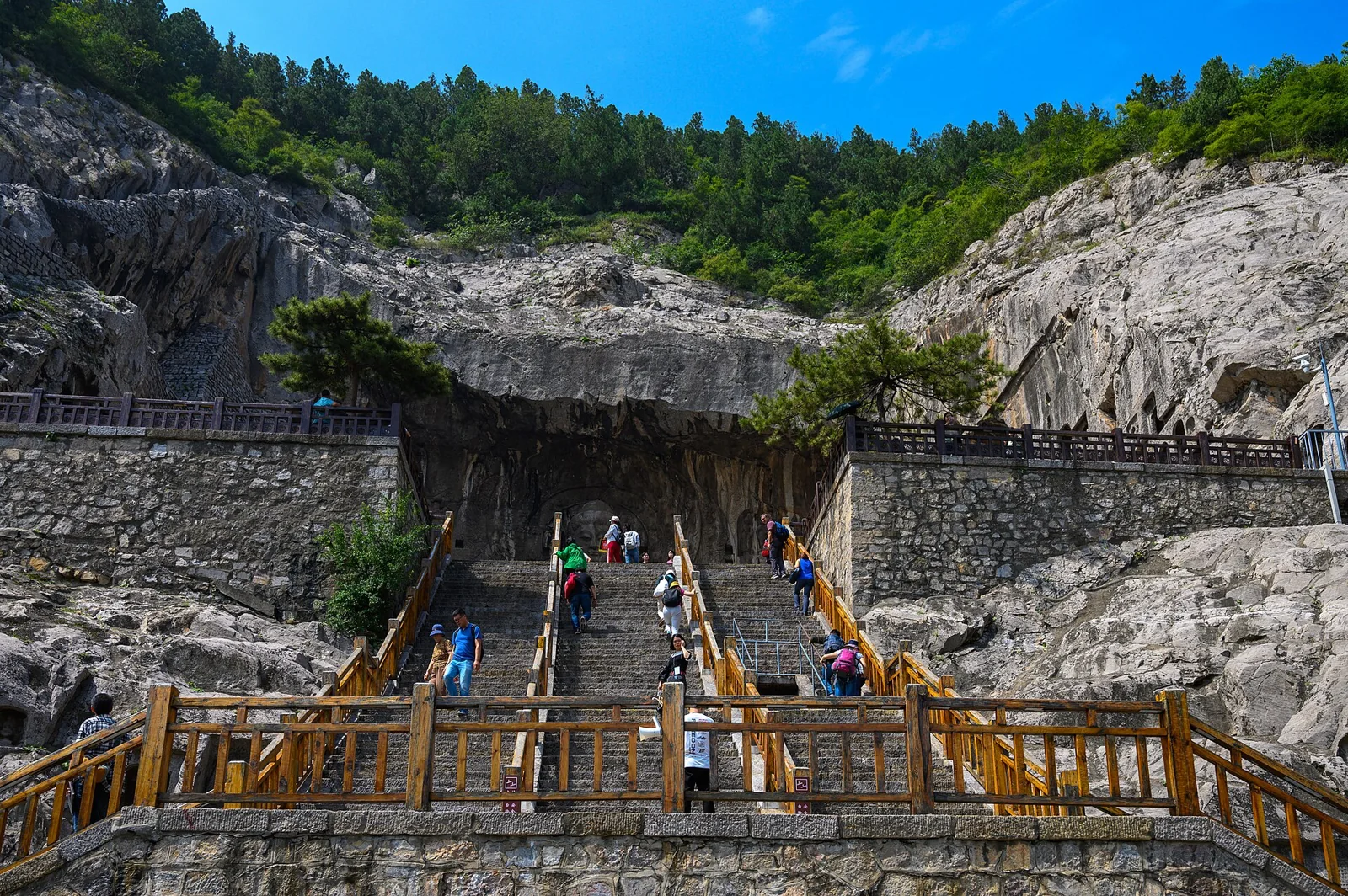
The operator’s art overview describes the Fengxiansi ensemble with its approximately 17.14-metre central Lushena Buddha and surrounding disciples, bodhisattvas, heavenly kings and guardians. First look at the whole arrangement: central and peripheral figures perform different visual roles.
Then compare a calmer figure with a guardian’s pose, facial expression and apparent tension. Ask how differences in scale and gesture organise the group’s hierarchy. The largest sculpture deserves attention, but seeing only its face can miss why the neighbouring figures matter.
Do not turn a popular resemblance story into a verified portrait attribution. A guide should distinguish a documented patron, a sculptural identity and a later interpretation. If the claim is presented without evidence, retain it as a story rather than a historical fact.
Guyang: small niches and words can carry large histories
The operator identifies Guyang among the earliest important caves, with many niches and inscriptions. Where open access and the viewing distance permit, compare a large central image with a small donated niche. Notice whether accompanying text identifies a patron or a devotional purpose.
An inscription can connect the carving to somebody who paid for or dedicated it. That makes the smallest work more than background texture. Choose one readable interpretation rather than attempting to decipher distant characters from a phone photograph. Stay behind the barriers; a better close-up is not a reason to touch the stone.
Why the famous procession reliefs are not in their original cave
Longmen’s dispersed-heritage inventory documents carved works removed from the site. The emperor procession is held by the Metropolitan Museum in New York; the companion empress procession is held by the Nelson-Atkins Museum in Kansas City. They should not appear in an itinerary as originals you will see intact on Binyang’s walls.
The Nelson-Atkins provenance record describes damage and sale in fragments during the 1930s, followed by reassembly using photographs and rubbings, with plaster filling missing areas. That history matters when you compare a museum image with the original setting: an assembled panel is not the same experience as a relief running across a cave wall.
Before arrival, use the museums’ online images to understand the procession’s scale, gestures and relation to patronage. At the cave, use onsite interpretation to consider what is absent. Missing faces or portions of relief are not automatically ordinary weathering; explain only the damage history which the site or a reliable record supports.
This also gives conservation instructions a purpose. Restrictions on contact, climbing and access help preserve a fragile archaeological setting, not simply regulate where visitors may stand for photographs.
Luoyang Longmen station is close, but it is not the grotto gate
The official transport page describes Luoyang Longmen high-speed station as about four kilometres from the site and identifies Bus 71 as a direct option. Its driving and bus times are estimates, not a protected connection. Luoyang’s other railway station involves a different journey, so check the exact name on the train reservation.
Choose the relevant service area as your local destination. The operator estimates around 20 minutes on foot from the Northwest Service Area to the grotto check and about 25 from the Northeast, with an optional electric vehicle at **CNY 10 per person per direction**. That fare is for the approach service, not a promise to carry you up every cave stair.
A boat provides a different river view. Ask for the operating dock, route, return or one-way conditions and price before paying; the operator says availability depends on weather. Do not let a hoped-for boat replace a confirmed return route to the train station.
For a group splitting between a boat and a walk, select a named meeting point and a time beyond the busiest gate. “Meet near the Buddha” is insufficient if people are on opposite banks or following different exit routes.
Access help and decisions when the full route stops working
The official contact page lists wheelchair and stroller arrangements through the Northeast team centre, **+86 379 6982 8566**, and small-item storage at **+86 379 6992 0437**. Ask about availability, charges or deposits and the actual size accepted before relying on a service. Small-item storage does not guarantee space for every suitcase.
For mobility planning, distinguish the service-area approach, riverside route and raised cave platforms or temple steps. Ask which portions form a continuous accessible route and where you can exit. An electric vehicle reducing the approach distance is useful, but does not make the whole four-area itinerary accessible.
If a cave is closed, use the open route and substitute a meaningful comparison rather than trying to reach its barrier. If your group tires after the West Hill, ask staff for the appropriate shorter exit and adjust the return transport. If you miss the daytime entry session, do not assume a night ticket restores access to East Hill or Baiyuan.
For an unused paid order, the operator’s policy permits a refund request within six months and describes staff processing in three to five working days; used tickets are not refundable under that posted rule. Follow the original purchase channel and its applicable product conditions. A partial visit is a planning choice, not automatically a refund entitlement.
Arrive with the right session and document, keep the ticket through each check and give a few carvings enough time. Longmen becomes much more intelligible when the practical route supports an actual comparison of works, instead of competing with it.
Sources and editorial note
Individually read rendered official visitor policy, seasonal/night schedule, transport, exact service contacts, art overview and dispersed heritage inventory; compare Met and Nelson-Atkins actual collection/provenance records and UNESCO chronology. Original observing route and deadline decisions. AI-assisted desk research; no transaction or field visit claimed.
Foreign passport end-to-end checkout, live night availability, return boat price and continuous wheelchair route not tested. Collections held overseas are not promised on cave walls; estimates do not protect rail connections.
- https://www.lmsk.cn/
- https://www.lmsk.cn/Pwxx_id_1.html
- https://www.lmsk.cn/Pwxx_id_4.html
- https://www.lmsk.cn/Pwxx_id_3.html
- https://www.lmsk.cn/lxxx
- https://www.lmsk.cn/Gywm_id_5.html
- https://www.lmsk.cn/Gywm_id_8.html
- https://whc.unesco.org/en/list/1003/
- https://www.metmuseum.org/art/collection/search/42707
- https://art.nelson-atkins.org/objects/8976/offering-procession-of-the-empress-as-donor-with-her-cour