

On this page
What kind of visit are you trying to make?
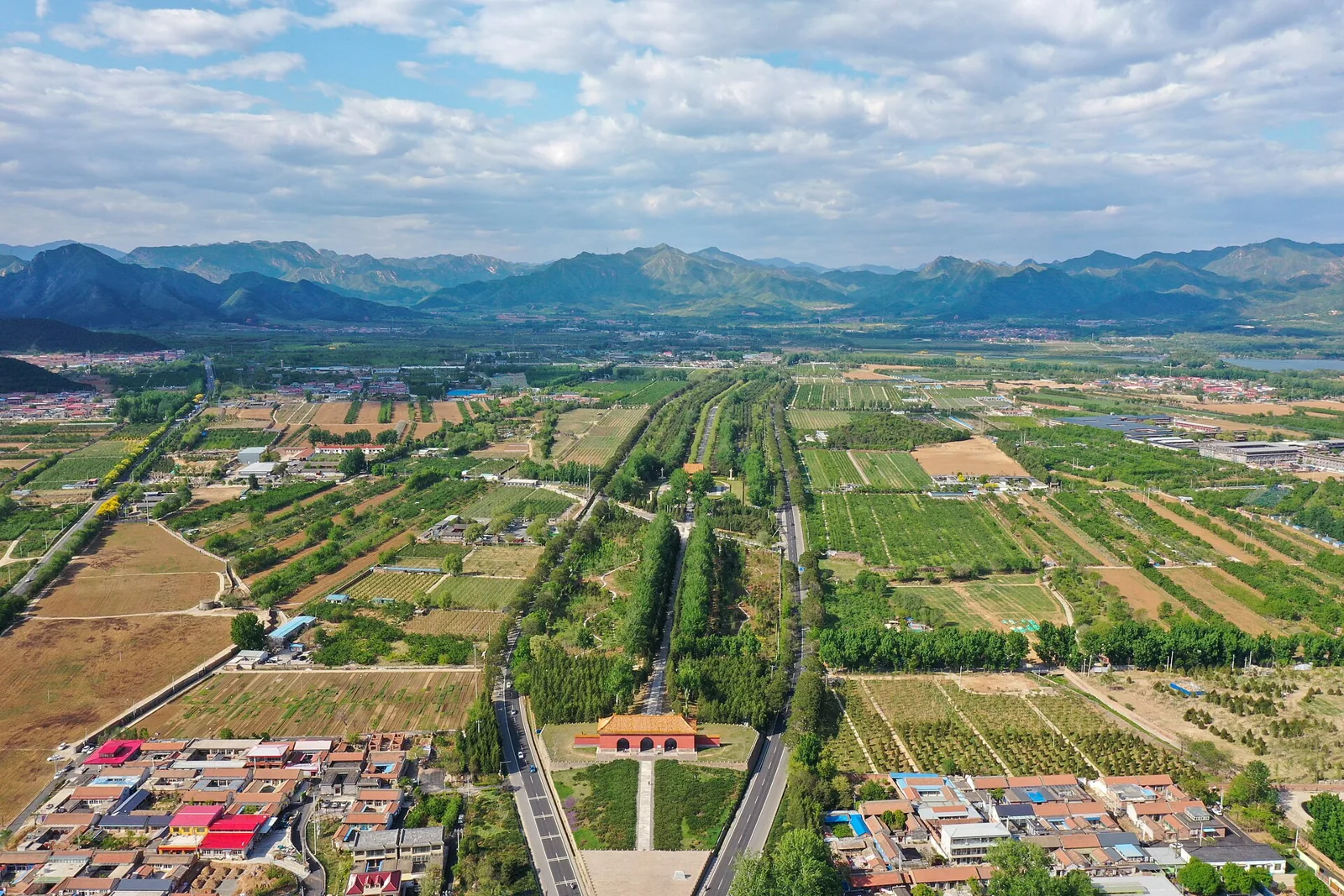
The Beijing tombs stand in the Tianshou Mountain landscape in Changping. The burial area relates individual mausoleums to their mountain setting and ceremonial approaches. It is more intelligible when you choose a question—imperial architecture, burial arrangements or the approach ritual—than when you try to add the greatest possible number of tomb names.
| Your main interest | A useful first choice | What that choice does not automatically include |
|---|---|---|
| Monumental mausoleum architecture above ground | Changling, 长陵 | Dingling's excavated underground chamber |
| The excavated imperial burial space | Dingling, 定陵 | Every original object from the excavation or another tomb |
| A ceremonial approach and stone guardians | Sacred Way, 神路 / 神道 | Admission to each mausoleum at the end of a wider historic route |
| A newly accessible site with managed interpretation | A confirmed Jingling or other assigned-guide product | Walk-in access or an English tour without an accepted arrangement |
Swipe to see the full comparison
If you have only a short visit window, one focused site is a reasonable choice. If you want two, select them because the second adds a different perspective. A visit that is physically manageable and understood can be more useful than several brief transfers and photographs.
Changling, Dingling and the Sacred Way are different experiences
Changling: the authority of the surface buildings
Changling is associated with the Yongle Emperor, Zhu Di, and Empress Xu. Look at the sequence of courts, the ceremonial halls and the relationship between the built front and the burial setting behind. Beijing's heritage description identifies Ling'en Hall as a major part of that surface complex. City heritage description.
This is a useful choice if you want to read the imperial mausoleum as architecture. Begin with the arrangement, then use the labels or guide to understand a specific building. Seeing the front courts does not mean you can enter an unopened burial chamber, and a closed component should not be treated as permission to find another way behind it.
Dingling: an excavated burial route
Dingling belongs to the Wanli Emperor, Zhu Yijun, and his empresses. The excavated underground palace gives it a different visit route from Changling. It is a deliberate chamber visit, with the descent and climb back out as part of the decision—not just another surface court on the same walk.
If underground spaces or stairs are unsuitable for someone in your party, establish that before buying a package centred on Dingling. Ask about the current usable route, not only whether the scenic area is open. A surface visit elsewhere can offer a different purpose, but it should not be described as the same burial-chamber experience.
Objects recovered from a tomb and the chamber itself are separate parts of an exhibition. Do not assume that every famous crown or robe in a promotional image is currently displayed beside the route you have booked.
Sacred Way: understand the approach rather than hurry to the end
The stone figures and officials belong to an ordered ceremonial approach. Look at their pairing, positions and the movement they create along the route. UNESCO describes sacred ways and stone monuments as part of the continuing ceremonial and spiritual functions of the imperial burial landscape. World Heritage account.
The historical Sacred Way extends beyond the section a visitor may walk today. A heritage account of its full length is not a description of one continuously ticketed pedestrian route. Use the current visitor entrance and exit and arrange pickup accordingly. Do not tell a driver simply to wait at “the tombs” when you will finish at another part of the approach.
The newer openings need a different booking plan
Beijing's December 2025 announcement reports Jingling opening on December 22. It lists Changling, Dingling, Zhaoling and the Sacred Way as regularly open sites, while Kangling, Yongling, Siling and Jingling require booking. That supersedes the old claim that visitors can only access three tombs; it does not make every named enclosure a walk-in attraction. Jingling opening and access arrangements.
For Jingling, the notice names the official 明十三陵景区 Douyin account and 昌平文旅集团 WeChat mini-program, with visitors accompanied by guides assigned by the scenic area. Choose the actual product, confirm its session and meeting point, and establish the language of the included explanation before arranging a journey.
A private driver or an independently hired guide is not automatically the assigned guide required by this arrangement. Ask how the operator's accepted visit is documented and where your party joins it. If your reason for buying is an English explanation, obtain that specific arrangement instead of inferring it from the ability to enter foreign-passport details.
A 2030 plan for wider opening is a future target. Do not book an unopened tomb on that basis. Check an actual access announcement and accepted reservation for the named site, not a map showing all thirteen.
Compare the named admissions, with the price conflict visible
The city publishes separate admissions, not one universal “Ming Tombs” product. Its July 2024 English table and the Visit Beijing attraction page agree on several site fares but differ on the Sacred Way. The latter lists Sacred Way at CNY 30 in high season and CNY 20 in low season, while the older English table gives CNY 20 and 15.
The Visit Beijing page publishes Dingling CNY 60/40, Changling CNY 45/30 and Zhaoling CNY 30/20 for high/low season. These are reference prices from published visitor pages, not a newly completed October checkout. Use the actual selected product or official window to settle the charge and included area. For the Sacred Way, budget with the higher published reference until the current product confirms it; this avoids building the day on an unexplained lower cached number. Visit Beijing fare listing · Older city English table.
The older English page describes on-site sales without advance reservation for the regular sites. That instruction should not be applied to Jingling or another assigned-guide opening. For any dated purchase, retain the accepted document, site and order, and carry the original passport if it is the identity used to reserve. Do not enter a fabricated mainland identity number when a supported passport procedure is needed.
A quoted tour cost should say which tomb admission it includes, whether the Sacred Way is additional, whether the guide enters and whether local transfers are covered. A full-day vehicle and a ticket to one tomb are different services. If a discount depends on age or documents, confirm that category for the actual visitor rather than assuming an older concession paragraph is universal for foreigners.
Why the journey has to name the entrances
Visit Beijing describes distances between individual mausoleums ranging from roughly half a kilometre to eight kilometres. That is a landscape-scale arrangement, not a cluster of museum rooms. The time between two visits must include a real local transfer or a deliberately chosen walk.
Write the day as distinct legs: your accommodation to the first entrance, the visit, the transfer to a second site if chosen, then the return. Save 长陵, 定陵 or the booked Sacred Way entrance in Chinese alongside the product. A map marker for the whole Ming Tombs area cannot identify all of these checking points.
For public transport, verify the final connection to the actual first entrance and a usable return service. A railway or metro stop named for the scenic area is still a transport stop; it is not proof you can step directly into the booked enclosure. Do not copy the bus frequency and last departure from the city’s 2020 heritage article as a current timetable.
For a driver, agree whether the vehicle waits at the same site or moves to your actual exit. If combining a through-walk on the Sacred Way with a tomb, name both pickup stages. This is especially important if the second visit requires a fixed guide session: an imprecise pickup can consume the time you reserved for that appointment.
A wall-and-tombs tour should survive a late wall descent
If combining with a Great Wall visit, ask which tomb you will see and the time available there after the wall. “Great Wall and Ming Tombs” is too broad to test. A package may contain only a Sacred Way walk, only Dingling, or a different arrangement altogether.
Make a sensible reduction rule before departing. If the wall visit runs late, remove an optional tomb rather than arriving at a fixed guided appointment you can no longer use. If the group is tired after steep wall sections, do not insist on an underground stair route merely to preserve the original stop count.
The existing Mutianyu guide explains its separate cableway and wall-section decisions. It is not evidence that Mutianyu and every Ming Tombs site can be combined conveniently from your hotel. A meaningful combined day needs a confirmed vehicle route, actual site selection and enough time inside each chosen place.
Do not chase a July exhibition after its advertised run
The July 10, 2026 city announcement describes a Ming-artifact exhibition at the visitor centre and Dingling's first exhibition hall, including a display of five imperial crowns. It says the exhibition runs for one month. That date-specific announcement cannot establish the same crown display for an October visit. Dated exhibition announcement.
If the objects are your reason for coming, establish the current exhibition and its location before selecting admission. A normal Dingling chamber visit and a temporary exhibition reservation are different promises. A promotional photograph can remain online long after a temporary display ends.
Before departure, finish the plan with the selected site's present opening and final admission, any guide meeting time, and the return. For mobility needs, distinguish the surface path, historic thresholds and Dingling's underground route. Follow conservation barriers and photography instructions; the heritage designation does not authorize access to a closed burial area. That leaves you with a visit chosen for its actual content, with a return you can carry out.
Sources and editorial note
Prepared from Beijing’s dated opening and exhibition notices, its English ticket and heritage pages, the Visit Beijing attraction listing and UNESCO. The Sacred Way fare conflict and expired July 2026 exhibition are identified. Route and purchase decisions are editorial advice, with AI assistance; no field visit or ticket transaction is claimed.
Bangsai has not verified a customer checkout, current bus frequency or English guiding session. Published prices are references, not a tour quotation. Access forecasts and old subjective assessments are not current visit promises. Optional Bangsai trip support is separate.
- https://english.beijing.gov.cn/latest/news/202512/t20251224_4360556.html
- https://english.beijing.gov.cn/specials/ticketing/attractions/202407/t20240719_3753671.html
- https://s.visitbeijing.com.cn/attraction/101416
- https://english.beijing.gov.cn/travellinginbeijing/focus/202012/t20201215_2165105.html
- https://english.beijing.gov.cn/beijinginfo/culture/culturecalendar/exhibit/202607/t20260710_4757061.html
- https://whc.unesco.org/en/list/1004/