

On this page
You can visit Huashan without the plank walk
For a first daylight visit, start by deciding how much mountain walking your group can complete, then choose matching ascent and descent transport. A limited West Peak visit using the West Peak cableway both ways is a more controllable plan than committing everyone to a long traverse towards the North Peak exit. It still involves mountain paths and stairs; it is not a step-free excursion.
The famous Changkong Plank Road is a separate cliff-side experience, not a compulsory link which every ordinary visitor must cross. Do not make the whole trip depend on access to it. The **last dated operational notice reviewed here**, issued September 30, 2026 and reproduced with scenic-area attribution, records that the plank road and Yaozi Fanshen were suspended from September 15 for inspection and safety upgrades. It says reopening follows satisfactory completion and acceptance; this review has not confirmed a subsequent reopening. Contact the scenic area before buying specifically for either project.
Huashan is in Huayin, outside central Xi’an. A rail arrival, a scenic-area entry, a valley transfer and a cableway boarding are different stages. A ticket bearing the mountain’s name does not remove the need to plan each of them.
West and North cableways put you in different places
The West Peak operator’s description locates its lower station in Wengyu valley and its upper station in a cliff-side chamber below West Peak. It describes a 4,211-metre line with an 894-metre relative height difference. Reaching the upper station saves a large climb from the valley, but the cableway station is not a promise that you have reached every peak.
A scenic-area management profile identifies North Peak at approximately 1,615 metres, West Peak around 2,083 metres and South Peak around 2,155 metres. This is the essential route geometry: starting in the lower northern area and continuing to the high peaks is a different physical commitment from starting near the western high-peak area. The historical profile is useful for geography, not today’s opening or ticketing rules.
| Route decision | What it lets you control | What it does not eliminate |
|---|---|---|
| West cableway up and down, with a limited local walk | Return to the same cableway; reduce the number of distant destinations | Stairs, uneven ground, queueing and the final descent deadline |
| West up, North down | Traverse between different parts of the mountain | A substantial walk and descent, plus two different valley transfers |
| North up and down with a local North Peak visit | Keep the excursion focused on the northern area | The climb required if you later add the higher main peaks |
| A route beginning on foot | A deliberately chosen mountain hike | The ascent effort, route restrictions and a viable exit plan |
Swipe to see the full comparison
This is a decision table, not a guarantee that every route is operating today. Confirm the current path connections and permitted direction on the site map. If somebody in the group already struggles on stairs, changing to the cheapest cableway does not by itself solve the terrain problem.
A West-to-North traverse needs a deadline, not a five-peak checklist
If you choose West up and North down, your route changes the exit you must reach. Start with the actual descent cableway’s last admission, not the departure time of a train back to Xi’an. Work backwards to a latest arrival at the cableway queue, leaving a buffer for slow sections and any staff-directed diversion.
Then identify the points where you can shorten or turn back while that remains possible. Adding South, East and Middle Peak simply because a diagram names them can exhaust the time budget before the northern descent. Give optional summits a separate allowance and remove them first when queues, weather or walking pace are worse than expected.
A route containing more descent is not necessarily kinder to knees or easier for a small child. Long stepped descents require control and attention. Keep enough energy for them instead of judging the day only by how little ascent the first cableway saved.
For a focused West Peak out-and-back, choose one manageable viewpoint or summit objective, then reassess before adding more. For a North Peak local visit, retain that scope unless the group has consciously agreed to the higher route. Neither option is a failed Huashan visit because it stops short of all five peaks.
Price the mountain, both cableway legs and both valley legs
The scenic area’s 2026 seasonal announcement reproduced by ZAKER gives the normal March 1–November 30 adult mountain admission as CNY 160, with a CNY 80 concession category whose eligibility requires the applicable policy. The notice’s March 1–4 resident-free event and discounted cableway promotion were limited events, not a permanent foreign-visitor tariff.
The September notice separately records an adult-admission CNY 80 promotion ending **October 10, 2026**. Do not carry that promotional figure into a later visit or treat an old search-result price as a confirmed new order. The admission, cableway and scenic vehicles are distinct costs.
Make a budget with five lines: mountain entry, outward valley transfer, upward cableway, downward cableway and return valley transfer. A West return uses two West cableway directions; a mixed traverse uses one direction on each system. Add food, onward transport and any optional activity separately.
This guide does not provide a single fixed all-in fare because it has not verified a current dated transaction for every component. More useful than an unreliable total is a purchase whose inclusions exactly match your route. A product containing one West cableway ride and one transfer can leave your descent unpaid; a return package may cover the wrong system for a mixed route.
For a concession, check each component independently. Mountain-entry eligibility does not automatically grant the same discount on transport. Likewise, a commemorative certificate, medal, audio guide or priority service is not a substitute for a missing admission or cableway leg.
Match the reservation to the way you intend to enter
Establish the actual visitor-centre or walking-entry procedure for your route before setting out. Confirm the date, admission session, transport direction and document type in the final order. If using an assistant, make sure the reservation is in each visitor’s own details and that you receive the usable order record.
The older scenic-area product page still contains pandemic-era health-code and Chinese-ID restrictions. Those stale clauses cannot establish the current foreign-passport procedure. This guide therefore does not repeat them as present rules or claim a completed overseas booking test.
Ask the scenic area or your intended authorised seller how an overseas passport order is checked and whether a staffed document-verification step is required. Carry the original passport. Do not assume a mainland-ID scanning instruction covers it, and do not use borrowed identity details to create an order which belongs to somebody else.
Use the published scenic-area enquiry numbers **+86 913 837 6888** or **+86 913 837 5999** to resolve route, document and operating questions. State the exact date and the two cableway directions you intend to use. “Can I visit Huashan?” is less useful than asking whether your chosen entrance and descent combination works that day.
A holiday timetable is not the regular timetable
The seasonal notice lists visitor-centre cableway-entry hours of 07:00–16:00 and cableway operation of 07:00–19:00 for its stated peak-season arrangement. Later notices and same-day safety decisions can override that baseline. Verify the final boarding conditions for the descent system you will use.
The September announcement’s earlier morning opening and later descent were expressly for **October 1–7**. It cannot support a promise of a 20:00 descent later in October. Nor does a published walking-entry window prove every path is open or that an improvised night ascent is a sensible substitute after missing cableway admission.
Plan a full day from Xi’an for a daylight mountain visit, including the rail or road journey, local transfer, checks and queues. The mountain portion should stay flexible. This is an editorial planning recommendation rather than an operator completion time; the shortest travel itinerary is not a queue guarantee.
For rail travel, distinguish **Huashan North, 华山北站**, from other stations bearing Huashan in their name. Check your train’s actual station and date, then plan the local journey to the entry point. A return train should leave a generous interval after you expect to reach ground transport; it should not be used to justify rushing on the mountain.
Look at the landscape and its names, not only its difficulty
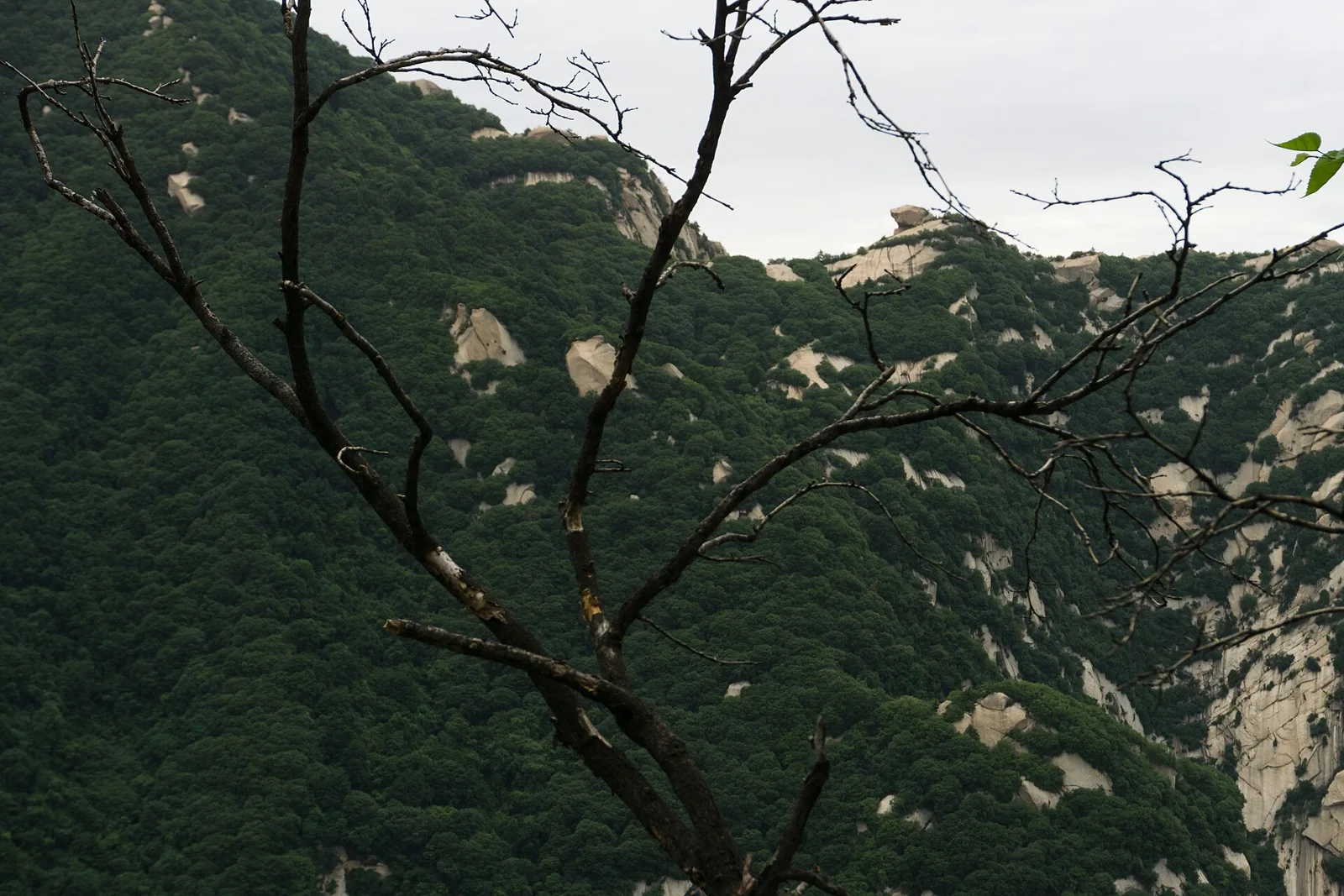
The mountain’s identity includes granite forms, named peaks, cliff inscriptions and Daoist places. The management profile associates West Peak’s “Lotus Peak” name with its rock form, describes North Peak as a viewpoint towards the main peaks, and identifies Yuquan Yuan and Zhenyue Palace among its Daoist sites. Use the relevant labels to connect a place name with the physical setting.
At a permitted viewpoint, first trace the ridge you have actually travelled, then identify the peak or valley described on the sign. This makes the scenery more understandable than collecting a photograph at every “Huashan sword debate” marker. If visibility is poor, do not substitute a confident identification for a hidden view.
For inscriptions, look at placement and scale as well as the characters. Why would a text be positioned on this rock or beside this route? A guide or translation can help, but an inscription’s dramatic lettering does not automatically date it to an ancient period. Ask the interpretation to distinguish original writing, later additions and modern commemorations.
The plank road’s fame should not erase the other landscape. If the special cliff projects are unavailable, a visit may still meet your interest in mountain forms and sacred geography. If your only purpose was a particular closed activity, changing the day or destination before committing to non-refundable transport may be the better decision.
When conditions change, protect the exit first
The West Peak operator has issued a dated weather shutdown notice for April 12–13, 2025, with refunds through the original sales channel. That demonstrates how a real temporary suspension is communicated; it is not evidence of an October 2026 shutdown or a blanket refund rule for every ticket in your itinerary.
If you learn of a cableway suspension before departure, check whether the whole route remains viable and which unused tickets can be changed or refunded. Do not automatically replace a cableway journey with hours of mountain walking. A different exit is a new terrain, time and transport decision.
If a descent service changes while you are on the mountain, follow staff directions promptly and ask about the current authorised exit. Do not cross a closed path because an old offline map shows a connection. Contact your onward transport provider if necessary; recovering a train fare is less important than completing the descent safely.
Wear shoes suitable for stepped and uneven surfaces, bring weather protection and keep a charged phone with your orders and saved route. Stop before fatigue makes decisions for you. Tell staff your location clearly if assistance is needed; the September notice publishes a scenic-area rescue number, **+86 913 436 5088**.
The useful commitment is a route you can finish, with the right tickets and an exit that works. Reconfirm the two cableway directions, the current cliff-project notice and the document procedure before leaving Xi’an; once on Huashan, let conditions decide how much extra you add.
Sources and editorial note
Individually read current indexed operator route description, management geographic account, 2026 scenic notices reproduced with explicit scenic-area attribution by ZAKER and media Weibo; September30 text also actually read in browser and preserved. Older product page contains pandemic terms and is excluded as current passport policy. Direct operator pages/browser and PDF fetch failures recorded without treating as closure. Original exit-first route reasoning. AI-assisted desk research, no field/transaction claim.
Published schedules are baselines subject to current notice. Foreign passport redemption, current complete cableway fare package, confirmed cliff reopening and fixed completion time are not asserted. Reproduced official notices are identified by their actual hosting source.
- https://www.sxtaihuaropeway.com/wzsy
- https://www.wangshangshaanxi.com/weinan/wnxxz/hsgwh/
- https://app3.myzaker.com/news/article.php?f=normal&pk=69a3faad1bc8e0401f000000
- https://weibo.com/2/detail/5348857110333145
- https://www.sxtaihuaropeway.com/newsinfo/8233916.html
- https://chinahuashan.com/front/reserveTicketsListView.htm?id=1&itemValue=ticket