

On this page
Start with a confirmed museum reservation
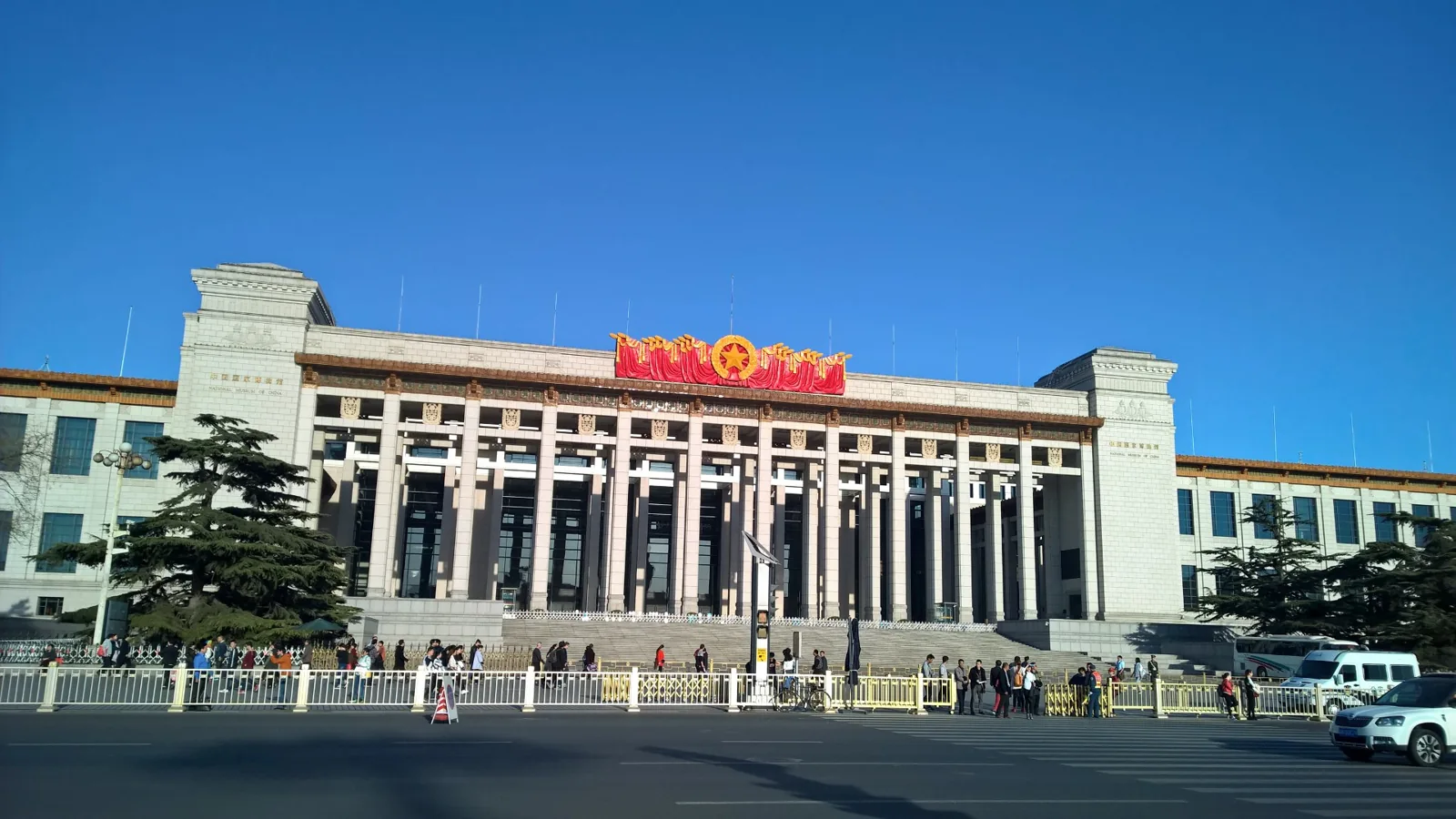
The National Museum of China is a useful first stop if you want a historical framework for the palaces, temples and archaeological sites elsewhere in your China journey. Its size makes selection essential: choose one historical sequence and one subject you care about, rather than treating every gallery as a compulsory stop.
Admission is free, but entry requires a successful real-name reservation. Use the official English reservation service. Beijing's Tian'anmen-area administration explicitly identifies this route as supporting email and passport numbers. During our page check, its sign-in link opened an official unified login screen with an email-address field and an email-verification-code field. We inspected the interface without creating an account or testing message delivery. That gives you an actionable starting point if you lack a mainland Chinese mobile number; it does not establish that a slot is available for your chosen day. Passport booking guidance.
Before opening the calendar, have each traveler's original passport details ready and decide who will manage the order. Compare the completed reservation with those documents before organizing your day around it. An account, a selected date, an email code and a saved visitor record are intermediate steps. Your evidence of admission is the successful reservation record with the correct visitors, date and entry period.
If the release sells out, protect your other plans: choose a different museum day or a different activity. Paying someone who promises to obtain a free slot does not remove the museum's document and reservation checks.
Release times, seasonal hours and the North Gate
The museum's reservation guidelines, effective August 1, 2025, specify the following:
| Detail | Standing rule |
|---|---|
| Booking window | Up to seven days ahead; daily release at 17:00 Beijing time |
| Standard opening | 09:00–17:00; last admission 16:00 |
| June 1–October 31 | Closes 17:30; last admission 16:30 |
| Regular closure | Monday, except Chinese national public holidays |
| Entry periods | 09:00–11:00, 11:00–13:30, 13:30–16:00; final period extends to 16:30 in the peak season |
| Admission proof | Original reserved ID and confirmation; North Gate visitor entrance within your reserved period |
| Party and frequency | Up to five people per order; one reservation per account per week; one per ID per day, four per month |
| Children | Ages 14 and under must be reserved by, and enter with, the accompanying adult |
| Cancellation | Deadline 15:00 on visit day; cancellations still consume reservation allowance; three accumulated no-shows trigger a 30-day restriction |
Swipe to see the full comparison
Late arrival, missing reservations and mismatched documents can prevent admission. Use these newer rules rather than older generic hours still embedded in booking instructions. Official visitor guidelines.
Make the time conversion before release day if you are still overseas: 17:00 here means China Standard Time, UTC+8. A browser or phone displaying your home time zone can otherwise leave you an hour or several hours late. Set a calendar reminder explicitly in Beijing time.
Treat the reserved period as an arrival commitment. In particular, an afternoon slot leaves less exhibition time than a morning slot. Our route suggestions below are estimates for viewing, not an assurance you can complete them after the final admission time. Holiday notices can change the standing schedule, so read the announcement for the exact dates of your trip before booking transport.
Getting to the correct side of the building
The museum is on the east side of Tian'anmen Square. Its visitor page identifies Line 1's Tian'anmen East station, exits C or D, as the metro approach. Navigate to the museum's **North Gate visitor entrance**, not simply to a pin somewhere on the museum facade. Follow the current pedestrian and security arrangements around the square; leave room in your schedule for the approach and inspection rather than equating a train's arrival time with museum entry. Museum directions.
For a taxi, save the Chinese destination and entrance together: 中国国家博物馆,北门预约观众入口. This is a communication aid, not a guarantee a vehicle can stop directly beside the entrance. If your reservation is close to its end, ask staff about the correct queue immediately instead of walking around the building looking for a quieter door.
Give the visit a question, not a checklist
For a first visit, **Ancient China** provides the broad historical spine. The museum describes eight chronological periods, from prehistory to the Ming and Qing dynasties, covering society, economy, politics and external relations. You can use that sequence to place other attractions into time: imperial architecture becomes easier to understand when it follows an encounter with earlier objects and institutions. Exhibition overview.
Our suggested viewing method is to carry one question through several periods: **who used this object, and what does its use tell me about their world?** Read the material, date, function and find location before deciding what a beautiful object means. A ritual vessel, a household utensil and a status ornament can all be visually striking while serving very different purposes.
Take fewer photographs and give a small number of objects more attention. For each, identify one detail you can explain afterward: a manufacturing technique, an inscription, evidence of exchange, or a difference between everyday use and ceremonial use. When a label leaves something unresolved, retain the question rather than turning a guess into a fact. This approach works even if you do not remember every dynasty name.
Choose a second exhibition by interest
| Interest | Useful next direction | A question to take into the gallery |
|---|---|---|
| Materials, ornaments and social status | Ancient Chinese Jade | Does the label describe something worn, a ritual implement or a symbol of rank? |
| Cooking, tea and everyday life | Ancient Chinese Food Culture | How did this object's shape help people prepare, serve or consume food? |
| A broad historical introduction | Spend longer in Ancient China | What changes between the early and later objects you selected? |
Swipe to see the full comparison
The jade exhibition traces changes between ornament, ritual use and later worldly uses. Its value is in comparing purpose and craft across time, rather than treating green color or apparent size as a measure of importance. When looking at a worked surface, ask what the maker needed to control: holes, edges, curves or the relationship between decoration and the object's function. Follow the label for cultural attribution; similar-looking forms need not come from the same place or period. Ancient Chinese Jade.
The food exhibition connects ingredients, tea and wine, utensils, kitchens and rituals. It can be a more approachable choice for a family than adding another long chronological sequence. Ask a child to choose an object they recognize as a container, then compare what the label says it held or did with their first guess. With adults, consider how serving and eating express social relationships as well as practical needs. These are our suggested observation exercises, not museum-led activities or promises of a particular object being on display. Ancient Chinese Food Culture.
A workable allocation of your time
For roughly two hours **inside**, choose a focused selection within Ancient China and allow time to orient yourself and rest. For three to four hours, add one subject gallery and a proper break. With young children or fatigue, reduce the exhibition list before reducing every stop to a hurried glance. These are editorial planning estimates; security, cloakroom use and travel are additional.
At the entrance, check the current information screen or ask the service desk for the day's gallery locations. Start with your highest-priority exhibition, because its opening status or your energy may change later. If that room is unavailable, switch to the second choice you already identified. That is more useful than spending the first half-hour wandering between floors with no alternative plan.
English interpretation: ask about the exhibition you chose
There are several different services, and an English museum website does not mean every live talk or audio file is in English.
The museum's audio rental page, dated in its URL to 2019 and still linked from the visitor page, lists English coverage for Ancient China and The Road of Rejuvenation. It posts RMB40 per device plus a RMB100 deposit and identifies a West Hall service desk. Treat these as published reference terms: ask staff to confirm the current collection point, fee, passport handling and available English content before renting. The same page distinguishes its full Chinese recording from the language coverage in the exhibition table; it does not promise a complete English narration of every gallery.
The current public guided-talk timetable is organized by week. Consult the week of your visit, rather than copying a 09:45 or 14:00 session from an old travel account. A session listed without a language commitment should not be assumed to be English. The museum also describes foreign-language interpretation, but that general service description does not establish an independently bookable session at your preferred time.
A paid commentary link is available on the official visitor page. Before paying for any commentary product, check the language, exhibition, meeting place, duration and whether a museum admission reservation is included or must already be held. The existence of a guide booking is insufficient evidence of your museum entry entitlement.
You can ask: “Is English audio available for Ancient China today, and does it cover the galleries currently open?” That is a more precise request than “Do you have an English guide?” If the answer is limited coverage, decide whether the available content still helps your chosen route before taking the device.
Luggage, rest and mobility services
The museum's September 22, 2026 practical visitor guide identifies large-luggage storage **outside the North Gate, on its east side**. Timed paid lockers are in the Art Corridor and third-floor public rest area. Free wheelchair and stroller loans are offered at the Art Corridor service counter; a mother-and-baby room is in the corridor's south section. It also identifies third-floor rest areas and drinking-water points, including corridors near the beginning and end of Ancient China.
A loan service is helpful, but it does not reserve a chair or establish every gallery's step-free route. If continuous wheelchair access matters, ask the counter to mark the accessible circulation for your selected rooms before starting. A companion can ask about equipment availability while another checks the exhibition information; avoid splitting a group so far that reconnecting consumes the visit.
For a railway or airport transfer afterward, keep a retrieval buffer for stored bags. Indoor viewing time is only one part of that day. If you can leave a suitcase at your accommodation, that removes a storage and collection step; if you cannot, use the museum's stated location rather than expecting every locker to fit it.
For photography, follow the signs in each exhibition. The museum permits photographs in displays of its own collection but prohibits flash, selfie sticks and tripods; borrowed works may carry different restrictions. Do not use a general permission from one room to override a sign in another. Photography instructions.
Combining the square without confusing entry permissions
The Tian'anmen-area administration's May 2025 guidance says a successful National Museum reservation can also be used for **morning or afternoon entry to Tian'anmen Square on that visit date**, without an extra square reservation. It does not give a blanket flag-raising exemption. If sunrise flag-raising is your goal, read the square's arrangements for that specific period instead of assuming an afternoon museum order covers it. A square reservation also does not replace the museum's required reservation. Administration's answer.
For a realistic combination, protect the museum's timed admission first and use the square around that commitment. Add the Forbidden City on another substantial block of time if you want more than a quick architectural look: it has its own booking requirements and a large route. Two confirmed reservations do not make two deep visits effortless in one day.
Check exhibition end dates before building the day around a name
An English “current exhibitions” list can lag behind a dated announcement. A concrete example at our October 2026 review was the Pompeii exhibition: the museum's September closing announcement specified **October 11, 2026** as its final day. It should not be treated as an available exhibition for a later visit merely because an English listing still appears.
For any temporary exhibition you specifically want, open its detail page, read both start and end dates, then look for a later extension, closure or rotation notice. Save the title and hall, not just a cropped promotional image. On arrival, check the day's information screen once more. For this museum, a reservation secures a museum entry opportunity under its rules; it does not establish that a particular borrowed work, temporary show or room will be available.
Sources and editorial note
Individually researched from effective August 2025 museum guidelines, September 2026 service and closing announcements, separate official exhibition descriptions, language-specific audio coverage and Tiananmen administration's passport guidance. Actual English email-code login screen inspected without sending a code or submitting personal data. AI-assisted desk research; no field visit or reservation success claimed.
No admission slot, email delivery, tour purchase or equipment availability was tested. Old audio rental terms are identified as reference terms requiring counter confirmation. Viewing durations and observation exercises are editorial suggestions.
- https://en.chnmuseum.cn/visit_692/
- https://pcticket.chnmuseum.cn/museum-en/
- https://english.beijing.gov.cn/12345hotline/faqs/all/202506/t20250619_4117006.html
- https://en.chnmuseum.cn/exhibition/current_exhibitions_648/201911/t20191127_174983.html
- https://en.chnmuseum.cn/exhibition/exhibition_series/special_exhibitions/201911/t20191120_171610.html
- https://en.chnmuseum.cn/exhibition/exhibition_series/special_exhibitions/202112/t20211227_253330.html
- https://en.chnmuseum.cn/visit_692/multi___media_guides/201911/t20191126_174583.html
- https://www.chnmuseum.cn/fw/wzgbjww/shjj/
- https://www.chnmuseum.cn/fw/wzgbjww/wsjj/
- https://www.chnmuseum.cn/zx/gbxw/202609/t20260923_282658.shtml
- https://en.chnmuseum.cn/visit_692/notice_to_visitors/201911/t20191126_174577.html
- https://www.chnmuseum.cn/zx/gbxw/202609/t20260923_282657.shtml