

On this page
Give the city a purpose beyond collecting courtyards
For a first substantial visit, choose **one permitted wall section, one remittance-house museum and one civic or religious interior**, then walk the public streets connecting them. That gives you three different questions: how a city is enclosed, how business operated across distance and how public institutions occupied urban space.
Pingyao, **平遥**, is in Shanxi. The UNESCO property includes the walled city and two separate temples: Shuanglin to the southwest and Zhenguo to the northeast. The same heritage listing does not place those temples inside the walls or inside the ordinary city pass.
Decide whether the trip centres on the city itself or also on those temples. Visiting all three components can be worthwhile, but it needs road transport and enough time to understand them. A list of attractions printed on a ticket is not a realistic walking itinerary.
The scenic-area operator’s website is pingyao888.cn. During this research its actual city-pass description loaded in the browser. Another familiar-looking domain, pygc.com, now presents information under a guesthouse identity; do not treat an old domain association as proof that its current terms come from the operator.
Three days does not mean three visits to each museum
The operator’s city-pass description states that it covers **city attractions, with Shuanglin and Zhenguo sold separately**. It gives **three days from the selected travel date**, limits **each attraction to one visit**, requires personal real-name use and says a used ticket is non-refundable. It describes QR-code or identity-card validation without paper collection. Its wall access list names North Gate, Lower West Gate and Great South Gate as entrances; Yunlu Old Street appears among exits, not entrances. The page lists **0354-5690000** and **0354-5674110** for enquiries.
Use those distinctions when allocating time. If you intend to spend longer at a museum tomorrow, do not consume its single entry today just to see the doorway. If the product is dated October 14, its stated three-day window is not a promise of 72 hours starting whenever you eventually validate it. Confirm the expiry shown for your actual order.
For a foreign passport, the page’s general QR/ID-card wording does not establish the exact passport verification process. Ask which booking route accepts your document and whether staff verification is needed at the chosen entrance. This guide did not enter traveller identity details or buy a pass.
A May 19, 2026 newspaper report gives CNY125 as the full city-pass reference, CNY35 for Shuanglin and CNY25 for Zhenguo while describing a **May 19-only** promotion. It is a dated price reference, not a verified October order; its event reductions are over. Get the amount and conditions of the product for your date before payment.
Separate the public street route from the paid wall or museum entrance. At each checkpoint, establish what is being validated. An accommodation booking, guide fee, sightseeing vehicle and a city pass represent different services; ask for an itemised explanation if a seller bundles them.
On the wall, compare enclosure with the street network
Choose the currently permitted ascent nearest the part of the city you want to explore. Confirm which descent points are open before assuming you can complete a circuit. If your pass limits the wall to one admission, a premature exit can affect a later plan to return for different light.
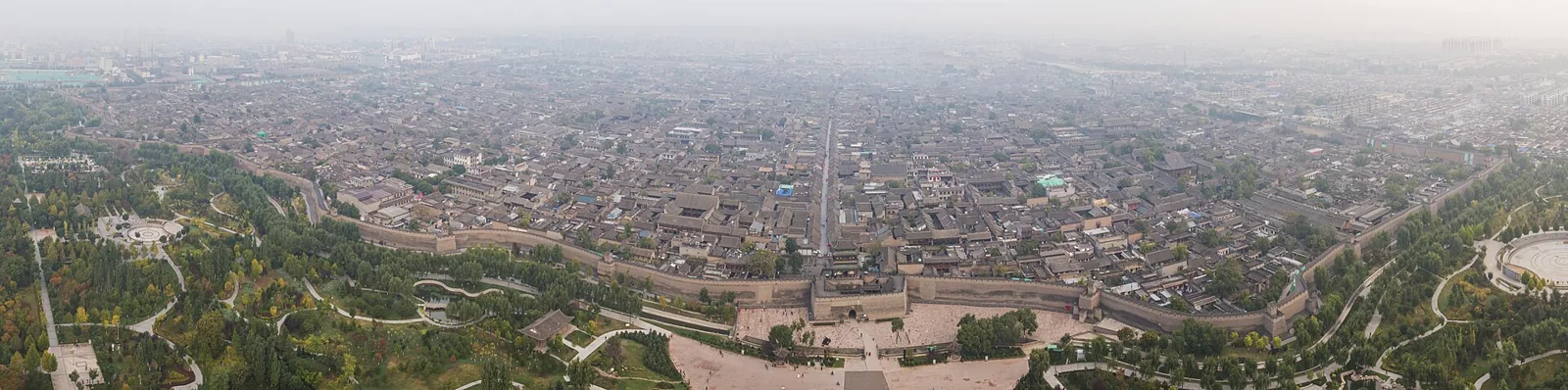
Once on the visitor route, compare the inner city edge with the outer side. Look for streets meeting a gate, the different directions of roof ridges and where larger compounds interrupt the smaller roof pattern. A wall walk offers an overview of urban relationships that is difficult to obtain from a narrow street below.
Then examine a gate from a safe permitted position: where does the through-route turn, and how does it connect to the street beyond? A gateway is a controlled passage through an enclosure, not only a tower placed for photographs. Use the site’s label or guide for the particular gate’s history rather than dating all visible bricks to one construction year.
UNESCO’s account stresses the city’s development across centuries and its role as a financial centre in the nineteenth and early twentieth centuries. A claim that every surface is untouched since an ancient foundation would contradict that evolving history.
A June 2026 newspaper report carried on a government site describes protective repairs to courtyards and monitoring of the wall and important buildings, alongside upgraded underground services. Preservation involves ongoing work. Neither a historic-looking finish nor a maintenance instrument should be interpreted as evidence of an immediate safety condition by a visitor.
Walk the authorised section and leave barriers, drainage edges and working areas alone. If you need a shorter route, choose its descent before passing the decision point; do not improvise access across a closed stair.
At Rishengchang, ask what a piece of paper made possible
A **piaohao, 票号**, was a remittance institution. **Rishengchang, 日升昌**, gives a specific way to investigate the problem: how could a merchant settle at another location without carrying the whole payment there as physical silver?
The National Administration of State Secrets’ 2020 historical explanation describes bills used for settlement between locations and protection through recognised handwriting, paper features and changing coded characters for date and amount. It explains controlled issue, checking, cancellation after payment and records. This is a historical account, not a guarantee that a particular original bill is on display today or a claim that one code alone solved every business risk.
Here is an **illustrative transaction**, not a reconstruction of a named customer’s account. A merchant needs value available at a distant branch. The issuing office accepts the transaction and produces a recognised claim; the receiving office must decide whether that claim is genuine and unpaid. Ask the exhibit to explain who owes whom and which stage creates the obligation. The paper carries a promise within an organisation, not silver hidden inside the page.
Now consider the failure cases. What prevents someone changing the amount? How does the receiving office recognise an authorised writer? How can a paid bill be prevented from being presented again? Those questions make the controls understandable without turning the visit into memorising a cipher rhyme.
When an exhibit shows a bill, identify whether it is an original, facsimile or teaching panel. Locate whatever its interpretation identifies as date, amount, issuer and validation. Do not reverse-engineer an entire payment from marks you cannot read, or assume that every remittance institution used the same substitution sequence.
A recreated counter can help illustrate a workflow, but a staged scene is not documentary proof of that exact historical transaction. Keep the institution’s account, surviving evidence and your imagined example separate.
Compare a business compound with a civic interior
After a remittance museum, choose a different type of public interior, such as the **county government compound, 县衙**, or an open temple included in your product. Use the current entrance map and interpretation for access; do not rely on a copied performance timetable.
In the business compound, notice the relation between public-facing rooms and the route farther inside. Where does a visitor wait or approach a counter? Where does access narrow? In the civic compound, compare the same questions: does the route align through courts toward an official hall, and what does that sequence communicate about authority?
These are comparisons to make from the visitor route, not claims that all historic functions survive intact in every room. A courtyard currently used for interpretation may have a different role from the original working space. Let the label establish that distinction.
If a magistrate performance is offered, determine its actual time and whether it is included. Watch it as an interpretation of a historical institution, not an authentic proceeding with legal authority. If no performance fits, the building’s sequence, entrance relationships and interpretation still justify the visit.
For a religious interior, change the question again. Identify the focus of the room and how the permitted route relates to it. A hall for ritual is not simply a more decorated version of a commercial reception room. Do not turn several distinct institutions into a list of interchangeable “ancient houses.”
On the walk between them, observe where a shopfront opens toward the street and where a more private courtyard is concealed behind an entrance. Commercial activity is part of the city’s history and present. The existence of a modern shop does not date the building, and an old façade does not certify a modern product’s origin or workmanship.
The two temples need a decision about actual access
Shuanglin and Zhenguo offer different reasons to leave the walled city. UNESCO highlights Shuanglin’s Ming- and Qing-period painted sculpture and Zhenguo’s early timber Wanfo Hall. Use that distinction to choose: sculptural groups and their placement, or the relationship between an early hall’s structure and its interior.
There is a material access qualification. A **July 9, 2026 report by Shanxi News reporter Zhang Chenyang** attributes a July 8 operator announcement to conservation work and **partial closure** of **Shuanglin’s Thousand Buddha Hall, 千佛殿**, and **Zhenguo’s Wanfo Hall, 万佛殿**, starting in July. It gives planned work periods ending in September 2028 and September 2027 respectively. This is a reported programme, not today’s hall-by-hall access inspection or a guaranteed completion date.
Before arranging a dedicated trip for a specific statue or hall, ask what can actually be seen from the permitted visitor route now. “The temple is open” does not answer whether the particular interior is accessible. Conversely, a partially closed hall is not evidence that the whole temple has shut.
If the desired sculpture is not visible, decide whether other open halls justify the trip. Do not promise yourself a famous close-up based on an old photograph. A digital display or reproduction may provide interpretation, but describe it as such rather than as access to the original.
Where sculpture is visible, compare posture, the direction of the face and the relation between the main figure and surrounding figures. Then use the label to identify the subject, date and material. Visual movement is a useful observation; it cannot by itself establish a deity’s name or a work’s age.
At Zhenguo, if Wanfo Hall can be viewed only from outside, look at the roof-to-support relationship from the authorised position. If the interior is unavailable, say that limit plainly when describing the visit. Conservation work is a reason to alter the plan, not to seek a gap in a barrier.
A railway station called “Ancient City” is not a city gate
**Pingyaogucheng station, 平遥古城站**, and **Pingyao station, 平遥站**, are separate entries in the official 12306 station directory, with different station codes. Check the exact one on your 12306 booking. Do not send a driver only the English word “Pingyao” and assume the pickup is unambiguous.
For the onward connection, provide the station name, train arrival and the gate or lodging pickup point. Ask whether the vehicle can reach the guesthouse itself or whether the final stretch is on foot or another authorised service. A room address within the walls does not guarantee a taxi can drive to its door.
On departure, keep the rail station separate from the city entrance in your map. Include the walk out, pickup wait and road journey before the railway’s own boarding requirements. A close-looking name on a map is not evidence that two places are within a short walk.
If visiting the temples between train journeys, verify each leg and where luggage will be held. A city-centre driver arrangement should explicitly include waiting or a return pickup rather than leaving that assumption until you are outside a temple.
Overnight: ask about the actual room, not only its courtyard photograph
A stay within the city can give more time to revisit streets and allow the paid interiors to be spread over the pass window. Confirm the window against the chosen dates first; a later check-in does not shift the ticket’s selected start date.
For a room in a converted compound, ask whether it faces a busy street or an interior court, whether there are steps to reach it, and where the bathroom is located. Heating or cooling, an en-suite bathroom and a quiet night should be confirmed for the actual room, not inferred from a photograph of a beautiful gate.
If you want interpretation, book a guide for a clear purpose: one remittance-house workflow and one contrasting compound, for example. Ask about language, duration, included entrances and what happens if a chosen hall is unavailable. A long attraction list alone does not describe the service you need.
A street evening, performance and museum visit have different clocks and rights. The pass page contains a Spring Festival light-show notice explicitly limited to February 17–23; it is not an October schedule. Confirm any event’s current venue, time, admission and the route back to your room. Public access through one city gate does not establish access through every gate at every hour.
One day or two: use the extra time for a different kind of evidence
For a full day, keep the wall, remittance museum and contrasting compound as the core, with meals and the street connections between them. Reduce the number of interiors before reducing time to read an exhibit. If a late arrival leaves only an evening, use it to orient yourself and plan the paid interiors during their actual operating hours.
For two days, divide the city interiors and consider **one** external temple after checking the affected hall’s access. Adding both temples simply because they share an inscription can make the second day mainly a road itinerary. Choose the one whose available material answers the question you care about.
Before the pass window ends, ask what you have understood rather than how many validations you have used. You should be able to explain why paper settlement needed controls, how a compound’s route expresses its function and how the walled city relates to the streets inside it. The temples add another kind of material evidence when their actual access supports your purpose.
Sources and editorial note
Independently authored urban enclosure/businessworkflow/civiccomparison guide. Actual officialSPAroot and id41pass fullyloaded and read, noorder. UNESCO812, NationalStateSecretsAdministrationhistoricalcontrolaccount2020, namedreportersJune2026courtyardmaintenance/July2026twohallworks and May19specificpromotion researched. Stationreferencespairedwith12306notcurrentrailfare. Nofieldvisit or originaldocumentdisplayguarantee.
CurrentOctoberpaidfare/order, passportverification, exacthallvisibility and specificroomaccessnottested. pygc.comguesthousecontentnotoperator. Illustrativeremittanceexamplemarkednotrealcustomer. Accounts/originals/reconstructionseparated. Stationautocompleteattemptdidnotconfirmactualavailability;noinferenceoftrainpurchase.
- https://pingyao888.cn/
- https://pingyao888.cn/#/newsDetails?id=41
- https://whc.unesco.org/en/list/812/
- https://www.gjbmj.gov.cn/n1/2020/0911/c413725-31858628.html
- https://www.jcgov.gov.cn/dtxx/tpxw/202606/t20260613_2360414.shtml
- https://finance.sina.com.cn/wm/2026-07-09/doc-inihfyen7330900.shtml
- https://gd.huaxia.com/c/2026/05/19/2150377.shtml
- https://kyfw.12306.cn/index/script/core/common/station_name_new.js
- https://kyfw.12306.cn/index