

On this page
Reserve the museum first, then give its objects enough time
Treat Sanxingdui as a substantial museum visit in Guanghan, with a separately planned journey from Chengdu. Confirm each traveller's admission date and session before fixing a tight road transfer or rail connection. A three-hour gallery visit is a reasonable editorial starting point for selected objects, interpretation and pauses; add the journey, ticket verification and any other museum buildings separately.
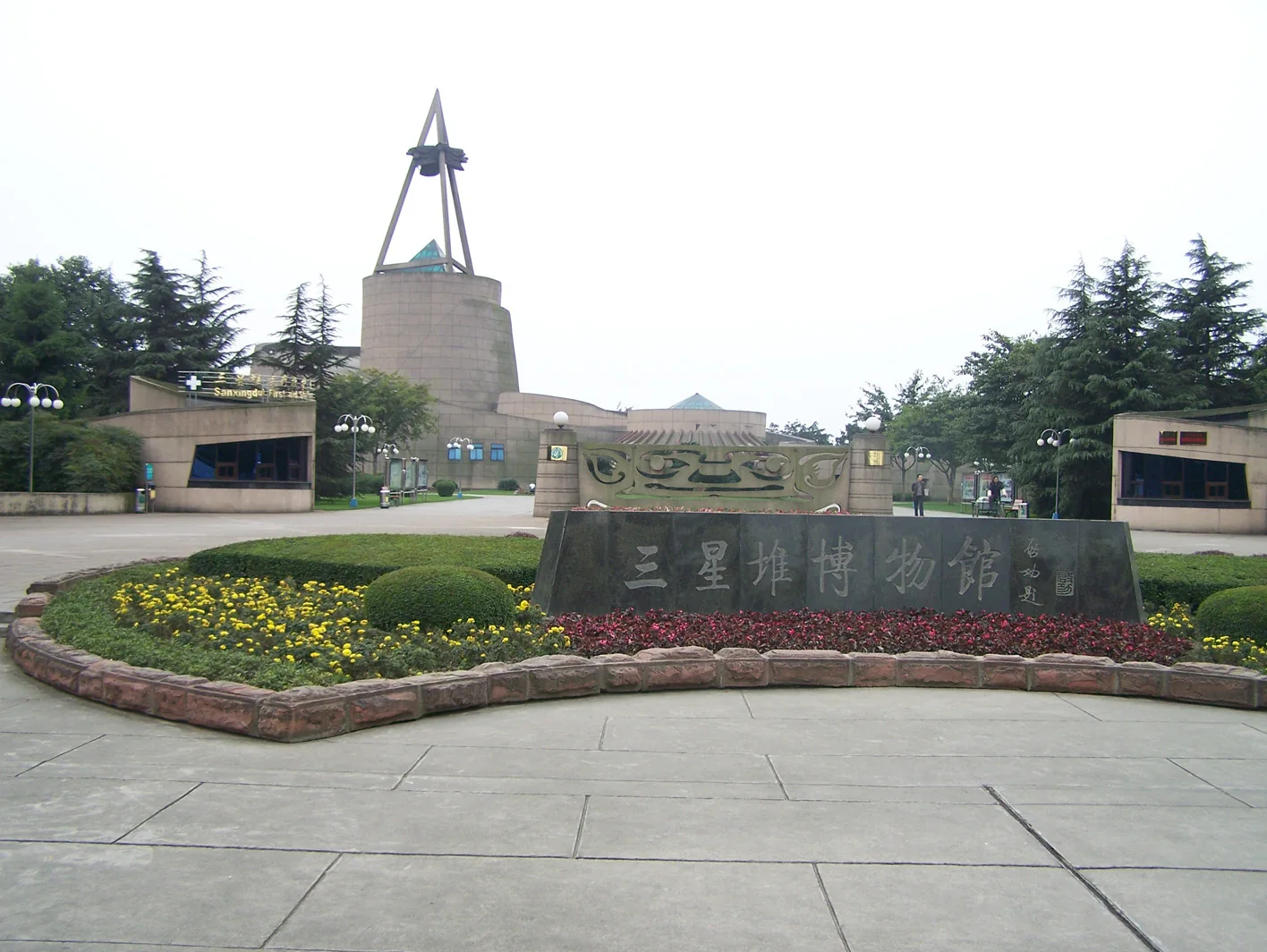
The current principal exhibition building opened in 2023. Do not build your route from an older photograph of the museum exterior or an old “bronze hall first” itinerary. On arrival, obtain the current floor plan and choose a few object groups to examine rather than following a checklist of every famous item.
A useful thread through the visit is **how objects were made, assembled, broken and reconstructed**. Large faces, thin gold surfaces and tall tree forms pose different practical questions. This approach makes the archaeology tangible even if you do not already know ancient Shu history or read Chinese. It also gives you something meaningful to look for beyond an object's size or popularity.
Foreign passport booking: use the museum's channel and keep the credential step
The museum's published visitor guide identifies an inbound-visitor reservation channel, with mainland residents directed to the official WeChat mini program. It also warns that third parties are not authorised to sell its admission and interpretation tickets. Begin through the museum's own website, official WeChat or named official channel, rather than assuming a search result selling a “Sanxingdui experience” is the museum's checkout.
There is documented support for overseas credentials. A June 18, 2025 report based on visits and interviews describes a dedicated inbound ticket pool and English purchase/payment pages accepting valid passports and relevant Hong Kong, Macao and Taiwan documents. That establishes a legitimate route to investigate; it does not guarantee today's inventory, successful payment with every overseas card or the current layout of the form.
During this page review, the official web booking entrance returned an access-error page, so we could not verify a completed booking flow. If that happens to you, stop that attempt and use the museum's own WeChat channel or contact the ticket service. Paying a reseller more does not by itself resolve a passport-verification problem.
Work through the credential chain deliberately:
- Choose the inbound channel appropriate to your actual document, then select the visit date and offered session.
- Enter every visitor's name and document details from the originals. A group organiser's details do not replace the other travellers' credentials.
- Check whether the order is confirmed, awaiting payment or only a request. Keep the order and its collection instructions.
- Bring the original document. The published guide directs foreign visitors with a successful reservation to the ticket centre for exchange; follow any more recent instructions attached to your confirmed order.
- Retain the resulting entry credential until you have finished the visit. Resolve re-entry or additional-building rights before leaving a checked area.
For enquiries, the guide lists **+86 838 553 3333**. Give your date, nationality/document type and exact error or order status. Ask whether your particular booking needs exchange and where the counter is. Do not assume an email containing a payment receipt is the final ticket.
The guide lists ordinary admission at **CNY 72** and a **CNY 36** eligible-student category. These are published tariff references, not a completed foreign-passport checkout. Confirm the applicable category and final charge; a foreign student document does not automatically establish a concession. A guide, rental device, transfer or immersive programme may be a separate purchase.
Guanghan North and Sanxingdui stations are different arrival choices
The museum guide describes an intercity train to **Guanghan North**, followed by a local road connection. A Guanghan government report about the November 2023 railway opening separately identifies **Sanxingdui station**, around five kilometres from the archaeological site. Neither station is the museum entrance, and their similar relevance does not make them interchangeable.
| Station name to search | What you still need to arrange | Common planning error |
|---|---|---|
| Guanghan North · 广汉北 | A road connection to the museum and back to that station | Choosing a return train from another station because both serve Guanghan |
| Sanxingdui · 三星堆 | A road connection, with the current route and service checked | Assuming the name means you step off the platform into the galleries |
Swipe to see the full comparison
Compare actual trains for your date using the full station names at both ends. Allow time for the local transfer, queues and boarding deadline on the return. A headline journey time for one promotional train is not a timetable for every train you could book.
If you favour a direct coach from Chengdu, establish the current operator, exact boarding point, return time and inclusions. An older announcement that a service was launched cannot establish its October 2026 fare or frequency. Ask whether the price covers only transport, or whether somebody will attempt admission booking separately. A seat confirmation is not a museum reservation.
With a private transfer, agree that the destination is the museum's public visitor entrance and write down the collection point. Ask how waiting time is charged and what happens if your admission session changes. Avoid a return arrangement so tight that a queue at a single large bronze determines whether you miss the vehicle.
Read the bronzes through joins, supports and missing parts
You can make a focused gallery circuit by choosing a mask, the gold staff and the large tree, where currently displayed. Find their labels and archaeological context before comparing them. The following questions are viewing tools, not a promise that every named object will be exhibited or reachable from every side on your date.
A mask's face is only the beginning
Start with overall proportions: the width of the face, projection of the eyes and ears, and how the front changes when viewed obliquely from a permitted position. Then look for holes, attachment points or different cast components described on the label. These details turn an expressive face into an object which had to be made and fixed in place.
In its interpretation of two 2021 Pit 3 masks, Shanghai University Museum describes separate casting of components and perforations potentially associated with assembly or attachment. The pair differs in scale and outline. Its exhibition was a past loan display, not today's Guanghan inventory, but the explanations provide useful questions to bring to comparable objects.
Ask what is visibly present and what remains a proposed function. Does a hole establish how the object was attached, or merely show that attachment was possible? Does a monumental face appear designed to be seen from below? These questions distinguish evidence from an attractive story without requiring you to reach a definitive answer yourself.
The Hong Kong Palace Museum's record of the large 2021 Pit 3 mask describes a 131-centimetre width, separately cast parts and a possible wooden-post mounting inferred from shape and holes. Seeing a face of that scale should encourage you to think about its original setting, not assume it was simply worn like a modern costume mask.
The gold staff has a surface and a lost core
The Sanxingdui Museum's own collection introduction explains that the gold staff was formed from hammered gold around a wooden core; the wood had carbonised, leaving gold skin and traces of the core. Its decorated end combines human, bird, fish and arrow-like imagery.
First find where the decoration is concentrated rather than expecting every part to be equally ornamented. Then compare the visual role of the gold surface with the mass of the bronzes. A bright material and a substantial supporting material did different jobs in the original object. The surviving object is therefore not necessarily the whole original construction.
Read the interpretation for the motifs, but keep physical description separate from meaning. You can recognise repeated figures or relationships among forms without claiming to know exactly what each sign encoded. Ask a guide which interpretations are proposed and which depend on direct material or archaeological evidence.
The bronze tree is a conservation achievement as well as an ancient work
Step back enough to understand the tree's overall structure before approaching for details. Trace the relationship between trunk, branching levels, birds and the dragon where these are visible. Then read about its condition when excavated and the work needed to support the reconstructed form.
A 2004 conservation paper published by the Sichuan archaeology institute describes No.1 tree emerging from Pit 2 in heavily damaged fragments. Conservators had to distinguish distortion from intentional curves, match components and plan structural support; trial assembly was part of that process. The standing museum presentation should not be mistaken for an intact tree simply lifted from the ground.
For a visitor, this changes the question from “How tall is it?” to “How did people establish this form?” Look for repair diagrams, excavation photographs and explanations of joins. Do not assume every visible line is an ancient break, every support is original, or that missing elements can be filled in with certainty.
If time is short, choose this object as your longer stop and make the others brief comparisons. Studying one reconstruction carefully can give you a stronger understanding of the museum than rushing between several crowds for a front-facing photograph.
New finds can belong to larger objects: let the label carry the uncertainty
The Hong Kong Palace Museum's past exhibition account describes how three-dimensional matching connected a large bronze beast from Pit 8 with a kneeling figure carrying a vessel from Pit 3, and a vessel-rim fragment from the earlier Pit 2 excavation. Those cross-pit relationships are particularly useful for understanding why archaeological knowledge keeps developing.
When a current display explains a composite object, locate the diagram or model and ask what material supports the proposed fit. An object discovered separately is not necessarily an independent sculpture. Conversely, a reconstruction or digital joining does not mean every ancient element is now physically assembled in one gallery case.
Use these records as interpretation, not a checklist of today's exhibits. The Hong Kong exhibition ran from September 2023 to January 2024; its loan objects, floor plan and opening hours belong to that event. They cannot establish a current Guanghan display or the availability of a particular piece. Ask museum staff where the current presentation of a relevant find can be seen.
Interpretation is worth choosing before you reach the busiest object
The June 2025 reporting describes foreign-language guiding and multilingual WeChat interpretation, alongside bilingual rental devices. Check what is currently offered in your language, its cost, route, group size and duration. Historical service provision does not reserve a guide for your chosen session.
Decide what assistance you want. An audio resource can suit independent pacing; a knowledgeable guide can help explain archaeological context and distinguish physical evidence from proposed ritual meaning. A transfer host who only delivers you to the gate may provide neither. Agree the meeting point and service rights separately from admission.
Give an interpreter a few questions: how the tree was reconstructed, how masks were mounted, and what the staff's vanished core changes about our understanding of it. Those are concrete enough to reveal the value of the explanation. They also help a family stay focused without turning the visit into a continuous lecture.
The museum guide lists convenience equipment for loan at visitor-service points. Ask about availability, route accessibility and return location before borrowing. If someone has limited stamina, a selected-object route with seating and a clear exit can be more useful than trying to cover every available building.
Do not build an evening itinerary from the website's largest time alone
The published guide shows a **08:30–20:00 exhibition-hall range with last check at 18:00**, but its accompanying text ties extended opening to specified holidays and vacation periods. It lists the restoration building separately at **09:00–18:00**. That mixed presentation does not support a guarantee that an ordinary October weekday offers the longest evening hours or that every building follows them.
Verify the actual session sold for your visit date, the latest dated opening notice and the last admission for each intended building. Ask explicitly about any extension: when its ticket starts admitting visitors and which spaces remain accessible. A regular daytime booking does not establish a separate late-session entitlement merely because the homepage shows 20:00.
The guide's published release arrangement is **20:00, up to five days ahead**, with holiday batches handled separately. Recheck your date's notice rather than turning that baseline into a permanent promise of stock. Have the passport details ready, but remember that starting an order is not the same as completing one.
If you cannot obtain admission, keep the day flexible. The museum guide says the excavation site itself is not open for visitor entry; an archaeological-site name on a map is not an alternate gate into the working excavation. Nor should you substitute a same-day visit to Jinsha Site Museum without checking its closure programme.
For an existing order you cannot use, check the applicable cancellation deadline and channel in that order and contact the museum if it is unclear. Do not assume a transport seller can cancel an admission order made elsewhere. Preserve the booking status and request time before purchasing any replacement.
Sources and editorial note
Independent published primary visitor-guide indexed full text read; direct official homepage blank and booking WAF blocked, not bypassed. Primary 2025 reporter interview supports inbound passport channels and interpretation; Guanghan 2023 rail opening distinguishes stations. Full 2004 Sichuan conservation paper and hosting museums HK Palace and Shanghai University actual artifact records read. Old loan schedules not present inventory. Original assembly and material observing questions, no copied itinerary. AI-assisted desk research; no visit or checkout claimed.
Official checkout access error prevents current end-to-end transaction verification. No current foreign student concession, live station bus timetable, restoration building extension or every featured object's presence guaranteed. Current label controls interpretation; museum archives provide evidence, not contemporary exhibit inventory.
- https://www.sxd.cn/Guide?type=3
- https://www.sxd.cn/web/
- https://paper.people.com.cn/rmrb/pc/content/202506/18/content_30080208.html
- https://www.guanghan.gov.cn/gk/xxgk/ahxw/bmgz/1656994.htm
- https://www.sckg.com/uploads/soft/20230728/2-230HQ51110130.pdf
- https://www.hkpm.org.hk/sc/exhibition/gazing-at-sanxingdui-new-archaeological-discoveries-in-sichuan
- https://museum.shu.edu.cn/info/1030/3976.htm