

On this page
Go to the East building for the broad ancient-art collection
If your reason for visiting Shanghai Museum is Chinese bronzes, ceramics, jade, sculpture or painting, start by checking **Shanghai Museum East in Pudong**, rather than automatically heading to the older museum on People's Square. The museum's current gallery directory separates the two buildings. The East building contains the broad sequence of ancient-art galleries; the People's Square list includes Ming and Qing furniture and minority nationalities' art, alongside its separate exhibitions. A museum name alone is insufficient for choosing the right building. Official gallery directory.
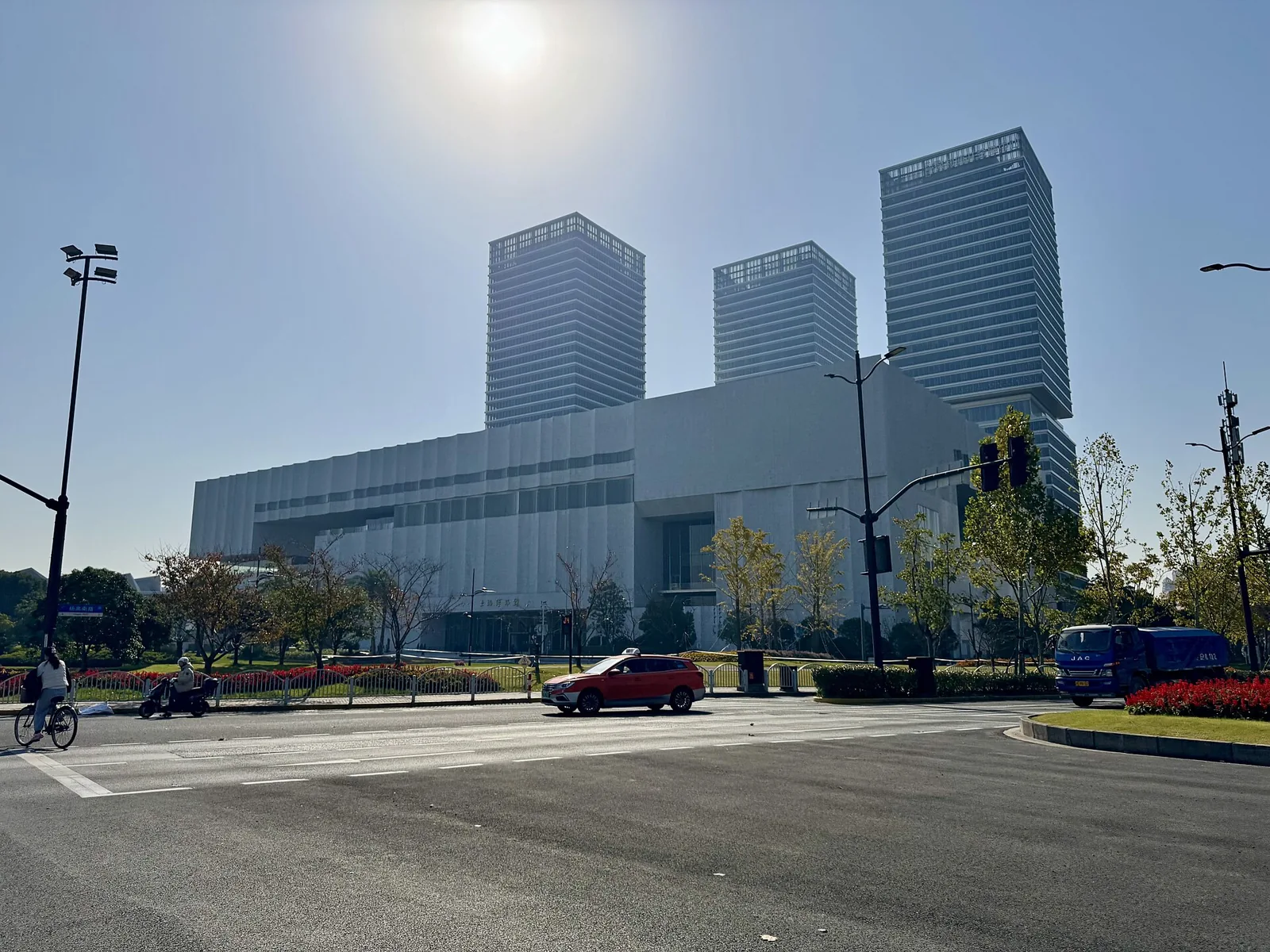
The East museum is at **1952 Century Avenue, 上海博物馆东馆**. For a taxi or map search, save that name with the address. If an exhibition is the main reason for your visit, save its building and hall as well. A display advertised by “Shanghai Museum” may be across the river from the collection you expected.
The official website moved to **www.shanghaimuseum.cn from September 1, 2026**, according to its homepage announcement. Use the museum's current links rather than assuming an old booking screenshot still describes the active process. A domain change does not itself change an exhibition's date, price or admission rule. Museum homepage.
Individual entry is simpler than many old guides suggest
The maintained East visitor page, checked in the browser, says individual visitors **do not need a general advance reservation**. Bring your original valid ID, including your passport, for security and staff verification at the **B1 East Gate near Dingxiang Road**. Standard hours are **10:00–18:00**, last entry **17:00**; Tuesday is the regular closure except national holidays.
**The Curio-City and Digital Gallery still require Special Reservation.** Paid exhibitions have their own ticket terms. Walk-in museum admission does not secure either an interactive session or a paid show.
Plan around the individual entrance rather than copying the reserved-group entrance from another visitor's instructions. If a machine does not read your passport, show the original document to the admission staff and ask about verification; do not substitute a domestic ID number or assume a screenshot of your passport is equivalent.
If you have only a few hours in Shanghai, this simpler entry arrangement is useful. You can choose a focused collection visit without arranging a paid booking intermediary. Keep the interactive areas optional unless their actual reservation is confirmed. For an organized group, consult the separate group rules instead of treating multiple individual visitors as proof that a tour group can enter without its required arrangements.
Choose a material, then choose what you want to understand
The East museum's collection can support a full day, but a shorter visit benefits from a narrower purpose. We suggest **bronze plus ceramics** for a broad introduction, or **one material gallery plus Archaeology** if you want the visit to connect directly to Shanghai. A specialist interest in jade, painting or calligraphy can replace one of those choices.
Bronze: look beyond the animal-mask decoration
The Bronze Gallery's own introduction explains the relationship between vessels, ritual, rank and power. Its historical sequence includes changes from wine-centered to food-centered ritual assemblages, alongside developments in casting and decoration. Its highlights include the **Da Ke Ding**, identified as a bronze food vessel, and bells associated with the Marquis Su of Jin.
Use that context to look for more than elaborate surface patterns. Our suggested first comparison is between a food vessel and a wine vessel: read the label's function before comparing handles, supports, openings and overall form. Then choose an inscription-bearing object and ask what its recorded information adds to the shape you can see. Decoration explains part of the object's visual appeal; use and inscription can explain why it mattered.
For technical interest, follow the gallery's section on production methods and compare the explanation with an actual object. Avoid assuming every complex form was made by the same casting process. Nor should green patina be taken as its original finished color. Ask which evidence the label provides for date and technique, and retain uncertainty where it provides none. These are suggested observation questions, not a claim we personally inspected those works on a field visit.
Ceramics: shape, glaze and intended use
The Ceramics Gallery covers pottery and porcelain across a long sequence, including Tang polychrome glazed pottery, Song celadon, later imperial porcelains and wares from other kilns. The distinction matters: “Chinese ceramics” is broader than blue-and-white porcelain.
Pick three objects with different functions instead of trying to memorize every ware name. A vessel for pouring, a bowl for drinking and a figurine make useful contrasting questions. How would a hand hold it? Which parts of the surface are decorated? Does the label identify a practical, ceremonial or funerary context? A tomb figure should not automatically be described as an object used at an ordinary dinner table.
Compare a restrained glazed surface with one that carries painted decoration, using the labels to establish material and technique. The apparent simplicity of a piece does not prove it was easier to make. A small number of such comparisons can give the visit a clear result: you leave understanding some differences in ceramic purpose and production, rather than only remembering that many beautiful objects were displayed.
Archaeology: make Shanghai more than a skyline
The Archaeology Gallery asks how Shanghai developed and organizes its finds around prehistory, the ancient port and the prospering metropolis. It is a useful choice if you have spent the rest of your trip looking at the Bund and Pudong's towers.
Take a local question into this gallery: **what evidence shows how people lived here before the modern skyline?** Note the find location and archaeological context along with the object type. An excavated everyday object may explain a settlement or relationship that a skyline photograph cannot. Compare evidence from different phases without assuming the modern city's identity existed unchanged throughout them.
For a traveler with limited time, this local focus is a reason to choose Archaeology over adding a third national material survey. For someone traveling onward to archaeological sites elsewhere in China, the material galleries may be the more useful preparation. The right choice depends on what you want the museum to clarify.
Compare English audio with a live bronze-gallery tour
The visitor page posts **English audio rental at RMB40 per set**, for permanent exhibitions, with no deposit; special-exhibition devices are charged separately. This is a different product from a live guide. Ask the counter whether its available English content covers the rooms you have chosen and where to return the set. Audio details.
The separate official English guiding page is more specific than a generic “English tours from RMB300” statement:
| Published service | Scope and terms on the page |
|---|---|
| English group tour | Ancient Chinese Bronze Gallery; 90 minutes; listed fee RMB300; group requires at least ten people and follows fixed schedules |
| English customized tour, 1–10 people | Bronze Gallery; one to two hours; RMB1,500 per hour |
| English customized tour, 11–30 people | Bronze Gallery; one to two hours; RMB3,000 per hour |
Swipe to see the full comparison
The page does not justify treating the group-tour RMB300 as a private full-museum tour price. Ask the desk how that amount is charged, whether the session will form and which dates and languages are available. For a customized party of up to ten at the posted rate, a one-hour booking is RMB1,500 and two hours is RMB3,000 before any additional terms; the hourly unit makes a substantial difference to your budget.
The museum identifies both WeChat booking and **in-person consultation and purchase at the East guided-tour service desk**. Its online guiding process requires a phone number and valid identity information. If an overseas number fails, use the named desk to ask about options rather than entering false account details. A published offline option does not guarantee immediate guide availability.
Choose the audio if you want to move independently between material galleries. Consider the live service when bronze is the reason for your visit and you value a focused discussion. The guiding page says the service does not include a museum entrance ticket; for a large organized party, the separate museum group admission must still be arranged. We checked the published terms, not a completed paid booking.
Families: an interactive reservation is a different commitment
The Curio-City occupies the third and fourth floors and is aimed at ages **6–18 and families with children**. It uses museum-career activities, such as archaeology, research, conservation and exhibition interpretation, to explore what a museum does behind the scenes. It is more specific than a generic playroom.
If this is your child's main reason for coming, secure the special reservation before promising the experience. Ask about the booked session's language and age arrangements; an English description of the space does not establish English facilitation for every activity. Do not confuse the general walk-in rule with permission to enter a session that is full.
Without an interactive booking, a shorter collection visit can still have a purpose. Our suggested family activity is to choose one vessel and work out its function from the label and shape. Let a child make an initial guess, then identify what changed after reading the interpretation. End that exercise when attention drops rather than adding several floors to make the visit look comprehensive. This is a parent-led suggestion, not a museum program or a substitute ticket.
Arrival, rests and a route you can finish
The museum's transit directions list these approaches:
| Metro line | Station and exit |
|---|---|
| 2 | Shanghai Science and Technology Museum, exit 8 |
| 4 | Xiangcheng Road, exit 2 |
| 6 | Pudian Road, exit 1 |
Swipe to see the full comparison
Aim for the actual B1 visitor entrance after the station, not just the building's address. Check the route that best fits your accommodation rather than taking Line 2 simply because it is familiar. Museum transit directions.
For approximately **two hours inside**, prioritize one gallery and a selection from a second. For **three to four hours**, include a rest and one further subject or the local archaeological context. These are our viewing estimates, with security, audio rental and transport added separately. Late admission leaves much less time; treat 17:00 as an entry cutoff, not the beginning of a leisurely half-day itinerary.
The service page lists accessible lifts, baby care, cloakroom service and wheelchair/stroller loans. Loans require valid ID or an RMB300 deposit and remain inside the museum. Ask the information center about the appropriate route and available equipment before committing your party to multiple floors. Facilities and services.
Put the most important gallery first. Confirm where it is open that day, then use its actual location to choose your second stop. A room under flow control does not mean the museum is closed; it means you may need to wait or change the order. If your companion needs a rest, agree a specific meeting place rather than “somewhere by the stairs.”
Dates and exhibition locations beat promotional thumbnails
The museum's directory mixes ongoing and earlier exhibition entries. At our October review, it listed the Qin exhibition with an end date of **September 7, 2026**, and the Liangtuxuan Phase II painting and calligraphy display with an end date of **October 7, 2026**. Neither should be recommended as open afterward solely because its card remains visible. The same directory listed the Zande Lou porcelain display in the East Ceramics Gallery's final section for June 17, 2026–February 22, 2027. These dates describe those particular exhibitions; they are not a promise about every work remaining on show. Museum's exhibition directory.
If a temporary show matters more to you than the permanent collection, open its detail page and check the date, building, hall and ticket requirement together. An exhibition at People's Square is not a missing room in the East building. Keep the museum's current domain bookmarked and check the day's announcement before traveling.
You can leave with a successful visit after understanding a handful of bronzes, comparing ceramic uses or learning how archaeology changes your idea of Shanghai. Covering every floor is optional. Arriving at the right building, with the right document and a realistic choice of galleries, gives that learning time to happen.
Sources and editorial note
Individually researched from the maintained English admission/service page, separate English guiding tariff, actual museum gallery directory and individually read bronze, ceramic, archaeological and Curio-City descriptions. Browser read the actual East admission and exhibition pages on the September 2026 new official domain. AI-assisted desk research; no visit, rental or reservation transaction claimed.
Published English guiding tariffs do not prove a formed session or overseas phone compatibility. Group-tour fee unit requires desk confirmation. Gallery access, individual object display, equipment and interactive-language availability can change; estimates and observation exercises are editorial suggestions.
- https://www.shanghaimuseum.cn/mu/frontend/pg/en/service/visit-east
- https://www.shanghaimuseum.cn/mu/frontend/pg/m/en/service/guide
- https://www.shanghaimuseum.cn/mu/frontend/pg/en/display/index?scrollTarget=.gallery-east-title
- https://www.shanghaimuseum.cn/mu/frontend/pg/article/id/RI00004046
- https://www.shanghaimuseum.cn/mu/frontend/pg/article/id/RI00004053
- https://www.shanghaimuseum.cn/mu/frontend/pg/article/id/RI00004049
- https://www.shanghaimuseum.cn/mu/frontend/pg/en/interact/interact-one
- https://www.shanghaimuseum.cn/mu/frontend/pg/en/index