

On this page
Start with the monastery and Pagoda Forest; add a demonstration around them
A considered first Shaolin visit should give the monastery compound and nearby Pagoda Forest their own looking time. Check the day's martial-arts demonstration on arrival and place it around those two visits. Mountain hiking, a nighttime theatrical production and an actual training course require additional planning; the word “Shaolin” on a sales page does not make these the same experience.
Allow roughly three to four hours on site for the compound, Pagoda Forest, a demonstration and ordinary pauses. This is an editorial allowance, not a measured walking time or an operator promise. Transport from your base and the approach from the visitor centre are additional. If you also want a substantial Shaoshi mountain walk, allocate a full day and confirm that the intended paths and cableway are operating before buying that combination.
| Your main reason to come | Build the day around | Establish before adding more |
|---|---|---|
| Buddhist history and architecture | Courtyards, inscriptions, a few accessible halls and the Pagoda Forest | Which interiors and interpretation services are available |
| Seeing kung fu performed | A confirmed demonstration venue and session, with the monastery before or after | Whether the particular ticket includes it and when admission to the hall begins |
| Mountain scenery and a long walk | A named Shaoshi/Sanhuangzhai route | Open trail sections, cableway direction and a realistic return arrangement |
| Learning martial arts | A separately agreed course with a named provider | Teacher, instruction language, duration and what the payment actually buys |
Swipe to see the full comparison
A short demonstration can make a family visit lively, but it will not teach somebody kung fu. Conversely, a quiet interest in architecture does not require watching every available performance. Choose the experience you actually want rather than treating the longest bundle description as the best itinerary.
Admission, passports and hours need a more careful answer than one copied price
The Zhengzhou government attraction listing gives ordinary admission as **CNY 80**, hours **08:00–17:00**, and scenic-area enquiries at **+86 371 6274 5000**. It is an older listing, useful as a reference, not a freshly tested October 2026 checkout. Confirm the dated ordinary product and last admission before travel. A closing time is not a recommendation to begin a multi-hour visit shortly beforehand.
The scenic operator's public question-and-answer archive explicitly answers an overseas-visitor booking question by directing the visitor to the ticket counter. Bring your original passport. That archive also contains older, conflicting prices and ticket procedures, so it cannot prove today's full tariff or a guaranteed walk-in under every circumstance. Ask whether your date needs advance booking and which counter handles a foreign document.
Use this short message if an online form only accepts a Chinese identity number: **“外籍游客持护照,在哪里购票和核验?今天是否需要预约?”** It asks where a passport holder should buy and verify the ticket, and whether booking is needed that day. Keep the response or ask your accommodation to help clarify it before committing to transport.
Do not use another person's identity number to get past the form. If a reseller accepts your passport, check the actual product's date, redemption instructions and name/document requirements; being able to pay is not proof that the credential is ready for entry. After a payment error, locate the order before purchasing again.
Ask for the total in separate lines: admission, any internal vehicle, cableway, guide and any additional show or course. The age or student category also needs its own document check. An overseas student card or foreign passport is not automatically interchangeable with a Chinese concession credential, and no nationality-specific benefit is guaranteed here.
Before leaving the counter, resolve four things:
- Where the ticket is first checked and whether another check needs the original document.
- Which attractions and demonstration rights the purchase includes.
- Last entry for your intended section and the site's clearance time.
- The unused-ticket refund channel, time limit and whether leaving permits re-entry.
These answers determine whether a short late arrival is worth buying. Do not assume that a ticket sold near closing carries over to the next morning.
Kung fu demonstrations: identify the venue, then build the timetable
There is current evidence for an indoor demonstration programme. The scenic management committee's January 2026 procurement result names Henan Shaolin Martial Arts Hall as the supplier and specifies a programme of performances lasting at least 30 minutes. This establishes the organised service; it does not establish the exact session list for your visit or a reserved seat attached to every seller's ticket.
The operator's undated archive gives different session lists. Ask the visitor centre for that day's hall timetable instead of arranging your whole journey around a widely repeated time. Write down the venue as well as the hour. Leave room to enter the hall when instructed, and ask where to go if the first session is full.
A Dengfeng government report dated October 4, 2026 describes additional visitor-centre performances for **October 1–7**. Those were a holiday programme. A photograph or announcement of that event does not make an outdoor visitor-centre show an everyday substitute for the indoor programme after October 7.
If a performance is your decisive reason for visiting, confirm it before a late arrival and make the transfer plan tolerant of a missed session. If historical interpretation is your priority, use the waiting interval for the compound or an available exhibition rather than spending the entire visit queueing twice. Avoid putting the hall and a remote mountain section on opposite sides of a very tight departure deadline.
Follow the courtyards, then stop at evidence that changes how you understand Shaolin
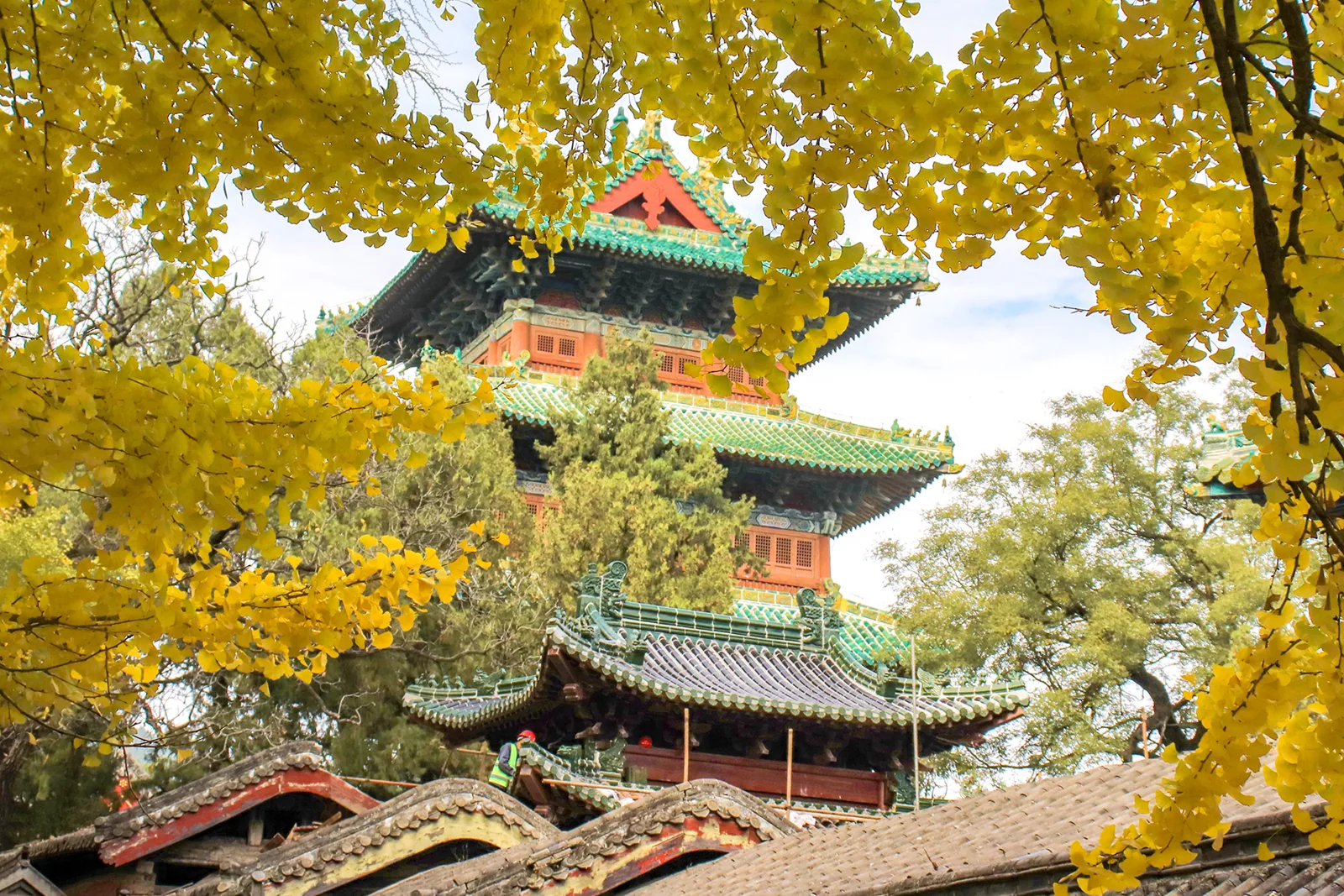
The monastery is a sequence of spaces, not just its famous entrance photograph. On entering, follow the permitted courtyard route and locate the interpretation before trying to identify every statue. Ask a guide to distinguish a hall's religious function from its construction or rebuilding date. A founding date for the monastery is not the age of every visible building.
UNESCO's World Heritage account places Shaolin within a serial group of Dengfeng monuments associated with sacred geography, patronage, ritual and learning. It also recognises repeated rebuilding at individual sites while historic layouts remain legible. The useful viewing question is how the courtyards organise movement and worship, not whether everything in sight is untouched early material.
Look beyond the entrance plaque
The Henan government historical account describes major losses in the 1928 fire and subsequent rebuilding. It places the Thousand Buddha Hall, or Qianfo Dian, toward the rear of the main sequence and describes its extensive arhat murals. It also identifies martial scenes in Baiyi Dian, the White-Robed Hall. Interior access and conservation controls must be checked on the day.
Where a mural is visible, first find its overall arrangement, then choose a small cluster of figures to study. Compare the setting and actions of religious figures with the martial scenes if both spaces are accessible. This is more revealing than collecting a photograph of each doorway. Do not use flash, reach across a barrier or assume a dark hall is an invitation to add lighting.
Ask for an inscription with an explanation, not just a famous name
The temple's Memory of the World nomination catalogues 499 inscriptions spanning 566–1990. Among its examples, a 1314 imperial-edict stele preserves Chinese, Uyghur-style Mongolian and Phags-pa scripts. A 1625 inscription records Cheng Shao's response to a martial display. These provide different evidence: one concerns authority and written administration; the other concerns the recognition of martial practice.
If a guide or exhibition can identify a relevant stone or its reproduction, ask what the text actually says, who commissioned it and why it was preserved. This gives a better basis for understanding the monastery's relations with rulers and visitors than treating a legend, a later inscription and a modern film scene as equivalent evidence.
The inscription collection appears on UNESCO's 2025 Memory of the World list. That recognition concerns documentary heritage; it does not mean all 499 pieces are laid out as an accessible English-language museum display. Dengfeng reported a digital archives exhibition opening on May 1, 2025. Ask whether it is open and included on your date, and whether interpretation in your language is available.
Give the Pagoda Forest a separate visit, not the final five minutes
The Zhengzhou cultural heritage authority places the Pagoda Forest roughly 300 metres west of the monastery. It is a burial landscape of brick and stone memorial towers, with inscriptions, rather than a collection of towers built for visitors to climb.
Spend time comparing two or three towers visible from the permitted paths. Begin with their outlines: square or polygonal plan, a compact roof or repeated eaves, the transition from base to body and the treatment of the top. Then look for the name panel or inscription. You can compare these visual choices without reading classical Chinese, while a guide can connect them to an individual monk and period.
Dengfeng's own cultural account highlights the 1157 Xitang tower, the stone-built Tanran tower and the multi-eaved Bi'an tower as contrasting examples. It also explains the special role of the Putong tower in receiving ordinary monks' ashes. These names are useful questions for an interpreter, not a promise that every face or inscription will be reachable on your visit.
Reserve about half an hour for this comparison if the paths and your stamina permit. That is an editorial suggestion. Keep to the route, respect burial and religious significance, and never touch carving to “feel the age,” climb a plinth for a better picture or make a rubbing yourself. Fewer carefully understood towers can be a more substantial visit than a fast attempt to count them all.
Shaoshi mountain is another commitment; Sanhuangzhai is not a casual extension
Shaolin's mountain setting is part of its appeal, but the monastery visit does not establish that a distant trail is currently passable. In the operator's archive, answers about Sanhuangzhai and Chuzu Hermitage include restrictions alongside older descriptions of open routes. Their missing or mixed dates prevent a reliable current all-open or all-closed conclusion.
Before buying a cableway or setting off, name your intended route and ask staff which sections can actually be completed, where you would return and when the final descent operates. A cableway station is not necessarily the endpoint of the mountain walk you have seen in photographs. Verify walking beyond the station, steps, weather restrictions and the correct pickup point independently of a package's general attraction list.
The Songshan UNESCO Global Geopark account distinguishes Shaoshi and Taishi in a much wider geological landscape and draws attention to Shaoshi's quartzite cliffs and tectonic history. That helps explain what a mountain visit adds. It supplies no operating guarantee or interchangeability between a Shaoshi hike and a Taishi night ascent.
If staff cannot confirm the through-route, use the monastery, Pagoda Forest and a confirmed demonstration as the day's complete plan. Do not set off hoping an unconfirmed mountain crossing will reach a waiting driver. In poor weather, an interesting cultural visit remains worthwhile; a closed trail is not an invitation to look for an unofficial entrance.
Choose the road transfer around your return, especially on a limited day
The government attraction listing identifies a bus from Dengfeng's west passenger station to Shaolin. Treat that as a route lead: establish the current departure station, first and last service, fare and return boarding point locally before relying on it. This guide does not claim a verified October 2026 bus frequency or a fixed one-hour transfer from Zhengzhou.
For a hired transfer from Zhengzhou or Luoyang, agree the pickup and return points in writing and specify **少林寺常住院、塔林** if those are your destinations. Ask whether the quoted price includes waiting, parking, tolls, any guide and the return leg. A cheap “Shaolin” transfer that stops at a school or a sales venue does not solve transport to the monastery you intended to visit.
If combining Shaolin and Longmen in one road itinerary, decide which deserves your main looking time and leave a real transfer margin. Two admission tickets cannot shorten the drive or protect the second site's last entry. With a late start, shortening one visit is more realistic than adding a mountain walk to an already compressed two-site day.
For reduced mobility, ask the visitor centre about the exact path between the entrance, compound, hall and Pagoda Forest, thresholds and accessible toilets. The operator archive mentions wheelchair hire, but availability and a continuous usable route need confirmation; a chair does not make a steep mountain extension accessible. Start with the cultural section and arrange a suitable collection point before fatigue becomes the reason to improvise the return.
Sources and editorial note
Independent research of UNESCO World Heritage and2025Memory of World inscription nomination/list, Henan historical hall account, Zhengzhou heritage authority, Dengfeng tower/archive records,2026official indoor-performance procurement and datedOct1–7visitor-centre programme. Operator Q&A indexed content read but direct HTTPS certificate failure; mixed undated answers not current guarantees. Original itinerary, visual comparisons and practical questions. AI-assisted desk research; no visit or transaction claimed.
Current foreign-document end-to-end purchase, date-specific tariff/concession rights, exact hall sessions, mountain reopening and bus frequency not verified. Cultural facts do not promise all named interiors or inscriptions accessible. Original viewing guidance separate from field experience.
- https://www.zhengzhou.gov.cn/view422/6498142.jhtml
- https://www.songshancn.com/about_message.php
- https://xinmi.zfcg.henan.gov.cn/cmsweb81e27e/dengfeng/cgxx/jggg/webinfo/2026/01/1916823.htm
- https://www.dengfeng.gov.cn/mtbd/10280410.jhtml
- https://whc.unesco.org/en/list/1305/
- https://media.unesco.org/sites/default/files/webform/mow001/1-nomination-form-the-steles-of-shaolin-temple-566-1990.pdf
- https://www.unesco.org/en/memory-world/list?hub=1081&sort=sort_date_desc&sort_by=unesco_country_label&sort_order=ASC
- https://ytsc.rootinhenan.gov.cn/sitesources/ytsc/page_pc/hnly/zywh/articlec31a075ac00d4b6a9c2fc9dbb4395e4d.html
- https://wwj.zhengzhou.gov.cn/country/3175049.jhtml
- https://www.dengfeng.gov.cn/slwh/5295055.jhtml
- https://www.dengfeng.gov.cn/slwh/9286965.jhtml
- https://www.unesco.org/en/iggp/songshan-unesco-global-geopark