

On this page
Start with one purpose, then add a second experience
Tongli, **同里**, is in Suzhou’s Wujiang district. For a first visit, give the day a clear centre: **Tuisi Garden, 退思园**, also translated as the Retreat and Reflection Garden, followed by an unhurried waterside walk. Add a boat if you want to experience the town from the water and its actual boarding arrangements fit. Buying a broad package before choosing those priorities can leave you with more inclusions than usable time.
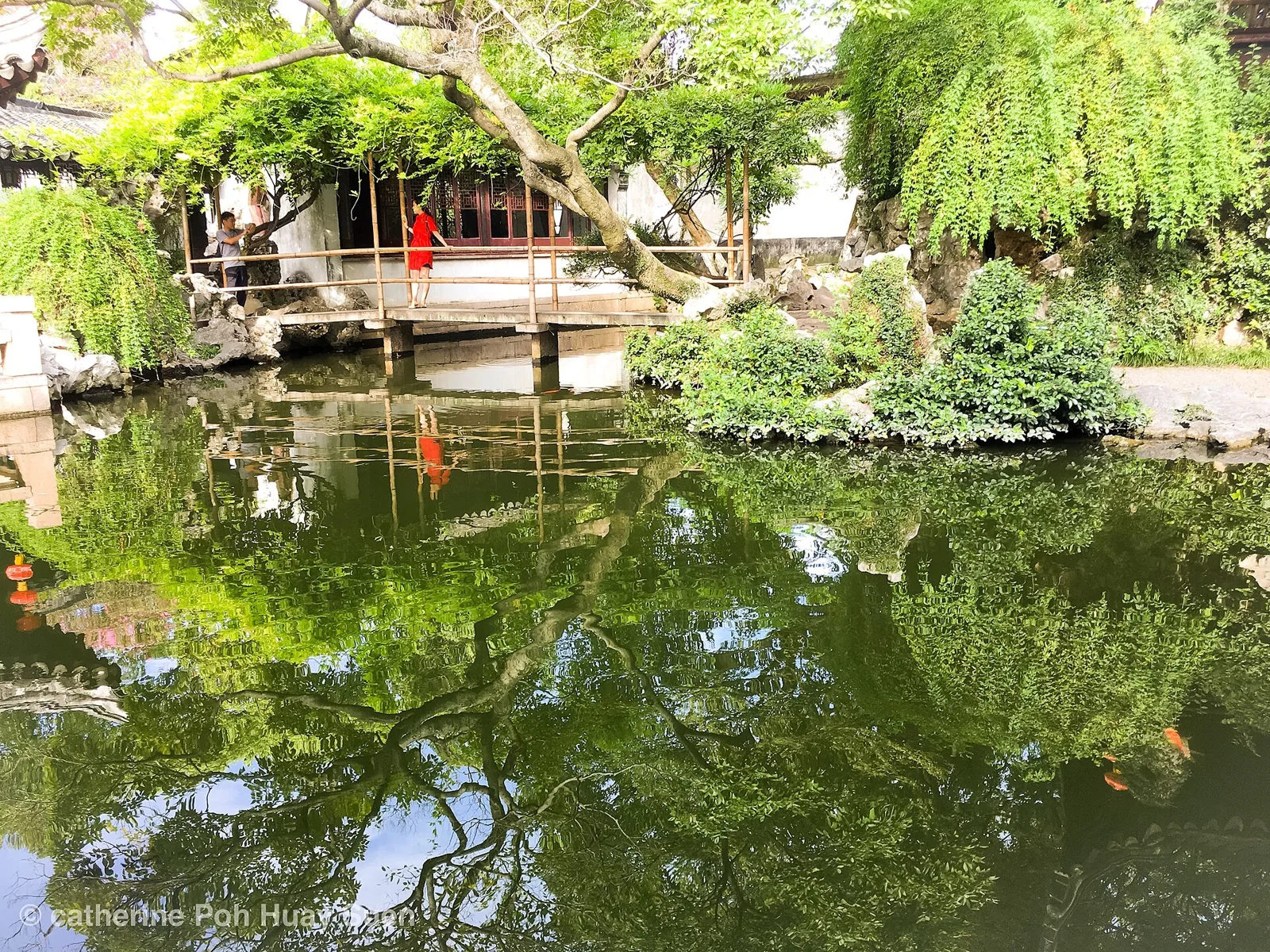
The garden and town illustrate different relationships with water. In the garden, water is deliberately composed with architecture to create a small landscape. Along town streets, it also relates to access, crossings and the way buildings address a working settlement. Comparing the two makes Tongli more interesting than another sequence of bridge photographs.
UNESCO’s Classical Gardens of Suzhou property includes the Retreat and Reflection Garden among nine gardens. That specific inscription should not be expanded into a claim that the whole town, every guesthouse and every ticketed hall carries the same World Heritage designation.
Read a riverbank as an edge people use
Suzhou’s January 2024 account of Tongli describes streets running alongside water, riverside residences and stone steps traditionally used to reach the river. It names Taiping, Jili and Changqing as the Three Bridges and records the custom of crossing them during weddings or other celebrations.
Use those features as a way to read an open public route. Choose a bridge and notice what happens at each end: does a lane continue straight, turn along the bank or meet a building entrance? Then look at a nearby waterside façade. Which side seems to face the pedestrian route and which side the water? A crossing is a connection between different kinds of space, not only a photographic arch.
An old set of water steps is not proof that someone still uses river water for the same domestic purpose today. A modern shop does not erase the older street relationship, and an old-looking façade does not date every fitting inside it. Keep the observation and historical account separate.
The Three Bridges custom is cultural context, not a service guaranteeing luck or a reason to push through a crowded bridge repeatedly. If a ceremony or resident activity occupies the route, give it room. The useful comparison can be made from another position without turning daily life into a staged attraction.
At Tuisi Garden, compare the house with the waterside landscape
The garden authority’s own description, published in 2020, associates the garden’s foundation with Ren Lansheng in 1885 and explains its name through reflection after retreat. It divides the site into western residential halls and an eastern garden linked by a moon gate. Shui Xiang Xie stands beside the water; Tuisi Caotang offers views around it; the account also identifies the raised Mianyun Pavilion, Gu Yu Sheng Liang and Xintai. The site is noted for buildings close to the water surface.
Start by noticing that transition rather than running straight to the most photographed water view. In the residential sequence, compare enclosed space, a courtyard and the next threshold. Then, on entering the garden, ask how the visible water changes the apparent distance between buildings. Is something nearby in a straight line but reached by a longer path around the pond?
The descriptive term “close to water” does not mean every building is floating, every floor is at exactly the water level or every route is safe to approach at its edge. It describes a designed relationship. Use permitted standing points and look for how the bases of buildings, terrace lines and reflections make the space feel connected.
Three comparisons you can make without a specialist vocabulary
| Comparison | What to look at | What it helps explain |
|---|---|---|
| A hall or courtyard versus the garden beyond its threshold | Enclosure, light and the first visible water | Why the garden is experienced through a transition, not as one continuous open room. |
| A building across the pond versus the same building from another open position | Nearer objects, its base and reflection | How a small space can offer several compositions without adding another building. |
| A low waterside view versus an authorised higher viewpoint, if reachable | Roof overlap, the water boundary and visible paths | How elevation can reveal relationships hidden in a lower view. |
Swipe to see the full comparison
Do not make a higher viewpoint compulsory. The lower comparison can be enough for someone who cannot manage steps or for a day when an upper route is unavailable. The descriptions are a basis for observing, not a guarantee that every interior and elevated passage is open today.
Use a name as an invitation to look, not a promised event
Garden names can suggest a way of experiencing water, weather or quiet. Read the sign, locate the relevant opening or outlook and compare it with the scene in front of you. A name evoking cool rain does not promise a cooled room; a place associated with music does not guarantee a daily performance.
If you choose commentary, ask the guide to explain one threshold and one view across water. Those two tasks can make the relationship between residence and garden concrete. Ask whether the language, meeting time and admission rights match your group before buying a service whose main selling point is simply more attraction names.
A town ticket needs an inclusion list and a usage rule
The municipal December 2025 water-tourism entry lists Tongli at **Zhongchuan South Road 1**, daytime reference hours of **08:00–17:15** and an admission price of **RMB100**. The publicly available city price handbook describes a RMB100 joint-ticket category with named components, including Tuisi Garden and other interiors. These are published references, not a completed October 2026 product checkout.
Before paying, read which places your actual ticket includes, when it must first be validated, whether each interior is single-use, and what happens if one component is unavailable. Count the inclusions you intend to use; a long list has little value if the final building closes before you reach it. Do not assume a boat, night performance or every part of a guesthouse’s surroundings is included.
The June 2024 city policy kept real-name ticket reservation for Tongli while removing it from many other Suzhou sites. “Most places no longer require reservation” therefore does not settle this town’s process. For a foreign passport, confirm the category in your chosen official channel and the gate’s required original document and voucher. We did not submit an identity or complete a passport purchase.
If online purchase fails, describe the stage that failed: finding a product, choosing a date, selecting passport, receiving a code or making payment. The older official English visitor page gives **0512-63311140** as the town contact. Check that it remains appropriate before relying on it, and ask about your selected date and document rather than seeking a generic assurance that foreigners can visit.
We have not established a universal rule that every street is free at every hour or that arriving after ticket verification ends supplies a free right to the interiors. Choose a lawful current entry arrangement for the visit you want; do not build an itinerary around slipping past a gate after dark.
Boats are charged per boat, and infants count toward capacity
The most specific published boat reference we checked is Tongli Town Government’s September 10, 2025 answer. It separates ancient-town day and night boats from wetland-park water activities and says town boats are purchased separately from admission.
| Product in that dated answer | Charge | Boarding reference | Published operating limit |
|---|---|---|---|
| Town daytime boat | RMB150 per boat | Tongli Boat Service Centre, Fuguan Street 48 | 08:00–17:15; sales stop 17:10 |
| Town nighttime boat | RMB180 per boat | Zhongchuan Bridge wharf | April–November subject to notices; 18:00–21:00, sales stop 20:30 |
Swipe to see the full comparison
Both list a maximum of six people **including infants held in arms**. Confirm current price, route, duration, destination and conditions at purchase; the table is a September 2025 quotation, not an independently purchased 2026 fare.
For planning only, six people sharing a RMB150 whole-boat charge would be RMB25 each. Three people would be RMB50 each. Those are arithmetic examples, not per-person tickets offered by this guide. A party of seven, including a baby, should not plan to fit into one six-person boat. Ask for the arrangement for the actual headcount before deciding to split the group.
Before joining an advertised shared departure, confirm whether you are buying the whole boat or a seat on a seller’s arranged trip. Confirm where it finishes and how to find your walking route afterward. A pleasant canal ride does not automatically deliver you beside the garden entrance or provide transport back to the metro.
Night garden, night boat and overnight stay are three different commitments
The 2021 English visitor page includes an older Tuisi night-tour rule and price. Do not carry that rule forward as a right to use today’s daytime joint ticket again at night. The town’s 2026 work report records new night-tour offerings and boat-service upgrades, demonstrating that products have evolved. It also records a garden repair design submitted for approval, which is not itself proof that the garden is currently closed.
Choose the evening experience you actually want and check its own admission, start, end and return arrangements. If the night boat matters, its boarding point and latest purchase time are relevant. If the garden matters, confirm that specific garden session. If you stay overnight, ask the accommodation what its package includes and whether return entry needs additional validation. A room booking is not by itself a garden voucher.
For accommodation inside the town, confirm the final pedestrian approach with luggage and the exact reception door. “Riverside” does not establish that a taxi can stop at that door, and a lively waterside restaurant below a room may matter more than its advertised view. Request the room’s actual relationship to public routes and evening businesses rather than assuming all old-town rooms are quiet.
Tongli metro station is the start of the last connection
The town government’s December 2023 transport answer directs visitors to Suzhou line 4’s Tongli station, followed by the automated transit connection to the ancient town’s north entrance or bus 725 to **同里古镇石牌楼**. Check current departures, fare and boarding location. An early launch announcement calling a demonstration service free does not prove that all later rides are free.
Save the entrance associated with your arrival route and the stop needed for the return. An ancient-town map pin can sit well beyond the point where your vehicle leaves you. Before adding an evening session, check the last connection to the metro and the metro services onward to your hotel. These are separate deadlines from the boat’s last sale or the garden’s closing.
If mobility is limited, ask about bridge steps and the particular Tuisi route you want. A short distance on a map may still include a bridge or threshold; a flatter bank walk does not establish that every garden viewpoint is reachable. Choose a shorter comparison and a meeting point when necessary.
Leave Tongli with a distinction you can describe: the town’s water as access and crossing, the garden’s water as a composed landscape, and the boat as a separately purchased viewpoint. That gives the day a purpose even if one interior, higher path or optional evening activity is unavailable.
Sources and editorial note
Independently written town-water versus garden-water guide. Actualbrowserread2020gardenauthoritylayout, city2024historicalsettlement, UNESCO813, town2025boatanswer and2023lastmile, 2026townreport. Dated100townprice andguidance notpurchaseverification. No traveller identity, boat order or stay.
Passport checkout, fullcurrentOctoberproduct/refunds/nighteligibility and accessibility nottested. Townoperatorwebsite timedout. Publishedreferences datequalified, no universalfreeafterhours or oldphoneguarantee.
- https://english.suzhou.gov.cn/szsenglish/atav/202401/d7e9762125e340a0ab1465f4b34091ad.shtml
- https://ylj.suzhou.gov.cn/szsylj/sjyc/201905/3fdb8e8723cc4a8a88f3e912d0c48af4.shtml
- https://whc.unesco.org/en/list/813/
- https://www.wujiang.gov.cn/zgwj/rdwdgysy/202509/6629866a63c44a53829f0d8d015a2463.shtml
- https://water.suzhou.gov.cn/slj/wjq/202512/41a96ec06ce4489882f8703288b26ca9.shtml
- https://credit.suzhou.gov.cn/html/wap_jgsc
- https://english.suzhou.gov.cn/szsenglish/sz5ajjq/201911/5212c69295364f8cb2c55ee5d5f13dcc.shtml
- https://www.suzhou.gov.cn/szsrmzf/szyw/202406/40f954ccaae94c33b74a5a4aa08bf968.shtml
- https://www.wujiang.gov.cn/zgwj/rdwdjtcx/202312/1338fe9f76b448b3980bc6c1747c9fc5.shtml
- https://www.wujiang.gov.cn/zgwj/c110566g/202601/e057524dc12947599579d8da7c3a7186.shtml