

On this page
Choose the experience before the ticket
For one unhurried afternoon and evening, **West Scenic Area, 西栅**, is the more coherent choice: walk the waterways in daylight, select an interior you want to understand and watch the same spaces change after lighting comes on. Choose **East Scenic Area, 东栅**, when your main interests are workshop layouts, domestic objects and Mao Dun’s former home. Choose both only when the earlier closing of East and the transfer between areas fit your actual arrival.
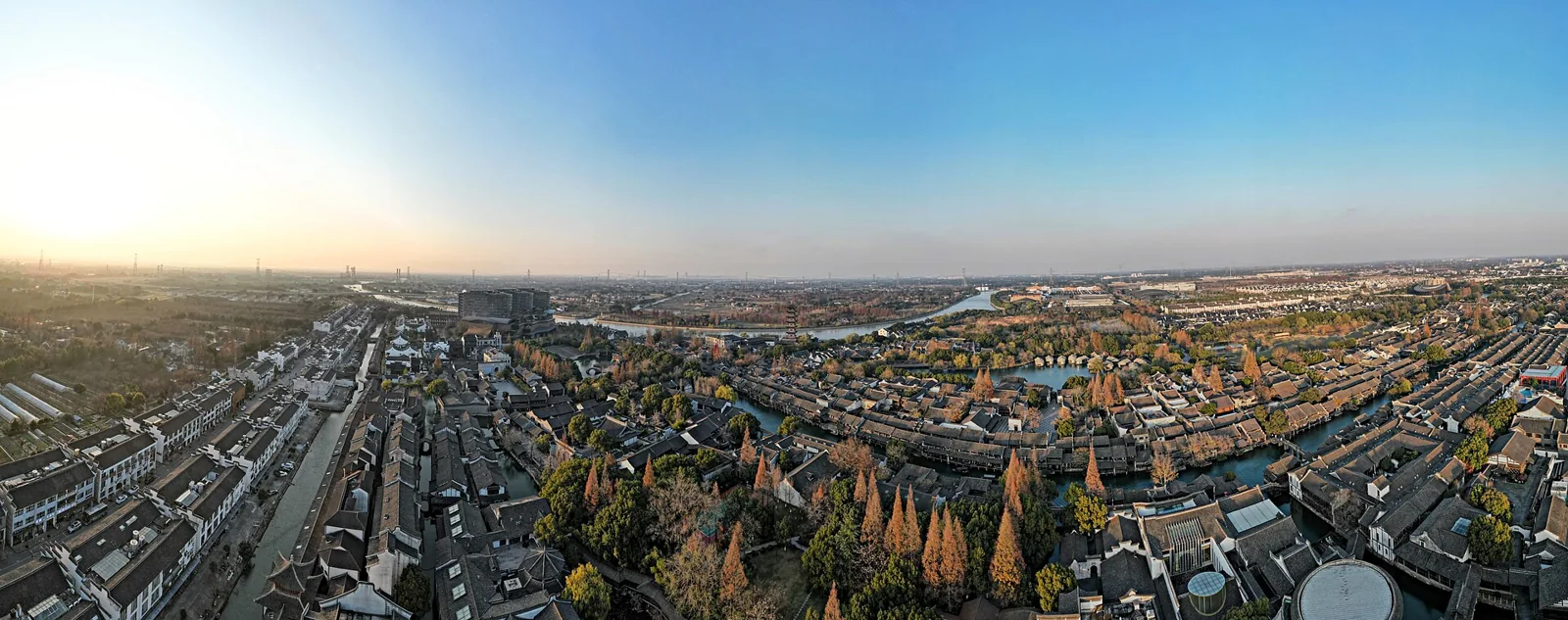
Wuzhen is in Tongxiang, Zhejiang. East and West are distinct admission areas, not opposite banks you can automatically move between on one ordinary West ticket. A room advertised as “near Wuzhen” does not establish that its occupants have entry to either area.
The official ticket list, opened and expanded during this review, displayed full adult East admission at **CNY110**, West at **CNY150** and the East–West combination at **CNY190**. These are admission products, not automatically a boat, room, museum special exhibition or theatrical performance.
Here is the useful arithmetic: separate full adult admissions total CNY260, so the displayed combination costs CNY70 less than buying those two separately. But adding East to a West-only plan still costs CNY40 and takes time. A saving against a trip you do not intend to make is not a reason to rush the trip you do want.
| Your main purpose | A reasonable starting choice | Resolve before paying |
|---|---|---|
| Daylight waterways followed by night views | West admission | Return transport and whether leaving breaks your entry rights |
| Workshops, old furniture and a writer’s home | East admission | Which interiors are operating that day and when they close |
| A substantial look at both areas | East–West combination | Arrival early enough for East, transfer and remaining energy |
| An overnight stay with excursions outside West | A specifically confirmed accommodation product | Written admission and repeat-entry terms, not just the hotel’s address |
| A particular theatre production | That production’s ticket first | Performance venue, language and its actual West admission entitlement |
Swipe to see the full comparison
A ticket’s clock is as important as its price
The operator’s February 2024 admission policy says ordinary admission is valid for one use on the day, with validation cancelling the entry entitlement. It also states no return or exchange after sale. East uses separate checks at its smaller attractions, so retain the admission credential rather than discarding it after the entrance.
That is the published general policy, not proof of a completed passport purchase or the terms of every special product. Before payment, read the dated product you are actually buying. If it offers different cancellation rights, save that specific provision with the order. This guide has not tested a paid order or international card acceptance.
One practical consequence follows: do not leave West for an outside dinner assuming you can return for its lights. Ask whether your particular credential allows re-entry **before** crossing the exit. If the answer is no, choose a meal inside or make the departure your final exit.
The policy includes concessions and free admission categories, including people aged 70 or above with valid identity documents and government-issued foreign disability certificates. It also lists student concessions. An overseas student should ask which document the selected ticket accepts; the existence of a category is not proof that every foreign student card will pass an online form. A concession does not establish an accessible route through every bridge or building.
The official general ticket page gives East summer hours as 07:00–18:00 and winter as 07:00–17:30; West is listed as 09:00–22:00. An individual interior can close earlier than its surrounding area. An evening arrival is therefore not interchangeable with a day visit to museums or workshops.
East: read a workshop as a sequence of work
The operator’s East guide, published in July 2020, describes Hong Yuan Tai dye workshop with a shop at the front and production spaces behind, including dyeing and cloth drying. It identifies Mao Dun’s former home as a nineteenth-century family residence and describes rooms with domestic and literary uses. It also identifies the Jiangnan Hundred Beds Museum and its elaborate Qing-period bed.
Treat those as specific places to investigate when open, not a guarantee that every historic demonstration is running today. Choose two interiors and give them time instead of racing through every label on an old route list.
At the dye workshop, follow the relationship between selling, making and drying. Where is the customer-facing space? Where does the cloth need working room or air? The hanging fabric makes an attractive image, but asking why it occupies that position produces a more useful understanding than describing it merely as decoration.
If a process demonstration is operating, distinguish the demonstrator’s explanation from your own inference. Ask what creates the undyed pattern and when that part of the process happens. If there is no demonstration, an exhibit describing a stage can still answer that question; do not invent an uninterrupted working tradition from a photograph of drying cloth.
At the bed museum, first locate the sleeping platform. Then see what encloses it and which decorative elements belong to that outer structure. A large bed can organise a small domestic territory rather than act as a simple mattress support. Compare a second example: is the difference in enclosure, joinery, ornament or all three? Use its label for period and material; visual elaboration alone cannot date an object.
At Mao Dun’s home, read the change between study, living space and courtyard. The useful question is how a family house accommodated intellectual work, not whether every item has remained untouched since the writer’s childhood. A memorial display, later reconstruction and surviving building element are different kinds of evidence. Follow the interpretation provided in each room.
West: compare the water’s route with the pedestrian route
The general ticket description explicitly says West combines retained historic exteriors with selectively introduced modern facilities. That makes it a managed heritage and visitor environment. Calling every interior unchanged or every shop an ancient institution would erase that distinction.
Use a daylight walk to follow one stretch of water and the parallel pedestrian route. At a bridge, look at how the two sides connect. Does the approach continue into a lane, stop at a building frontage or turn along the bank? Then compare the same bridge from the next waterside viewpoint. Its function as a crossing and its appearance as an arch need not be read from the same position.
Choose a waterside building where the public route allows a pause. Look for the relationship between doorway, roof edge and water. A façade seen from a boat can reveal a different orientation from the shop entrance seen on foot. Neither view by itself tells you whether today’s business operates in the same way as an earlier household.
The operator’s West guide from July 2020 describes Caomu Bense dye workshop and the old post office among its attractions. If both fit your interests and are open, compare them as different systems: one concerns making and presenting a material; the other concerns moving information between places. You do not need to buy a souvenir to make that comparison.
Return to a familiar waterside position after dark rather than treating the evening as an entirely separate checklist. Notice which surfaces are lit and which disappear, how reflections duplicate a façade and where a bridge interrupts the reflected line. That is a concrete way to understand why daylight and night photographs tell different stories about the same space.
Night lighting does not establish that a building interior is open. Keep the room visits earlier in the day and the repeat exterior walk for later. If weather or a scheduled performance changes the route, retain one short repeat walk rather than trying to recover every omitted stop.
Wood, literature and modern concrete: give Mu Xin a separate decision
Mu Xin Art Museum is not simply another old house. OLI’s own architectural account describes cast-in-place concrete pavilions organised along a central route and refers to the street and water environment of Mu Xin’s childhood. Credit OLI’s design account rather than attributing this museum to I. M. Pei because another regional museum has that association.
If architecture interests you, compare the museum route with the water-town route outside it. Where does a passage become a room? Where does an opening frame water rather than a neighbouring wall? Which views appear gradually, and which are given immediately? Those are observation questions, not claims that the new structure copies an old town literally.
Inside, allow the writing and artworks to establish Mu Xin’s work. An architectural photograph cannot substitute for reading an exhibit, and a literary life should not be reduced to a room’s visual style. Use the label to separate an original work, reproduction and biographical document.
The official museum ticket page lists summer opening as 09:00–17:30, winter as 09:00–17:00 and closure on Mondays. Check the operating notice for your date, particularly a holiday. Museum admission and a special exhibition can have different entitlements; do not assume a West ticket or a permanent-exhibition ticket includes both.
An overnight package can change the route—but inspect the actual inclusions
The specific official **Yiyuan “游园诗梦” two-day, one-night package** was read in the browser during this review. It lists one room, two West adult admissions, two shared-boat places and two Mu Xin permanent-exhibition tickets, excluding special exhibitions. It offers repeat West entry during the stay, subject to facial registration at the hotel; that permission lasts until **12:00 on checkout day**. Leaving after that time and returning requires a new admission. Unused components are forfeited without component refunds; cancellation is requested before 18:00 the previous day.
Those are that product’s conditions, not universal rules for every hotel in or near Wuzhen. Check date availability and the final amount separately. A price displayed before selecting a date is not a guaranteed room quote.
Build your own comparison around what you will use. A museum ticket has little value if your visit falls on a closed day. Two shared-boat places are not a private boat. A repeat-entry entitlement matters more if you plan to step outside than if you will stay within West throughout. If your party needs separate rooms or accessible facilities, solve that room requirement before comparing the package’s extras.
Ask where check-in starts and where luggage is handed over. A hotel address inside the scenic area does not tell a taxi where luggage reception happens. Confirm the pickup point by its Chinese name and a map pin, then keep the confirmation with your booking. This also prevents a late arrival from becoming an unnecessary walk with bags across multiple bridges.
Boat arithmetic: a seat, a whole boat and a journey are different units
An operator transport guide published in July 2020 described West boats at CNY480 for a whole boat of up to eight people including infants, or CNY60 for a shared adult place. It described one-way trips rather than unlimited travel and explained that shared services form groups. **These are dated references, not a verified October 2026 purchase price.**
Even if those figures still applied, four adults sharing a private boat would pay CNY120 each, whereas four CNY60 seats total CNY240. The private option buys a different arrangement; dividing by the maximum eight does not give every smaller party a CNY60 private fare.
Before paying, identify the named boarding point, destination, people count and departure arrangement. Ask whether a shared booking keeps your party together and how grouping works. If you intend to meet someone on foot, exchange the destination pier rather than saying only “the end of the canal.” Leave time for the pedestrian connection from that pier to your next activity.
For a visitor using a wheelchair, ask about boarding assistance and the physical transfer separately from town admission. Permission to bring a wheelchair into the area does not establish that a particular boat can accommodate it. If boarding is unsuitable, the bridge-and-bank comparison above still gives a purposeful water-focused visit.
Theatre dates can change the meaning of an evening
The 2026 festival programme runs **October 15–25**. That is a dated event period, not a permanent festival operating every night. During it, choose whether the trip is centred on a specific production or on the town and public-space activities.
The operator’s August 2026 announcement says eligible invited-production tickets allow one West entry on the performance day, with special-price and free-reservation tickets excluded. Read your exact ticket’s terms before buying a separate West admission. Ordinary scenic admission, in turn, does not reserve a theatre seat.
For a production, confirm venue, performance start, duration, language and any subtitles from its own listing. Give the route to the venue priority over a boat queue or a second scenic area. A hotel repeat-entry arrangement still needs its own confirmation; neither a bag branded for the festival nor a room-package title establishes an included performance.
Outside those dates, do not plan around an old festival timetable. During them, a bridge or public route can also be an activity space. Keep crossings clear and move to another viewpoint if a performance or queue occupies your intended position.
Arrive in Tongxiang; leave from your actual exit
The dated 2020 operator transport guide describes a railway approach via **Tongxiang station, 桐乡站**, followed by local transport. It mentions K282 to Wuzhen bus station and K350 onward to the scenic areas. Use those as route leads to check, not current bus timetables or promised fares.
When booking rail, distinguish Tongxiang station from a scenic-area entrance. Check the onward service for your arrival date, luggage and final destination. For a direct coach, confirm the named stop; “Wuzhen” in a destination field alone does not prove delivery to your hotel reception.
Work backwards for the return. Decide which area you will leave, where the pickup can legally stop and how that connection fits the train or coach you have actually booked. West’s listed 22:00 closing is not a commitment that public buses will still connect with your last train. If your return depends on a service you cannot verify, shorten the evening or arrange a confirmed alternative before entering.
For unresolved passport handling, product rights, luggage reception or boarding assistance, use the operator’s service page and **0573-88731088**. Send the product name and visit date with the question. A reply about a general day ticket cannot settle a different accommodation package.
The strongest Wuzhen visit is not the largest collection of paid inclusions. It is a route whose entry rights, interior opening times and transport fit the experiences you chose—and whose daylight observations give the night views something to mean.
Sources and editorial note
Independently researched and authored product-rights and spatial-reading guide. Actual browser expanded official 12 ticket products and read Yiyuan package inclusions and terms. Official 2024 policy, 2020 East/West and transport descriptions, OLI designer primary account, museum product and 2026 festival/official operator announcement separately researched. No paid order, visit or registration performed.
Passport order, card acceptance, date-specific room price, current boat fare, boarding access and real-time return timetable not tested. Modern facilities within retained exteriors explicitly distinguished. Product conditions must match selected date and credential.
- https://www.ewuzhen.com/ticket/list
- https://www.ewuzhen.com/ticket/detail?goodsCode=PK-202002-4949&goodsId=214432045038940161
- https://www.ewuzhen.com/strategy/detail/681903615486255106
- https://www.ewuzhen.com/strategy/detail/201806226391591
- https://www.ewuzhen.com/strategy/detail/201912039465417
- https://www.ewuzhen.com/combo/detail?goodsCode=CB-202603-3708&goodsId=1020272750505934849
- https://www.ewuzhen.com/ticket/detail?goodsCode=PK-202002-0949&goodsId=214433676845494273
- https://oliarch.com/project_category/cultural/
- https://www.ewuzhen.com/strategy/detail/310810525749440514
- https://www.wuzhenfestival.com/
- https://weibo.com/2/detail/5332222044540385
- https://www.ewuzhen.com/service