

On this page
Start with a section, not an obligation to complete the circuit
Xi’an City Wall is worth visiting without cycling its entire 13.74-kilometre perimeter. For a first visit, use Yongningmen, the South Gate, as a clearly named meeting point; inspect the gate complex, walk a manageable section and return, or descend at another entrance whose opening you have confirmed. This approach gives you time to understand the fortification instead of treating the wall as a distance challenge.
The ordinary admission reference is CNY 54 per person, with a CNY 27 concession category. These are the government-set rates confirmed in a Qujiang administrative reply dated August 14, 2025, rather than a converted reseller price. Check the actual dated product for concession eligibility and any special event. A bicycle, deposit or performance is not automatically included in that ordinary entry price.
For overseas visitors, the most consequential change is ticket verification. A scenic-area announcement reported by Shaanxi Daily says the entry system changed on July 1, 2026: overseas visitors with online bookings exchange them at a ticket window for a paper entry credential. Do this before joining the gate queue. An electronic purchase confirmation is not the same thing as the paper document used for entry.
Take your booking to the ticket window before the gate
The July entry notice describes the foreign-visitor process as paper-ticket scanning plus facial verification. It also provides a window route for overseas visitors and people paying cash. The notice does not prove that every online seller accepts every passport, and it does not establish a universal advance-booking release time.
If buying online, first check that the product accepts your document type and selected date. Enter the name and document details requested by that seller; keep the order number and purchase record available offline. Carry the original document used for the booking. At the chosen entrance, find the staffed ticket window, show the order and document, and obtain the paper credential before proceeding to verification.
If you cannot complete an online purchase, ask the ticket window about its foreign-visitor sale and registration process. Do not attempt to solve a passport problem by entering a borrowed Chinese identity number. That can produce an order which looks successful but fails the document check. Nor should a hotel booking on your behalf imply that the hotel’s own identity can replace yours.
Facial verification is specifically mentioned in the published foreign-visitor procedure. If this is unsuitable for you, ask the staffed ticket office about an alternative before paying; this guide has not verified an alternative admission route. Keep the paper credential until you have left, and ask about same-day re-entry for your particular product rather than relying on the rules for a different ticket category.
Payment has improved, but check the actual window
A Qujiang report published in September 2026 says nine City Wall ticket windows support overseas bank cards. That is useful evidence of a real payment service, but it is not a list of all gates or accepted card brands. A foreign card working at one window does not prove it will work at every rental desk or stall.
Ask whether your intended entrance has a card terminal and whether the rental deposit uses the same payment method. Keep a practical alternative for a failed payment. Admission, bike hire and the refundable deposit should be recorded separately; otherwise a large temporary charge can be mistaken for the ticket price.
Choose an entrance and an exit that belong to the same plan
A taxi destination reading only “Xi’an City Wall” is inadequate: the wall surrounds the centre, and the wrong side creates an avoidable journey. Save the Chinese name of the specific gate and, for Yongningmen, identify whether you mean its north or south entry point.
The authority’s published entrance list includes 17 ascent and descent points. Its total counts Yongningmen’s north and south entrances separately; it is not a claim that the wall has only 17 historic gates. A July 2026 administrative reply also confirms the expanded access network. Neither document is a promise that every point keeps identical hours every day.
| Your next priority | Useful gate names to investigate | Decision before ascending |
|---|---|---|
| A first look at the principal southern gate complex | Yongningmen, 永宁门 | Choose the exact entrance and an easy return point |
| Historic layers on the southern stretch | Hanguangmen, 含光门; Wenchangmen, 文昌门 | Check the intended exhibition or museum separately from wall access |
| Continuing towards the eastern part of the old city | Changlemen, 长乐门; Zhongshanmen, 中山门 | Confirm which descent is open at your expected finish |
| Starting near your accommodation on the west or north | Andingmen, 安定门; Anyuanmen, 安远门 | Compare a short local visit with the extra travel to South Gate |
Swipe to see the full comparison
This table is a route-planning aid, not an operating-hours table. Before setting off, verify the last admission and descent conditions at both ends. Being allowed onto the wall does not mean a particular museum will still admit you, or a rental station will still issue bikes.
For a walk with an uncertain exit, an out-and-back section is the more controllable choice. Set a turnaround point while everyone still feels comfortable. If using a one-way route, keep a ground-level route back to your hotel saved as well: descending on another side changes your transport problem even when the wall itself was easy to follow.
Read the fortification while you walk
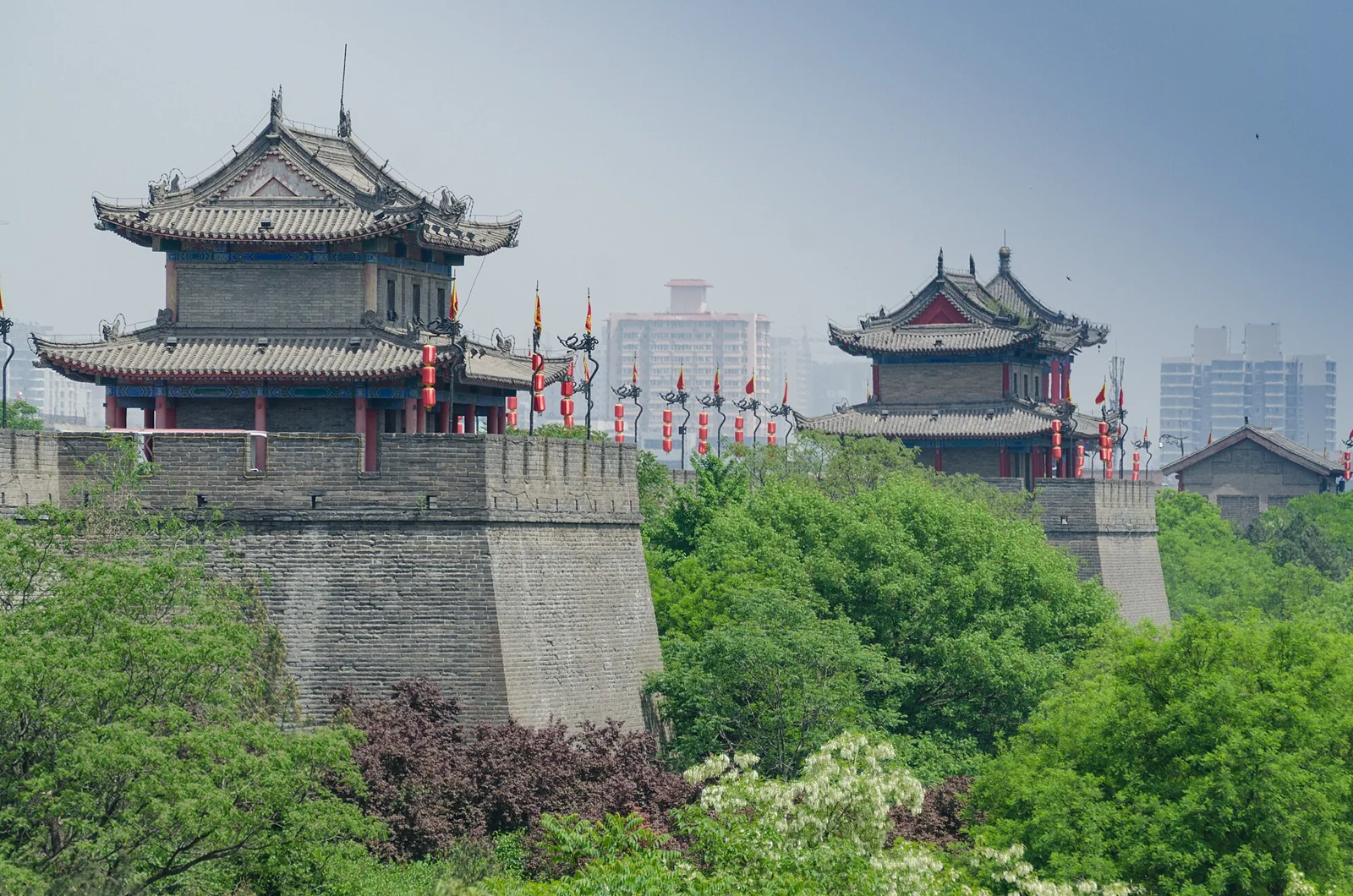
The visible circuit is a layered, maintained structure. Qujiang’s historical account places the Ming expansion in 1370–1378, drawing on earlier Tang imperial-city and Yuan city foundations. It records later brick-facing and repairs, including major modern restoration. The wall’s older foundations therefore do not make every visible brick a Tang original.
Use the gate complex to ask a spatial question: how was movement into the city controlled? Look at the relationship between the opening, towers and enclosing walls. Then compare the narrow passage at ground level with the broad surface above. The visitor entrance you use today is part of modern circulation; it need not reproduce the historical approach exactly.
Along a quieter section, notice the projections extending beyond the wall line. The official account describes 98 projecting platforms, often called *mamian*. Their shape interrupts what would otherwise be a long flat defensive face. Look back along the outer wall from a permitted public position and consider how a projection changes the view of the adjoining section. This is an observation exercise, not permission to enter closed towers or climb parapets.
The same account distinguishes a rounded southwest corner from the other corner forms. If that feature matters to you, choose a route which can reach it without forcing the whole perimeter. A family can use a simpler challenge: identify one tower, one projecting platform and one change in brickwork, then describe how each differs. You do not need to memorise a dynasty list to learn something from the visit.
Modern maintenance also belongs in the story. The city’s protection report describes extensive restoration and preventive monitoring. A repaired surface is evidence of conservation, not proof that the monument lacks historical value. Be cautious with guides which call the whole circuit untouched or describe a reconstructed tower as entirely original.
Decide about the bicycle after seeing the surface
Cycling is a genuine City Wall activity, confirmed in the management authority’s July 2026 reply. That does not settle the current hire fee, deposit, rider restrictions, rental period or return arrangements. Online descriptions disagree on several of these terms, so this guide does not turn an unverified rental package into a fixed promise.
At the desk, ask to see the tariff and rental conditions before paying. Establish four amounts or limits: hire price, included time, deposit and overtime charge. Then establish the route conditions: where you may ride, where you must walk or dismount, where you may return the bicycle and the final return time. A wall entrance closing time is not a bicycle-return deadline.
For two people, compare two singles with one tandem only after confirming the tariff and that both riders can safely use it. A tandem changes steering, braking and the ability to stop independently. For children or older riders, get the actual age, height and equipment restrictions from the desk rather than treating someone else’s successful rental as eligibility evidence.
Check the brakes, tyres and saddle before leaving the station; ask for a replacement if the bicycle does not feel suitable. Keep the rental record and photograph any existing damage with staff aware of it. If returns are allowed at another station, confirm that your particular agreement permits it and that the station will be open when you arrive.
A full circuit is roughly 13.74 kilometres, not a short photo stop. Your real duration includes registration, fitting, walking through any restricted sections, pauses and the return procedure. Decide whether that fits the rest of the day before committing. If weather, surface conditions or confidence are poor, the admission can still support a worthwhile walk.
A focused visit can leave room for the rest of Xi’an
For an initial South Gate visit, allow approximately 60–90 minutes on the wall for a short walk with observation stops, plus the separate time needed for ticketing and transport. This is an editorial planning estimate, not an operator duration or a promise that a queue will be short. Increase it if you want substantial photography, a museum or a longer one-way section.
Begin by orienting yourself at the gate complex. Choose one direction, identify a visible landmark for the turnaround and keep enough energy for the return. For a mixed-mobility group, agree on the shorter route first; confident walkers can add distance only if there is a clear reunion plan. “We will meet somewhere on the wall” becomes difficult once people use different gates.
The Hanguangmen museum can add historical depth, while exhibitions in towers can make a walk more than skyline photography. The 2026 authority reply describes cultural displays at Changlemen and 13 defensive towers. Verify the specific display’s access and hours; the reply is not a current timetable for all interiors. Choose one meaningful stop rather than rushing between every named exhibit.
Leave luggage at a confirmed storage facility before the visit when possible. A broad wall-top walkway does not solve the ascent, descent or rental problem created by a suitcase. Similarly, confirm a continuous step-free route for anyone who needs it: entrance access, the intended wall section, any exhibition and the exit must all work. Reports of exoskeleton rentals do not establish wheelchair access or suitability for a particular medical condition.
Evening views and advertised events are different purchases
If the goal is daylight-to-evening photography, select a manageable section and verify the current gate and exit schedule. Give yourself daylight to understand the route before relying on darkness and illuminated landmarks. Keep the return transport independent of any show ending time.
Do not infer a nightly performance schedule from an old summer article. The 2026 summer programme was announced for July 1–August 31. Its feiqian game and described performances are evidence of that programme, not a guarantee for an October visit. Likewise, the 2026 lantern festival announcement ran to March 22. A lantern photograph does not establish an operating festival on your date.
When a performance is the main reason to visit, find its current product, date, entrance, start time, seating or standing arrangements and weather policy. Ask whether wall admission is included and whether attending changes your descent route. Buy an experience you can identify, rather than assuming the ordinary CNY 54 ticket contains everything pictured online.
Resolve these problems before they cost you the visit
If the gate rejects an electronic confirmation, go to the staffed window with the original document and order: the July 2026 passport procedure specifically requires the paper credential. If the document details differ from the order, ask the seller or window about correction or cancellation before buying another ticket.
If the planned exit is closed, follow staff directions to an open descent point. Recalculate ground transport from that location; do not keep walking solely because a map shows a shorter geometric route. If a rental return becomes uncertain, contact the rental staff while you still have time to reach an authorised return point.
If riding becomes uncomfortable, slow down and stop in a place which does not obstruct others. Ask staff about the nearest authorised return or assistance; do not leave the bicycle at an arbitrary gate. A deposit refund depends on completing the return process, not merely finishing your sightseeing.
Before leaving the hotel, save the precise gate name, current admission information, original booking document and payment alternative. At the entrance, settle the exit and rental conditions. On the wall, let the fortification itself set the pace: a considered section is often more useful than an exhausted circuit.
Sources and editorial note
Individually researched government price reply, expanded entrance list, July2026 operational notice reproduced with operator attribution, September foreign-card service report and primary conservation/history accounts. Operator homepage had SSL failure; no unseen schedule inferred. Original spatial-reading exercises and route choices are editorial analysis. AI-assisted desk research; no completed booking, rental or field visit claimed.
No verified rental price/deposit/age tariff, universal foreign-card support, alternative facial-check route, gate timetable or full step-free circuit is asserted. Posted admission rates are not tested checkout results.
- https://qjxq.xa.gov.cn/zwgk/ndzdxxgk/jytabl/1958091978013503489.html
- https://www.sxdaily.com.cn/2026-07/01/content_20049276.html
- https://qjxq.xa.gov.cn/xwzx/xwdt/1949774484239577090.html
- https://qjxq.xa.gov.cn/zwgk/ndzdxxgk/jytabl/2079470382543396866.html
- https://qjxq.xa.gov.cn/xwzx/xwdt/2097259847898689538.html
- https://qjxq.xa.gov.cn/zjqj/gyqj/tsqj/5df21c5565cbd81235fc1efa.html
- https://en.xa.gov.cn/MediaCenter/News/1738099529058168833.html
- https://en.xa.gov.cn/MediaCenter/News/2075158116966174721.html
- https://en.xa.gov.cn/MediaCenter/News/2003015649295138817.html