

On this page
Must a foreign visitor reserve online?
**The temple’s currently displayed standard ticket page offers both on-site paper tickets and online buying.** It names the on-site **票务处理中心, Ticket Processing Center**, and the official WeChat account **雍和宫游客信众服务**. This is the useful starting point for a normal visit; do not assume the municipal-park booking platform sells admission to Yonghe.
The operator’s ticket page carries an old publication timestamp but its body has different rules from the older announcements. It currently allows **five tickets per WeChat account per day**, and explicitly describes both channels. Beijing’s January 2022 launch announcement instead describes online-only buying, a three-ticket account limit and a particular advance-sale period. Those historic arrangements should not be presented as a permanently unchanged current process.
For passport visitors buying a full-fare ticket online, the operator gives **QR-code entry** on the visit day. Its full-price purchase instructions also make the name and Chinese identity-card-number fields optional, with QR entry available if they are not supplied. Do not put a made-up mainland identity number into a form. Follow the current passport/full-price route and retain the actual issued QR code.
For a concession purchase, the published passport instructions direct the visitor to the Ticket Processing Center with the original accepted documents. A domestic identity-card-reader instruction elsewhere on the page does not mean a foreign passport should be forced through the same automated process.
If the online channel is inaccessible, ask the processing center about that day’s product and remaining admission. An advertised counter channel does not guarantee no queue or unlimited places. If your day is fixed or involves a larger group, resolve the purchase before building other reservations around entry.
Match the ticket to the traveler, not a reseller’s category
The operator’s posted standard fare is **25 yuan**, with its eligible half-price ticket **12 yuan**. Do not silently calculate the concession as 12.5 yuan; the published amount is 12.
The ticket rules include document-based concessions for qualifying minors, students and visitors aged 60 or above. An older traveler should therefore check the **half-price** policy rather than importing the free-over-60 rule from some Beijing municipal parks. A foreign student card or other overseas certificate is not something this guide has verified as automatically accepted; show the original document and ask the center to determine eligibility.
A simple purchase check is:
- Identify the visit date and any special holiday arrangement.
- Choose the official full-price route or ask for concession verification with the appropriate original documents.
- Confirm the issued ticket, QR code or paper ticket, and the entry instructions attached to it.
- Keep the credential accessible and complete the visit within its allowed use; the operator limits a ticket to one use by one person.
The same current price page states that the temple has **not authorized third-party platforms or individuals to sell or resell its admission tickets**. A travel site may display a product anyway. That listing is not proof of authorization or accepted entry. If buying a separate guiding service, establish how the actual temple admission will be obtained through the permitted channel instead of treating a guide voucher as an admission ticket.
Use the original order’s refund function for an unused official ticket. If the request cannot be completed or the stated time has passed, contact the listed service numbers **+86 10 84191906** or **+86 10 84191907** with the order details. This guide has not performed a purchase or refund and does not promise a successful transaction on a particular overseas phone or bank card.
Leave enough time before last admission, especially on religious holidays
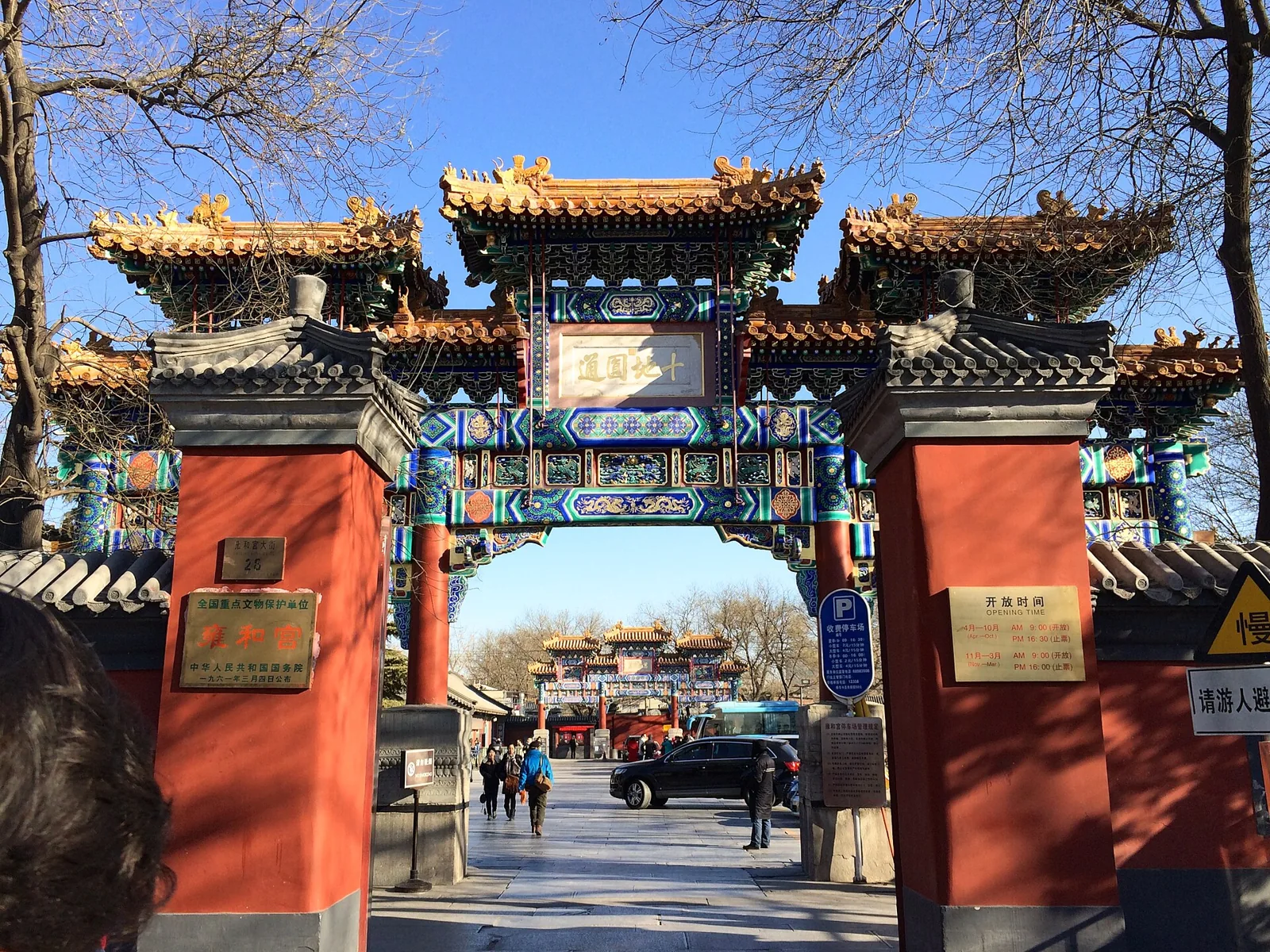
The operator’s standard opening page and Beijing’s English location-and-hours page distinguish last admission from clearing time:
| Season | Opens | Ticketing and entry stop | Clearing time |
|---|---|---|---|
| April 1–October 31 | 09:00 | 16:30 | 17:00 |
| November 1–March 31 | 09:00 | 16:00 | 16:30 |
Swipe to see the full comparison
Arriving at 16:20 in the warmer season gives little useful visiting time even if you can still enter. For an unhurried first visit, allow approximately **one and a half to two hours inside as an editorial estimate**, plus purchasing and arrival time. More time makes sense for close reading of displays or a guided explanation; a group that only wants a hurried interior photograph is unlikely to get the intended experience here.
Religious-holiday dates can change the normal plan. The temple’s 2026 Spring Festival announcement, reproduced by Beijing Dongcheng, specifies unusually early closure on New Year’s Eve and special hours on other festival days. It also introduces holiday ticket and visitor-flow arrangements. Those February–March dates are not an ordinary October timetable or a prediction for next year’s festival.
Weather changes can also produce a temporary closure. The operator’s August 13, 2026 reopening notice, read from the actual announcement image, resumes opening following an earlier weather-related suspension. An old closure headline is therefore insufficient evidence that the temple is still shut. Read the latest dated notice for the day you intend to visit.
Read the former palace as a living temple
Yonghe, 雍和宫, combines a princely-residence history with ongoing Buddhist use. The operator’s introduction explains that the site was the future Yongzheng emperor’s residence, became an imperial palace in 1725 and a Gelug Tibetan Buddhist temple in 1744. Its public religious role resumed in 1981.
As you follow the open central sequence, notice how formal entrances and successive courtyards create a controlled approach to the halls. The official plan names Zhaotai Gate, Yonghe Gate Hall, Yonghegong Hall, Yongyou Hall, Falun Hall and Wanfuge. Use those names to orient yourself, while taking today’s open route and signs as the authority for where you may enter. A historic plan is not proof that every side hall is open to visitors.
Wanfuge, **万福阁**, contains the well-known standing Maitreya figure. The temple’s own description explains an important numerical distinction: the visible figure is **18 meters high**, while the main sandalwood material extends **26 meters including eight meters below ground**. You are not looking at a 26-meter-tall visible statue. Consider the relationship between the figure, the surrounding hall and the space needed to view it, rather than making a photograph the only task.
The art also rewards interpretation beyond scale. The temple’s discussion of Buddhist images distinguishes peaceful figures from wrathful protective forms and explains them within Buddhist religious meanings. A fierce face should not automatically be labelled an “evil demon” for entertainment. Read the available label or ask a knowledgeable interpreter about the figure’s role.
The operator identifies notable woodcarving traditions, including the Arhat mountain composition and carved shrines. Look at material, carving and placement where viewing is permitted. These are religious and cultural objects within a functioning place of worship, not props to touch or reposition for a better image.
English interpretation is available without photographing the interiors
The operator’s guiding page lists **free Chinese-and-English phone audio accessed by scanning on site**, as well as staffed guiding in Chinese, English, German and Russian. Try the official audio link early in the visit, check that it works on your device and use headphones or a low volume so the explanation does not disturb worship.
The same page posts a foreign-language guiding rate of **200 yuan for one to three people**, with a stated explanation length of roughly **40 minutes**. Larger group bands cost more, and the page specifies an additional charge for extending the explanation. This is a published service reference on an older-dated operator page, not a confirmed English appointment or an admission-inclusive package.
If interpretation is important, ask the visitor service point about English availability, the current quote, the route and whether the guide can cover the objects you most want to understand. A one-hour commercial tour and the temple’s roughly 40-minute posted service may be different products. Do not assume that paying for guiding removes ticket or photography rules.
An effective independent visit can use the official audio for historical context, then pause quietly at a few selected halls. You do not need to memorize every name or complete every display to understand the transition from imperial architecture to religious use.
Follow the worship rules even if you do not take part
You can visit to learn about the architecture and religion without personally making an offering. Stay out of the way of people bowing, keep voices low and avoid directing worshippers as photographic subjects.
The operator’s standing visitor rules prohibit **photography, filming and incense burning inside the halls**, prohibit smoking and advise a modest number of incense sticks rather than large bundles. Respect a no-photography sign even when other visitors have phones out. An outdoor courtyard photograph and an indoor image are different permission questions.
The 2026 festival notice says the temple supplies environmentally suitable incense and refuses externally brought sticks; it also warns against carrying lit incense through the grounds or into halls. Distribution and burning may stop in extreme weather. Do not buy large quantities outside under the assumption that they are required for entry or that staff will accept them.
The same notice advises visitors to decline unsolicited paid explanations, sales or requests for donations from strangers and to inform staff. Use the temple’s identified service points if you want interpretation or an official item. Do not assume that a seller’s claimed religious connection establishes authenticity.
If smoke, crowding or prolonged standing is difficult for someone in your group, choose a shorter visit and ask staff about a suitable route. This article has not verified step-free entry to every hall. A quiet pause outside a busy hall may be a better decision than insisting on completing the whole sequence.
Use the named station, then find the visitor entrance
Yonghegong Lama Temple station, **雍和宫站**, is served by Metro Lines 2 and 5. Map the last walk to the visitor entrance and ticket-processing point, rather than assuming that the nearest perimeter gate is admitting tourists. Beijing’s English address page gives **12 Yonghegong Street**; matching the Chinese destination name is more reliable than substituting a nearby shop’s pin.
On major worship days, read current station and street notices. Beijing has previously closed the station temporarily for Lantern Festival crowd management. That 2024 measure is not a current closure, but it demonstrates why a normal metro journey may need a different final approach during a special event.
Keep the temple visit and a nearby neighborhood walk as separate choices. The Confucius Temple/Imperial College area and Wudaoying have their own attractions and admission decisions. If you add them, leave time for a meal or rest after the quiet, concentrated temple visit instead of pushing the group through another checklist.
Before leaving your accommodation, have the intended ticket route, credential and visit window clear. At the temple, let the open courtyards, religious activity and actual signs guide the pace. A successful visit combines useful understanding with space for the people who are there to worship.
Sources and editorial note
Individually researched from the actual maintained operator ticket page read in both browser and web, standing hours/rules, guiding and religious-art descriptions, the visually checked August 2026 reopening notice and 2026 festival announcement. Old publication dates are distinguished from changed page-body rules. AI-assisted desk research; no ticket, refund, guided appointment or field visit claimed.
Published guide rates do not establish a booked English session. Overseas concession documents, date-specific capacity, holiday access and full step-free hall entry need confirmation. No religious outcome, item authenticity or payment success is guaranteed.
- https://www.yonghegong.cn/2017-01/05/content_40043509.htm
- https://www.yonghegong.cn/2017-01/05/content_40043333.htm
- https://www.yonghegong.cn/2017-01/05/content_40043598.htm
- https://www.yonghegong.cn/2017-01/05/content_40045177.htm
- https://www.yonghegong.cn/2016-12/26/content_39984666.htm
- https://www.yonghegong.cn/node_7249378.htm
- https://www.yonghegong.cn/2017-01/03/content_40031087.htm
- https://www.yonghegong.cn/2026-08/13/content_118645353.htm
- https://wap.bjd.com.cn/news/2026/02/06/11569801.shtml
- https://english.beijing.gov.cn/latest/news/202201/t20220106_2584077.html
- https://english.beijing.gov.cn/specials/cyclingroutes/route4/map/202306/t20230609_3129229.html
- https://english.beijing.gov.cn/livinginbeijing/transportation/beijingsubway/202402/t20240223_3568242.html