

On this page
Choose an island visit or a shore visit
**For the iconic White Dagoba and its temple setting, organize the visit around the south side and Jade Islet. For a lower-climb garden-and-lake walk, start on the north shore and select open stops there.** Trying to complete both sides, all courtyards and a boat ride is a different, longer outing.
Beihai Park, 北海公园, is in central Beijing, near Jingshan and the Forbidden City. That proximity can make it look like a small extra on a crowded itinerary. Inside, however, the lake separates the island and shore areas. Give the park a purpose before adding it after several hours of palace sightseeing.
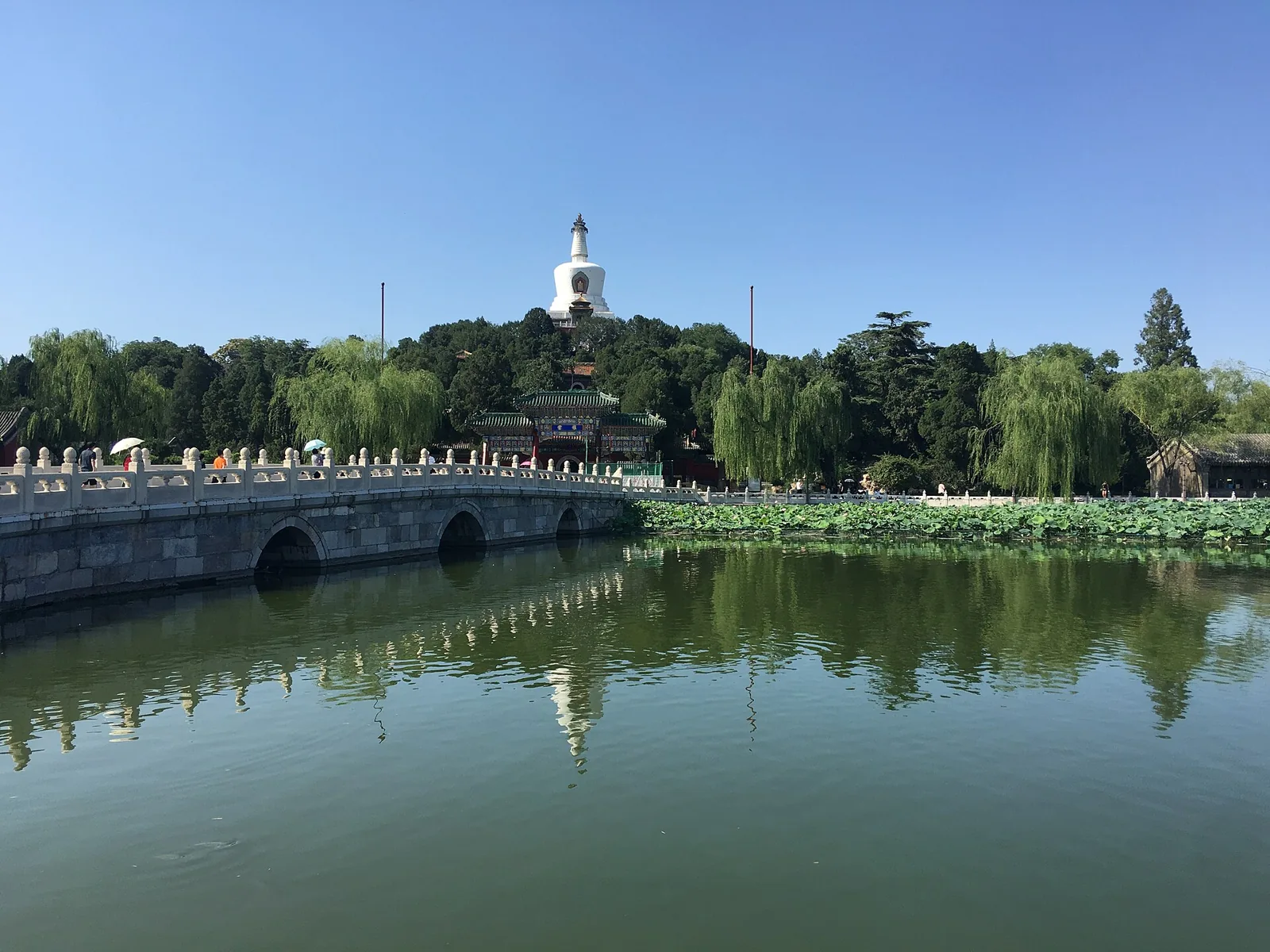
For a first, focused island visit, approach the south entrance, look at Yong’an Bridge and the White Dagoba composition, then enter the temple-and-hill area only if it is open and suits your party. Allow roughly two hours as an editorial starting allowance, more if you want slow observation or a long rest. You can finish with a shore view without committing to the climb.
For a north-shore visit, Beihaibei, **北海北**, on Metro Line 6 is the useful named station confirmed in the city’s July 2026 visitor information. Choose the north gate and a limited set of gardens or waterside stops. Starting there does not require crossing the lake to obtain a worthwhile visit.
A boat can connect or enrich the two sides when operating. It should be an option in the plan, rather than the only way your party can finish.
What to buy, and what a foreign visitor can do at the gate
The operator’s current visitor page posts ordinary park admission at **10 yuan in April–October** and **5 yuan in November–March**, with combined tickets at **20 and 15 yuan**, respectively. The July 2026 city information corroborates the 10-yuan warm-season park fare.
Ordinary park admission is the appropriate starting product for a shore walk. If your aim is entering the temple area below the White Dagoba or visiting the Round City, **Tuancheng, 团城**, ask the ticket window which internal access the current combined ticket includes and whether those spaces are open that day. Do not assume a boat or guide is included because the product says “combined.”
A municipal data inventory explicitly describing 2021 information lists Yong’an Temple and Tuancheng as separately charged areas. That establishes why an internal-admission decision exists, but this article does not sell its old individual fares as a verified current checkout quote. The live operator’s general ticket table does not itself spell out every combo inclusion. Resolve that product detail at purchase rather than inferring that all named gardens and events are covered.
Foreign visitors have a documented on-site alternative to app booking. In its June 2025 answer naming both Beihai and Jingshan, Beijing confirms online and offline purchases, with paper tickets available at the park gates and no advance reservation required for ordinary park entry.
This newer, specific answer differs from the January 2023 English ticket page, which still tells foreign travelers to phone ahead and says unreserved on-site buying is unavailable. The newer answer provides the practical assistance route. Carry your original passport and ask for the intended date and admission product at the window; a smartphone verification failure need not automatically cancel your visit.
For online buying, follow the current official 畅游公园, Visiting Beijing Parks, entry and read the order’s identity and QR-code instructions. A payment attempt is not the same as an issued ticket. If you are unsure about an internal area, concession or overseas payment, the official answer gives **+86 10 64037972**, with English service **08:30–17:00**. Confirm the specific difficulty rather than buying an unrelated ticket to get past a form.
Rework old north-shore routes around construction and Monday closures
**Xiaoxitian, 小西天, is not a dependable open stop in a late-2026 itinerary.** The operator’s July 24, 2026 construction notice, read from its actual notice image, announces closed-site restoration. Work is planned from July 27, 2026, with completion expected in **December 2027**. The notice says the area is closed and instructs visitors to use the signed route around it. A projected completion month is not a confirmed reopening date.
This matters because older recommended circuits lead visitors from the island ferry through the Five-Dragon Pavilions to Xiaoxitian, Chanfu Temple and other north-shore courtyards. You can use the landscape idea while removing a closed stop. Do not follow an old checklist to a construction barrier and then try to cut through the work area to complete it.
There is also a weekly restriction. Beijing’s September 2026 notice confirms resumed Monday closure from September 1 for Yong’an Temple, Yilan Hall, Huafangzhai, Jingxin Studio, Xitianfanjing, Chanfu Temple and the Wanfolou remains. These names describe internal historic areas; the notice does not declare the whole lakeside park closed every Monday.
For an ordinary Monday, deliberately plan a landscape walk with views of the island and open public paths. For a temple- or courtyard-focused visit, choose another day and then check temporary notices for the particular places you want. A Tuesday–Sunday date resolves the normal weekday rule, but does not override restoration or exhibition setup closures.
The operator also retains other courtyard notices on its home page. Their presence alone is not proof that every affected courtyard is still shut today. The useful question for staff is specific: “Is this named courtyard open on my date?” Avoid turning a single historic announcement into a blanket closure of Beihai.
Look at the White Dagoba and Nine-Dragon Wall as different kinds of architecture
The White Dagoba, 白塔, is the island’s visual anchor. The park management center’s heritage description dates its beginning to **1651**, notes later rebuilding after earthquake damage, and places it at the top of the island’s temple composition. The structures rise in stages from the temple gate toward the stupa.
Notice that sequence from below before climbing: bridge, temple approach, terraces and white silhouette. The image across water and the experience of ascending through the temple are related but different. Seeing the tower from a shore path is not the same as entering its surrounding compound, and a visit to the compound is not a promise that you can climb inside the stupa itself.
If your group wants less ascent, the bridge-and-lake composition gives a substantial view of the landmark. If you choose the higher route, assess the steps and descend by an authorized path; the fact that the hill is smaller than a mountain excursion does not make every terrace suitable for every traveler.
The **Nine-Dragon Wall, 九龙壁**, on the north side offers a different way to look closely. The management center’s description identifies its double-sided glazed-brick dragon decoration. If the access route is open, look at both faces and compare how color, relief and repeated forms build the scene. It is a screen wall, not simply a mural attached to a palace room.
Choose one of these as your main architectural task if time is short. A traveler interested in the lake composition may prefer the island and shoreline; someone interested in decorative craft may spend longer at the wall and nearby open gardens. Neither requires claiming Beihai is a separately inscribed UNESCO site. Its imperial history and surviving landscape are sufficient reasons to visit without attaching an unverified designation.
Choose the boat by its purpose and charging unit
The operator’s actual boat-service page distinguishes passenger services from boat rentals. Selected posted fares in yuan are:
| Product | Posted charge | What you are choosing |
|---|---|---|
| Large ferry, north shore–Yilan Hall, both directions listed | 20 per person, one way | A crossing between named landings |
| Small ferry, west shore–Linguang Hall | 5 per person, one way | A different, shorter named crossing |
| Round-lake dragon boat | 50 per passenger trip | A sightseeing circuit |
| Staff-rowed boat | 40 per person for half an hour; 60 for an hour | Time on the water without rowing yourself |
| Ordinary four-person electric rental | 180 per boat per hour; 400 deposit | A self-operated rental |
| Four-person pedal rental | 120 per boat per hour; 400 deposit | A rental requiring your own effort |
Swipe to see the full comparison
Do not compare 20 yuan and 180 yuan as if both bought the same journey. One is a single passenger crossing; the other is an hourly boat rental with a deposit. For four people using an ordinary four-seat electric boat for one hour, the posted hire works out to **45 yuan each**, before any rounding or extra-time terms. That arithmetic helps compare a group rental with per-person sightseeing, but it does not make the rental a ferry.
At the dock, establish the boarding location, destination or permitted rental area, return point, charging increment and deposit refund process. Keep the return instruction with the person steering or rowing. If your priority is reaching the north shore, choose a service that actually lands there rather than a scenic circuit that returns to its starting point.
The page posts **09:00–17:00** service, small-boat ticket sales ending at **16:00** and the last large-boat departure at **16:40**. These are standard posted times, not a guarantee of every vessel, route or seasonal extension on your day. A park open until 21:00 does not imply boats continue until then.
If boats stop for weather or seasonal reasons, retain a walkable return route to the exit you selected. A rental deposit is also cash flow you must have available during the visit; it is not simply another admission fee. Ask what happens to unused service if conditions change, using the terms of the product you actually purchased.
Finish with a route that still works without the optional stops
The operator’s current schedule gives April–October park closure at **21:00**, with last entry **20:30**; November–March closure is **20:00**, with last entry **19:30**. Historic areas have shorter daytime windows. The operator homepage spells out their warm-season last entry at **17:30** and cold-season last entry at **16:30**, ahead of closing half an hour later. Leave the desired interior visit before those cutoffs and use the remaining park time for scenery.
A workable short southern plan is the entrance and bridge view, the available temple-and-island route if appropriate, and a return to a known gate. A workable northern plan is a lake segment plus one or two open architectural stops, with the Nine-Dragon Wall as a possible focus. A longer visit can link them with a confirmed ferry or shore walk while leaving out Xiaoxitian’s closed construction area.
The operator’s visitor page lists gate-area wheelchair loans and a mother-and-baby room inside the south gate, with the visitor-service number for assistance. Loan availability and access to historic terraces need checking; this guide does not certify a step-free climb to the White Dagoba or every garden interior. For a party that needs rests, a smaller shore route can be more useful than completing an entire circuit.
Before setting off, name your **entrance, main experience and exit**. When deciding on a boat or another courtyard, ask whether it improves that route and whether the open status is confirmed. Beihai is enjoyable as a deliberate garden visit even when a closed monument or unavailable ferry changes the details.
Sources and editorial note
Individually researched from the live Beihai visitor and boat pages, the actual July 2026 Xiaoxitian restoration notice image, the newer park-specific passport-window answer, September closures and management-center heritage descriptions. Old booking and fare evidence is explicitly dated. AI-assisted desk research; no checkout, dock transaction or field accessibility test claimed.
Current combo inclusions require product confirmation; the general operator table does not enumerate them. Boat fares are posted references, not proof of date-specific operation. Other historical courtyard notices are not treated as continuing closure without confirmation. Accessibility and durations have practical limits.
- https://www.beihaipark.com.cn/#/guide
- https://www.beihaipark.com.cn/#/index/boat
- https://www.beihaipark.com.cn/#/detail/f20cbb9232c64466a8ea25a657d34a5f
- https://english.beijing.gov.cn/12345hotline/faqs/all/202506/t20250620_4117982.html
- https://english.beijing.gov.cn/specials/parktours/guidevisitors/beihaipark/overview/202301/t20230111_2896599.html
- https://english.beijing.gov.cn/specials/parktours/informationvisitors/focus/202609/t20260904_4850656.html
- https://www.beijing.gov.cn/fuwu/bmfw/bmzt/jxqlzn/shdw/202607/t20260713_4760044.html
- https://gygl.beijing.gov.cn/mlgy/mlgy_gyjg01/201912/t20191211_1048483.html
- https://gygl.beijing.gov.cn/mlgy/mlgy_gyjg01/202109/t20210930_2506297.html
- https://english.beijing.gov.cn/specials/parktours/guidevisitors/beihaipark/index.html
- https://data.beijing.gov.cn/zyml/wnkfsj/63f3ccb5324d460091913b8d818686d7.htm