

On this page
Choose a landscape visit, not just a famous address
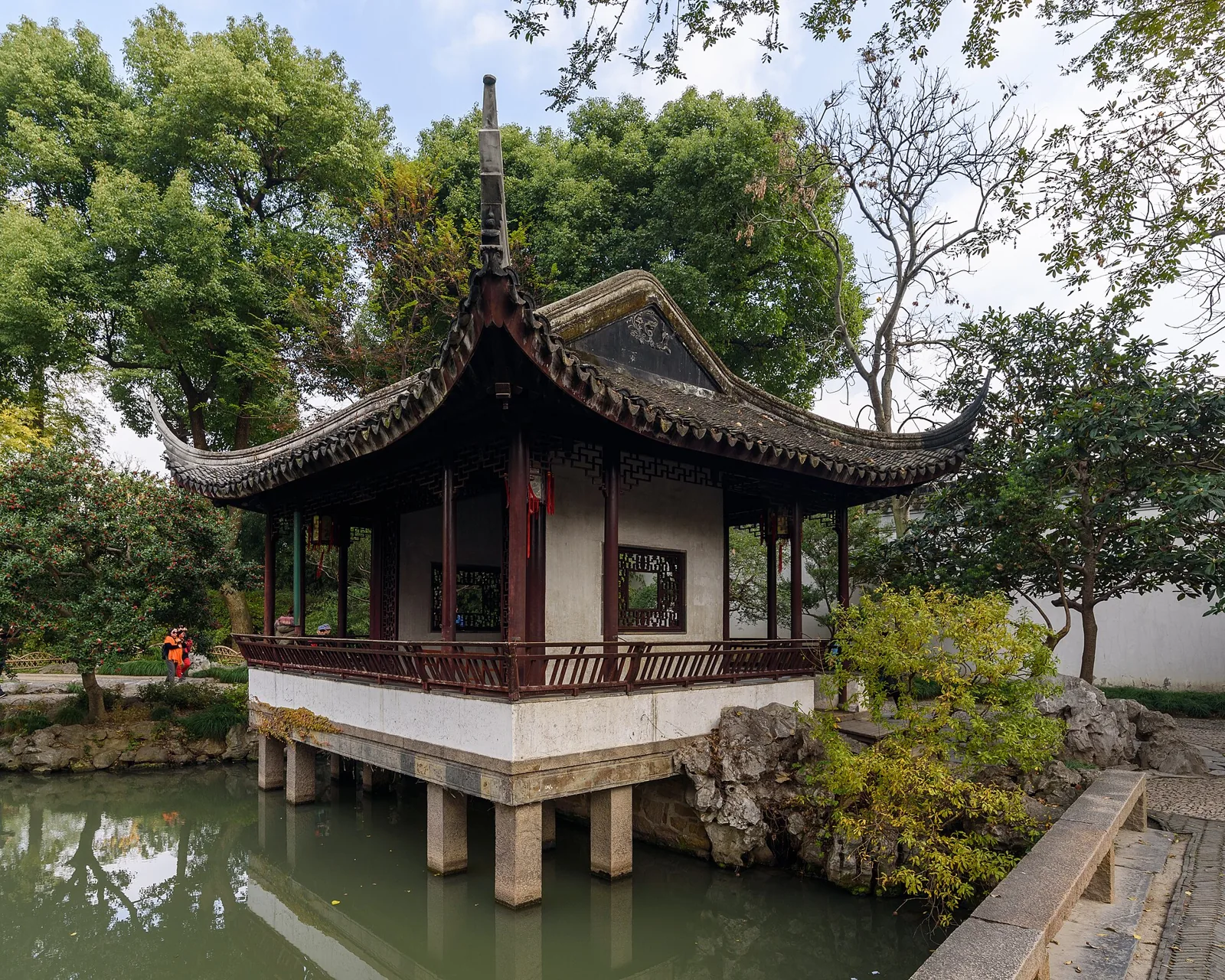
The Humble Administrator’s Garden, **拙政园**, is a good choice when you want to understand how buildings, water, rocks and plants make a sequence of views inside a city. It is a paid garden at **178 Dongbei Street**, not the garden of the neighbouring Suzhou Museum. A museum appointment does not provide garden admission, and a night-tour product is not automatically an ordinary daytime ticket.
For a first visit, choose daylight and enough time to stop at several positions around the central water landscape. That recommendation is about seeing relationships, not completing a mandatory numbered trail. A pavilion can be a destination, a foreground frame and a distant focal point depending on where you stand. Walking quickly past its name misses that change.
You can prepare with three questions: where will I enter, what exact product have I bought, and which views will I spend time comparing? These are more useful than an itinerary promising every pavilion, museum room and nearby garden in a short gap between appointments.
Foreign-passport products exist, but inspect the selected product
On the city’s Jun Dao Suzhou cultural tourism portal, checked on October 14, 2026 in China, the garden list showed a passport/Hong Kong–Macao–Taiwan adult product at **RMB80**, plus a separate passport adult product labelled for same-day booking. In the latter, the displayed current date was selectable; the ordinary passport product offered later dates. This observation disproves a blanket claim that the portal never lists same-day passport bookings. It does **not** prove that your preferred session remains available or that a purchase will succeed.
Choose the record that fits the visit date rather than treating two similarly priced entries as interchangeable. Open its booking conditions, then check the date, session and document category together. A label containing Passport is useful; the generic line about scanning a Chinese identity card is not proof that a foreign passport will work on that same automated reader. Ask which voucher and manual verification route applies to the product you select, and bring the matching original document.
The portal distinguishes platform support **0512-66555111** from scenic support **0512-962015**. For a rejected online field, identify the product title and the error to platform support; for the gate’s passport-verification procedure, ask scenic support. We inspected the published products and conditions without entering traveller information, submitting an order or testing a foreign bank payment.
What the published daytime price table actually says
The garden authority’s price table, dated July 11, 2024 and still publicly available at review, gives this seasonal division:
| Ordinary garden admission | Months in that table | Published adult price |
|---|---|---|
| Higher-price season | April, May, July, August, September, October | RMB80 |
| Lower-price season | January, February, March, June, November, December | RMB70 |
Swipe to see the full comparison
June belongs to the lower-price group in that table; do not turn the rule into “April through October”. The RMB80 passport product observed in October is consistent with the table, but the payable product and date still need checking. A reduced-price category is an eligibility question, not a promise that every overseas student or senior receives the same concession.
Cancellation and no-show treatment are different
The portal’s inspected passport-product conditions say unused tickets may be refunded, dates cannot be changed directly, and changing the date requires cancellation and a new booking. They also separate refund entitlement from no-show records: cancellation before midnight on the previous day avoids a no-show; late cancellation after the reserved session can count toward suspension. Two no-shows within a week trigger a 30-day booking restriction under those conditions.
Consequently, “refundable” should not persuade you to hold a session that your train cannot realistically reach. Resolve a date change promptly and check whether replacement stock exists before relying on the new visit. Preserve the old and new order records; do not assume that a cancellation automatically moves the appointment.
Opening time is not the end of admission
The authority’s January 2025 operating table lists daytime opening from 07:30, with seasonal closing and earlier last entry:
| Period in the table | Closing | Last ticket verification |
|---|---|---|
| March–October | 17:30 | 17:00 |
| November–February | 17:00 | 16:30 |
Swipe to see the full comparison
Check the actual date’s notice and accepted session before travelling. The 2026 early-opening announcement moved opening to 06:45 only from June 19 through October 7. That period has ended at this guide’s review; it is not an evergreen promise of 06:45 admission. Holiday extensions and night-tour arrangements also need their own date-specific confirmation.
For sightseeing, last entry is an outer limit, not a recommended start. If the only acceptable session is late, choose a shorter set of views and protect the exit margin. If an evening product is your real priority, read its route, language, duration and inclusion of garden admission rather than buying ordinary daytime entry and assuming you can remain through the transition.
Use east, centre and west as different spatial experiences
The garden authority’s site account distinguishes an open eastern area, a central area organised around water, and a western area with a bent pond and changing corridors. Its central landmarks include Yuanxiang Hall, Xiangzhou, the Lotus Breeze Pavilion, Jianshan Tower and Xiaofeihong; the west includes the Thirty-Six Mandarin Ducks Hall and With Whom Shall I Sit Pavilion.
Orient from the entrance map and follow open circulation toward the central water landscape. Then decide whether to continue into the west or spend the remaining time revisiting a view from a different position. This is a flexible editorial sequence, not a claim that every entry gate permits an identical route or that a diagram guarantees every passage is open.
Try giving each area a different task:
| Area | A useful observation | What to compare |
|---|---|---|
| East | Find a point where you can see a broad scene and another where a building frames a smaller part. | How much the boundary of the view changes without adding a new attraction. |
| Centre | Choose one building across water, then see it from another authorised shore position. | Foreground, reflection, apparent distance and its relationship to another roof or tree. |
| West | Notice a corridor’s turn before following it. | What was hidden before the turn and what appears afterward. |
Swipe to see the full comparison
You do not need the ideal empty photograph to do this. A brief pause beside the walking line can be enough. Avoid turning a narrow covered passage into a static group discussion area when other visitors need to pass.
At Yihong Pavilion, the distant tower belongs to the city
The garden authority’s Yihong Pavilion interpretation places this pavilion at the boundary between east and centre and discusses the westward view toward the central water and the distant Beisi Pagoda. Shanghai’s public garden-culture explanation identifies the pagoda as outside the garden. This is an example of borrowed scenery: a sight does not have to be owned by the garden to contribute to its composition.
If visibility and the current route allow, first find the distant vertical feature, then bring your attention back to the nearer water edge. What visually links near and far? Compare that view with one where a nearer tree, roof or wall interrupts the tower. The change helps explain why protecting a garden view concerns the surrounding city as well as the garden itself.
Do not interpret a tower seen from here as something your garden ticket lets you climb. Nor should a hazy day or obstructed position become a reason to search restricted ground for a prescribed photograph. The useful lesson is the relationship between the garden boundary and the visual boundary, even when the long view is imperfect.
A round opening is a frame that changes when you move
The Shanghai account describes **Wuzhu Youju, 梧竹幽居**, as a pavilion with four circular openings. Instead of photographing one opening and leaving, choose a permissible standing point where you can see through it. Move a short distance sideways without blocking circulation, and notice what the frame includes and excludes.
A foreground trunk may cross a distant roof; a piece of water may expand or disappear. The opening stays in place while the scene changes with the observer. That is why a garden is difficult to understand from a single postcard view or overhead plan alone.
With children, turn this into a quick drawing exercise: a circle containing three things actually visible through the opening. Compare it with a companion’s sketch from a different angle. The difference is a result worth discussing, rather than an error to correct. No flower season or specialist art vocabulary is needed.
Keep a distinction between a designed opportunity and current conditions. An opening can frame plants without guaranteeing spring blossom, summer lotus, autumn colour or winter snow. The main garden experience remains available for consideration when one seasonal subject is absent.
Xiangzhou and the fan pavilion offer different kinds of likeness
The Shanghai garden-culture account identifies **Xiangzhou, 香洲**, as a stationary boat-shaped building and describes **With Whom Shall I Sit Pavilion, 与谁同坐轩**, through its fan-shaped roof, openings and furnishings. These are architectural forms to examine, not a boat service or an invitation to expect a scheduled performance.
At Xiangzhou, look for the features that make a building read as a vessel: the relationship to water, the organisation of enclosed and open space, and the imagined direction of travel. Then notice what makes it remain a building. The interest lies in that tension; a literal label such as “old boat” loses it.
At the fan pavilion, compare the roof outline with an opening or furnishing described on the sign. Does the same shape behave differently overhead and at eye level? A design idea can tie several scales together without making every feature identical. If interiors are inaccessible, compare the visible exterior rather than claiming to have examined furnishings you cannot see.
These stops also give you a way to choose a guide. Ask whether they can explain a spatial relationship at two selected places in a language the group understands. A recitation of every pavilion name is not automatically a more informative service. Confirm meeting point, duration and any admission inclusion before purchasing commentary.
A Ming foundation does not date every present feature
The garden authority dates the foundation to **1509**, associated with Wang Xianchen, and records later changes in ownership, division into parts and restoration before public opening in 1952. It presents Wen Zhengming’s role in the original design as a tradition, rather than documentary certainty that every present feature came from his hand.
UNESCO’s account of the Classical Gardens of Suzhou includes this garden in a group of nine and stresses carefully made miniature landscapes, literary associations and continuing conservation. The heritage listing concerns a group of distinct gardens; it is not a single ticket or a requirement to visit all nine.
Read foundation date, rebuilding date and repair date as separate questions. This also changes how you look at a fresh coating or restored wooden element: current maintenance can sustain a historic design, while an ancient name alone cannot identify the age of the material in front of you. Let a specific label or guide establish that chronology when it matters.
Pair with Suzhou Museum only when both appointments fit
The garden and Suzhou Museum’s main building are a useful pairing for comparing classical and contemporary treatments of courtyard, wall, roof and water. They remain separate visits. Confirm the museum’s main-building appointment, not its distant West branch, and preserve time for leaving one site, resting and finding the other entrance.
Line 6’s **拙政园苏博站** is a useful approach station; the city’s June 2026 metro service report identifies it and its service desk with accessibility information. Ask for the exit and onward route appropriate to your party. The station name alone does not remove the walk or establish that every garden corridor is step-free.
The garden’s August 2025 visitor rules specifically prohibit climbing historic buildings and rockeries, entering non-open areas and flying drones; they also flag wet steps and paths. Keep the view-comparison exercises on authorised routes. If someone cannot manage a section, ask for an alternative to that named section and agree where the party will reunite.
If only one institution fits comfortably, choose it and spend the saved time properly. A garden visit has succeeded when you can describe how one view changed as you moved, which distant sight was borrowed, and why the purchased entry matched your plan. It does not depend on finishing a list of every building name.
Sources and editorial note
Independent garden-space guide using primary garden authority layout/history/Yihong interpretation, Shanghai garden-culture explanation, UNESCO813. Actual city portal loaded in browser; ordinary and separate same-day passport-product conditions/calendar read without identity, purchase or next-step submission. 2024seasonalprice/2025hours and2026Juneexpiredopening checked.
No passport order, foreignpayment or continuousaccessible route tested. Current slots and interior access vary. Day and night products separate; no guarantee flowerseason or emptyviews. Price tabledated2024, hoursdated2025.
- https://m.cloud.sz-trip.com/ScenicDetail?id=5442&type=scenic
- https://ylj.suzhou.gov.cn/szsylj/mpjg/wztt.shtml
- https://ylj.suzhou.gov.cn/szsylj/kfsj/wztt.shtml
- https://www.suzhou.gov.cn/szsrmzf/mszx/202606/face4650ec2245ce818aecc53eb4aaaa.shtml
- https://ylj.suzhou.gov.cn/szsylj/ryxz/202407/921e9d7452614019bfabb78a4431a0ed.shtml
- https://ylj.suzhou.gov.cn/szsylj/sjyc/201905/c1df393edc8745abb20e8a9bd5525782.shtml
- https://ylj.suzhou.gov.cn/szsylj/ylwh/201604/de87bef1b00346399c17a6df2afb2651.shtml
- https://lhsr.sh.gov.cn/jnylwh/20200824/7cc5e5102094470b94a8f771808c1f53.html
- https://whc.unesco.org/en/list/813/
- https://www.suzhou.gov.cn/szsrmzf/bmdt/202606/ae3471e8389d4da7b1be1246cdef0066.shtml