

On this page
The branch name is your first important decision
Choose **Suzhou Museum Main — 本馆**, at **204 Dongbei Street**, if your priority is I. M. Pei's museum architecture and the historic-quarter visit beside the Humble Administrator's Garden. Choose **Suzhou Museum West — 西馆**, at **399 Changjiang Road**, for its own exhibitions and a different location. West is not simply another room beyond the Main building's courtyard.
The museum's current rules distinguish their admission: **Main requires a timed real-name reservation; West allows direct entry after security, subject to crowd control**. Switching branches can provide another museum visit, but it cannot guarantee the same building, object or exhibition you originally intended to see.
For a first Main visit, reserve enough time for both architecture and a small collection focus. The courtyard photograph is one part of a building organized around rooms, connections and controlled light. Pair that with one object you can study carefully, rather than trying to finish every gallery before a separately timed garden booking.
This guide is based on actual official-page reading, a museum-hosted research paper and project descriptions by architecture and lighting participants. It is not a report of an on-site visit or a completed foreign-passport reservation.
Reservations: same-day availability is conditional, not categorically impossible
Main's official reservation page says booking is available seven days ahead, with system service **08:00–23:00**. It also expressly allows **same-day reservation if tickets remain**. Do not interpret that as guaranteed walk-in admission, but do not follow a guide claiming that every same-day attempt is prohibited either.
The September 2026 museum notice describes the seven-day range as including the booking day and names the official website, official WeChat account and **苏州博物馆全预约** mini-program. Read the actual calendar for your desired visit, particularly around a closure day. “Seven days” without its counting convention can lead you to set a reminder for the wrong date.
Use the official channel and choose 本馆 before confirming the address and time. For a foreign passport, use the appropriate document type offered in that channel. If your identity or phone details cannot be entered, contact **0512-67575666** about the exact field and intended date. We have not completed the mini-program's passport flow and do not promise that every foreign account will work without assistance.
Do not substitute an invented mainland identity number or accept an order that identifies another traveler. Save the successful reservation, document used, branch and entry period together. Bring the matching valid document for staff verification. A third-party screenshot showing “Suzhou Museum available” is not the same as a confirmed Main reservation in your name.
Main's rules allow one change to another available period on the original date. If you cannot attend, read and use the actual cancellation procedure rather than building multiple speculative reservations. No-show restrictions can affect a later visit. Ask before moving other plans around an assumed date change: changing an entry period and changing the visit date are different requests.
For West, the current rules permit visitors to arrive directly and proceed through security. They also say entry can slow or pause at the instantaneous capacity limit. No reservation requirement does not mean there will be no queue, and a separately ticketed exhibition can have its own conditions.
Do not turn a holiday extension into normal opening hours
Both branches' ordinary published period is **Tuesday–Sunday, 09:00–17:00, last entry 16:00**, with Monday closure except legal holidays. The September/October 2026 extension to 20:00 was date-limited and excluded the Zhongwang Mansion area. It ended for the specified National Day extension on October 6; it is not an everyday evening entitlement.
Plan around the actual reserved period. Main's rules address an arrival tolerance, but the final period still requires entry before the last-entry cutoff. Treat your confirmation as the target arrival time rather than using a tolerance as planned extra sightseeing time.
If you have luggage, Main directs storage at the visitor service centre **30 minutes before the reserved entry period**, with the first period's storage beginning at 09:00. That changes a train-to-museum plan: reserve time for the bags before joining the admission route, and establish the collection arrangements for afterward.
The museum warns of road works around Main and recommends checking the current municipal restrictions. Use the exact entrance and road-accessible approach for your date; an old taxi-drop-off recommendation may no longer be the most usable one. A metro journey still needs its final pedestrian segment, especially when a party is moving slowly or carrying cases.
Before combining Main with the Humble Administrator's Garden, verify that the garden has its own confirmed entry arrangements. Geographic adjacency does not establish a combined ticket, internal shortcut or flexible second appointment. Keep an actual walking and resting margin between the two.
Read the new building as a contemporary response to its neighbors
PEI Architects describes the museum as adjoining the historic Zhongwang Mansion complex and the Humble Administrator's Garden, opening in 2006. Its design draws on Suzhou's white walls, dark roof forms and garden architecture. Site architect Bing Lin's project account describes interconnected galleries and courtyards, using white walls and stone roof tiles as a contemporary interpretation of that local language.
Start by observing the roof geometry from an accessible public space. How do planes meet, and where does a dark edge define a white wall or an opening? Then look from a room toward a courtyard. Which part of the view is enclosed by the building, and which part is left open? These are practical ways to read the design rather than assuming that any white wall and dark roof is an old building.
The new museum, the historic mansion and the neighboring classical garden belong to different histories. Read the date and label for the area you are in before calling a photograph “ancient Suzhou architecture.” A contemporary interpretation can be worth studying in its own right; it does not need to be mistaken for a surviving Ming house.
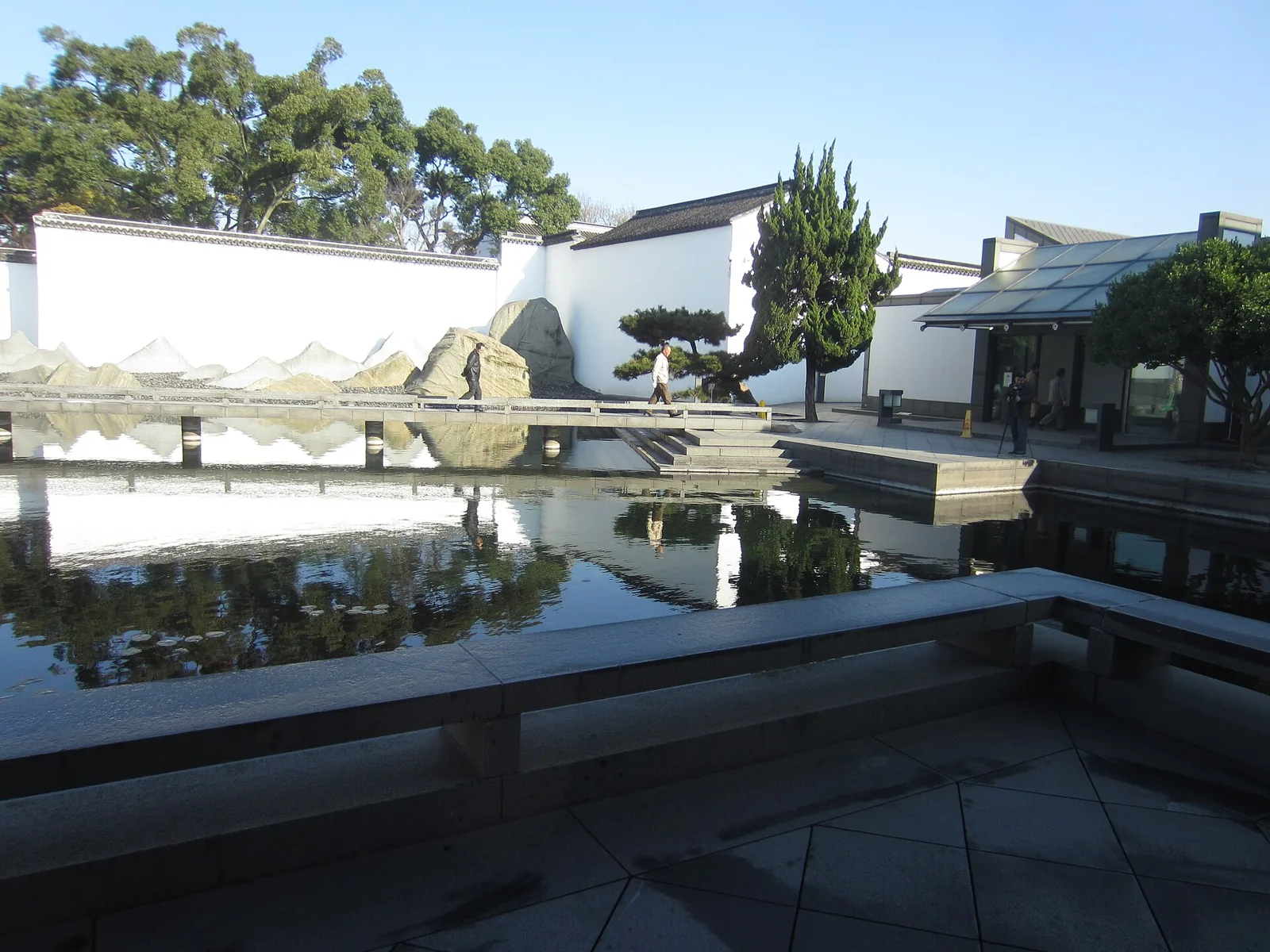
Our main image is Another Believer's 2015 photograph. It illustrates the museum's architectural setting, not today's visitor path or permission to enter every visible area. Follow the current circulation and any temporary restriction rather than trying to recreate the photographer's precise position.
Notice the light before you take another courtyard picture
Lighting participant Fisher Marantz Stone explains that the project was designed for controlled daylight in galleries and public spaces, with conservation requirements and changing exhibitions in mind. Light here has a job as well as an aesthetic effect: a gallery is not simply a brightly lit room for taking portraits.
At a permitted pause, compare an object-viewing space with a circulation space. Where does daylight appear to enter? Is it direct, diffused or reflected? Do a doorway and a window frame different kinds of view? You can study those distinctions without deciding that a room must have a particular technical lighting system based on appearance alone.
In the contemporary water-garden area, compare a full scene with one relationship within it: water against wall, a stone profile against a pale surface, or a roof edge reflected below. Stay within permitted viewing areas and keep access clear. An interesting image comes from selecting a relationship, not necessarily from standing in the longest photo queue.
If weather or crowds make the best-known courtyard view disappointing, shift your attention to a gallery threshold or another open architectural connection. The museum's spatial design continues beyond the famous scene. You do not need a guaranteed sunny reflection or an empty courtyard to leave with a useful architectural observation.
The lotus bowl: a name supported by research, not a color nickname
The museum-hosted 2019 study of the **mise lotus bowl** describes a bowl and stand, with lotus decoration continuing across their shapes. It recounts recovery during Tiger Hill pagoda work in the 1950s and examines how its identification developed through comparison: the Famen Temple finds and inventory, expert study, and later kiln-site evidence and marks. A popular caption giving a single recovery year is less informative than that chain of evidence.
If the bowl is on display, look separately at the body and its support before reading them as one form. Where do petals point upward, and where do they turn downward? How does the stand change the silhouette of an object that could otherwise look like an ordinary vessel? Then look at the glaze over the relief. A photograph of one flat patch of color misses much of the object's design.
The research account is valuable because it shows why a museum's classification can become more precise. “Mise” is not a color you can prove by matching a phone screen to a pale green souvenir. Read the label's date, kiln attribution and provenance. A display drawing, underside photograph or comparison can explain evidence not visible from the case's usual viewing angle.
Do not claim that a workshop reproduction has the original's material, firing or provenance merely because the shape resembles it. Enjoy a contemporary object as a contemporary object, with its own maker's information. The original's archaeological and research history cannot be transferred to a gift-shop product.
The 2019 paper describes an earlier gallery arrangement; it does not guarantee the bowl's exact position or original-versus-replica status today. Ask which version is displayed and whether the current collection route includes it. If it is unavailable, use the research to understand the object and spend your on-site time with another confirmed original rather than searching every room on an outdated map.
A time-limited opportunity: the assembled relic pagoda
For the Main building's twentieth anniversary, the museum announced the **original Northern Song pearl relic pagoda** assembled as a complete object in the **塔放瑞光** display, **September 15–October 18, 2026**. A September 16 report confirms that the presentation began. These dates are essential: this guide does not promise the same assembly or access after October 18.
The reported object combines a nanmu-wood body with materials including gold, silver, pearls, agate and crystal. Look first at the whole structure, then choose one material and follow where it is used. How do repeated small elements create a larger architectural effect? Does a detail serve as an edge, a support, an enclosure or decoration?
Read the label's distinction between the original, any separate component and any explanatory image. An assembled presentation can help you understand the relationship between parts, but it does not mean the object should be treated like a miniature building visitors can touch or operate. Conservation and interpretation shape how you are allowed to approach it.
If this is your chief reason for coming, secure a Main reservation within the announced dates and reconfirm the display before an inflexible journey. West's different location or a past exhibition of some components is not a substitute for that exact anniversary presentation. After the date window, ask what is currently shown instead of assuming an internet image is current.
Build a visit that can survive an unavailable object
For an architecture-focused Main visit, begin with an open gallery route, pause at a few thresholds and courtyards, and add one collection object whose display is confirmed. For a collection-focused visit, choose the original you want to understand, read its context carefully, and leave time for the building around it. These are alternative emphasis choices, not fixed timed circuits.
For West, start with its current exhibition programme and identify the floor and any separate ticket. Choose it because its actual displays fit your interest, or because a flexible museum day suits you. Do not navigate there solely because a search result calls both buildings “Suzhou Museum” and shows a photograph of Main.
For electric-wheelchair users, the museum's published rules recommend contacting the visitor service centre to change to a manual wheelchair. Ask about the chair, assistance, storage and continuous route before arrival; a suggested replacement does not establish that every gallery or approach meets your personal requirements. The rules also mention smooth floors and sunken steps, so avoid treating a modern building as automatic proof of unrestricted access.
Use museum-approved photography and follow individual exhibition restrictions. The rules prohibit flash, extra lighting and specified support equipment, and restrict commercial use. Keep the question you are trying to answer in mind: structure and light, the relationship of bowl to stand, or the assembled parts of a relic object. A few labelled observations are more useful than treating the museum as a backdrop for an entire camera roll.
If a reservation fails, the anniversary display ends or an object is withdrawn, change the **confirmed visit**, not the facts. Main architecture, West exhibitions and Suzhou's neighboring gardens offer different reasons to visit; none needs to be described as the exact equivalent of another. Choosing clearly lets you spend your time studying what is actually open.
Sources and editorial note
Independent architecture/research itinerary. Actual rendered Main/WestReservationTipdistinctrules; officialSep16museum notice reproducedSuzhouGov;PeiArchitects/OLIsitearchitect/FMSownprojectaccounts; actual6page2019institutionhostedlotusresearchPDFfulltextread;anniversarySep15Oct18announcementandfirstdayconfirmation. No passport transaction or field visit.
No completed foreign-passport booking; current object display/original status and continuousaccess must confirm. Main/West differentbuildings/admission notequivalents;older2019collectionroomnotcurrentinventory.
- https://www.szmuseum.com/
- https://www.szmuseum.com/Other/ReservationTip
- https://www.suzhou.gov.cn/szsrmzf/mszx/202609/2d1a50ec4496485d9f5c332de585dfdc.shtml
- https://www.suzhou.gov.cn/szsrmzf/szyw/202609/053cb19d0dcb47eab25253e6869f2b01.shtml
- https://www.suzhou.gov.cn/szsrmzf/tpxw/202609/d934c6a713e1421d97396a5500c84850.shtml
- https://pei-architects.com/projects/suzhou-museum/
- https://oliarch.com/project/suzhou-museum/
- https://www.fmsp.com/projects/suzhou-museum/
- https://file.szmuseum.com/WaterMark/%E9%97%A8%E6%88%B7%E7%BD%91%E7%AB%99%E5%A4%9A%E5%AA%92%E4%BD%93%E6%96%87%E4%BB%B6/academic/2019/201911_msclhwdqsjs_cheny.pdf