

On this page
Free admission still needs a confirmed place
Lingyin Temple and the surrounding Feilai Peak scenic area became admission-free on December 1, 2025, including Yongfu and Taoguang temples. The practical obstacle for most foreign visitors is now obtaining a valid place in the real-name reservation system, rather than buying the old scenic-area ticket and separate temple coupon. A hotel room, a taxi ride and a paid guide do not prove that place has been secured.
There is an important change between the temple's two English notices: the November 2025 rules allowed on-site registration if space remained; the February 2026 notice cancels that route and replaces it with an online waitlist. Use the later rule. Do not plan to arrive without confirmation and join a registration queue. The February notice explicitly requires a successful reservation or allocated waitlist place, a reservation voucher and the original valid identity document.
Once entry is settled, the strongest visit combines two different experiences: sculpture carved into a limestone landscape and an active monastery whose buildings and images have been repeatedly renewed. Neither becomes more meaningful by collecting every temple name on the map. Decide what you want to understand, leave room to observe it, and make uphill additions optional.
Prepare a passport booking without mistaking submission for success
Search WeChat or Alipay for the official mini-program named 杭州灵隐飞来峰, described in English as Hangzhou Lingyin Feilai Peak. The November notice permits passports for non-mainland visitors, ordinary bookings one to seven days ahead, and release at 08:00 on the seventh day before entry. It lists morning and afternoon sessions, daily visiting hours of 07:30–17:30 and verification ending half an hour before closing. The accepted booking and current interface should determine your arrival session.
Practical preparation:
- Have each person's original passport details ready, including the person travelling with you. Choose the passport category rather than trying to satisfy a mainland identity-card field with a different number.
- Compare the selected date and session with your actual arrival in Hangzhou. A morning reservation on the day of an uncertain train arrival creates an avoidable dependency.
- After submitting, reopen the order or reservation record. Check the visitor, document type, date, session and status. Keep the accepted voucher accessible on the phone you will bring.
- Before leaving accommodation, check that the original passports, working phone and confirmation are together. A screenshot of someone else's appointment is not your reservation.
These are preparation steps, not a claim that Bangsai completed a foreign-passport booking. We checked the published passport rule; we did not submit a traveller's identity, test an overseas phone account or verify that every international account can complete every mini-program step. If the interface rejects your document, save the exact error and ask the scenic-area service team about that case. Giving a hotel employee the document category and rejected stage is more useful than saying only that the app does not work.
A waitlist is a possible allocation, not an entrance voucher
The February notice allows a waitlist request until 20:00 on the day before the intended visit. Allocation follows the order of applications, with results available in the mini-program and through WeChat or Alipay service messages. Its booking and waitlist support number is **0571-87969691**; from outside mainland China, use **+86 571 87969691**. This is the scenic reservation contact, rather than an assumption that the monastery's reception number handles every app problem.
Make a small distinction that protects the rest of the day:
| What you can actually verify | Travel decision |
|---|---|
| Accepted reservation matching your party and date | Arrange the approach around that session; recheck instructions before leaving. |
| Waitlist application received, but no allocated place | Keep a flexible alternative. Submission alone is insufficient grounds to travel to the gate expecting entry. |
| Waitlist place successfully allocated | Open the resulting record and check the party, date and entry conditions before changing transport plans. |
| Failure message, missing person or wrong document | Resolve that specific discrepancy through the platform or support; do not silently treat the rest of the group as covered. |
Swipe to see the full comparison
Be particularly careful with a late successful waitlist. The January 26 management notice reproduced by Hangzhou's city news service sets ordinary cancellation at 17:00 the previous day, says successful next-day waitlist places cannot be cancelled, and describes escalating no-show suspensions of 30, 60 and 90 days. The same notice preserves exemptions for visitors aged 70 and above and other eligible groups. If you rely on an exemption with a foreign document, confirm the accepted evidence and entry procedure; do not infer it from another country's senior card.
An alternative can be a chosen segment of West Lake, rather than an unrelated paid product promising temple admission. Reserve Lingyin because you intend to use the place, not as a speculative placeholder for several possible days.
Find two different dates in the rock, rather than one timeless grotto
Feilai Peak is opposite the monastery across Lengquan Stream. The temple's carving introduction places works across the Five Dynasties, Song and Yuan periods and identifies the smiling Maitreya group beside the stream as a signature carving. This is a layered sculpture landscape, not a single construction campaign.
Start with a comparison you can use without memorising hundreds of images. In its Qinglin Grotto account, the temple distinguishes a small Three Saints of the West group dated 951 from the Three Worthies of Huayan above the grotto mouth, dated 1282. Use signs and a guide to locate those groups rather than assigning dates from size or weathering alone. Look at how each group fits its niche: how much space separates figures, whether an outline stands clear of the background, and how an opening frames what you can see. Those are observable questions, not a test requiring you to recognise every bodhisattva.
The same grotto account describes narrative scenes near Longhong Grotto involving journeys to obtain Buddhist scriptures. If that path is open, shift your attention from the main seated figure to movement: who walks, what is carried, where an animal stands, and how the scene directs your eye across the rock. A travel story expressed through bodies and objects offers a different encounter from a frontal devotional image.
At the smiling Maitreya group, take one broad view and then notice the surrounding figures. Do their gestures and positions create several small conversations or one uniform pose? That question gives companions something concrete to compare. It does not require deciding that every rounded or cheerful image represents the same person.
Do not climb a barrier, touch a carved face or enter a closed grotto to complete the exercise. A route closure may remove one comparison; it does not invalidate the others. Photo coverage of every niche is less useful than understanding why two nearby groups need different historical labels.
The entrance hall has a front and a back for a reason
At Lingyin's Hall of Heavenly Kings, the temple's own introduction identifies the cloth-bag manifestation of Maitreya facing the entrance, Weituo or Skanda at the back facing uphill, and the Four Heavenly Kings at the sides. It attributes the Yunlin Chan Temple plaque to Emperor Kangxi and the Weituo image to the Southern Song period.
Read the arrangement before moving on. The welcoming central image is not the whole hall; turn your attention to the figure facing the next part of the monastery. Notice how a visitor's direction changes the relationship between the images. Position, facing and threshold are part of the experience, not empty space between statues.
Keep this exercise separate from worship. Stand where you do not obstruct a doorway or someone making an offering, observe posted photography restrictions, and move when the space is needed. You do not need to perform a devotional action to appreciate the layout. Equally, someone else's act of worship is not a performance arranged for your camera.
In the Great Hall, look at both a focal image and a narrative world
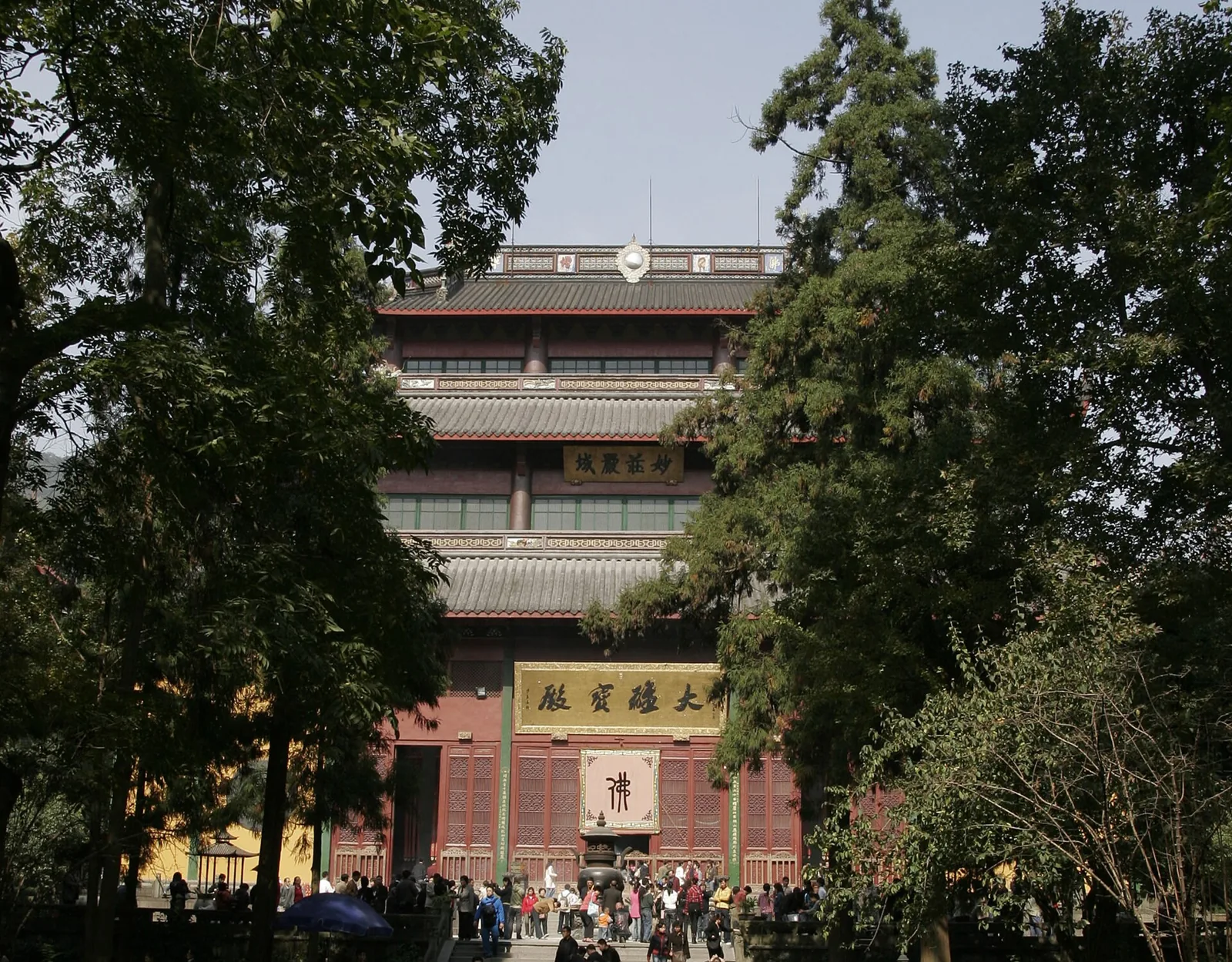
The 2013 temple description of the Great Hall places it behind the entrance hall and identifies the main Shakyamuni image as assembled from carved camphor wood in the 1950s rebuilding project. Behind that central image is a large clay-sculpture ensemble associated with Sudhana's visits to teachers in the Huayan tradition. This contrast matters more to a first visitor than an unqualified claim about the country's biggest Buddha.
First look at the main image from an authorised standing position: the face, hands, seated posture and surrounding architectural space. Then, if circulation allows, look at the ensemble behind it. Ask how many directions your eye follows there. A single focal image concentrates attention; a group containing many figures, levels and encounters distributes it. You have just identified two ways a hall can convey a religious subject without needing to reduce them to one photograph.
The monastery's history records destruction, rebuilding and repair, including the major 1952–1954 campaign. Its age as an institution is therefore not the age of every timber, coating or statue visible today. A modern repair does not make a place culturally meaningless, and an ancient foundation date does not make its entire present fabric ancient. Read a specific object's label before describing it as a surviving original.
These descriptions do not guarantee that every area is open on the day or that a service can be interrupted for sightseeing. Follow the available circulation; if the rear ensemble cannot be viewed, use the main hall comparison and continue without forcing access.
Set the physical scope before committing to every temple
For a first visit, choose a core: selected rock-carving groups and the first principal monastery halls, with rests and room for entry procedures. That is an editorial choice of scope, not an official timed circuit. Extra temples should answer a reason to continue, rather than an obligation created by free admission.
Before taking an uphill extension, check the actual directional sign, return route and remaining time. With a traveller using a wheelchair or finding steps difficult, ask about the **specific** entrance-to-hall or entrance-to-carving route, thresholds, ramps and accessible toilets. A useful question names the destinations; “Is Lingyin accessible?” is too broad to decide whether the planned sequence works.
The November 2025 city report records two new ramps on Lingzhu Road and public-toilet improvements. Those approach works do not establish a continuous step-free route through every temple and grotto. If one desired section cannot be reached, choose another observable area and an agreed meeting point rather than separating the party without a plan.
Before leaving the controlled area, check whether anything you still need lies inside. The original reservation rules allow one entry/exit per identity per day. Do not assume a lunch excursion outside creates a right to return with the same voucher.
Your taxi destination may be a transfer point, not the temple door
Allow for the last part of the approach. Hangzhou's September 7, 2026 autumn travel reminder specifies taxi and ride-hailing transfers for the Lingyin area on autumn weekends and holidays, 08:00–17:00, naming **西溪路608号停车场** and **小牙坞公交站**. Save those Chinese names if they apply to your date, and ask the driver where the onward bus boards. A car estimate to “Lingyin” should not consume the entire margin before your session.
For public transport, the November 2025 police and city-bus guidance identifies Chengzhan metro station, lines 1/5, with bus 7 to the Lingyin terminus, and Wulian on line 19 with an onward bus connection. Use those as route leads to check in the current transport app. The report itself gives conflicting C/D exit guidance for Wulian, so this guide does not prescribe one exit. Verify the station sign and actual boarding stop.
The bus operator's February 2025 notice also distinguishes Lingyin Bus Terminus from Lingyin North Station for certain weekend and holiday services. For the return, find the boarding location for **your bus**, rather than standing at the stop where another service arrived. Do not rely on old Y2/K7 labels or an undated timetable still attached to a temple information page.
Leave with three things understood: the entry record you actually used, the difference between rock-carving and monastery imagery, and a workable return boarding point. That is a more useful visit than an exhaustive checklist with an uncertain gate appointment.
Sources and editorial note
Individual source-based passport/status and sculpture-reading guide. Actual English Nov2025/Feb2026 notices read in browser; January management notice reproduced verbatim by city service; temple’s own carving/grotto/hall/history descriptions independently read. September2026 taxi reminder and operator stop-renaming notice checked. No personal booking or site visit.
No foreign-phone/passport reservation submitted, current slot availability or every accessible route not tested. Historical art descriptions do not guarantee every sculpture/path open today. Expired June2026credit campaign excluded.
- https://en.lingyinsi.org/detail_15105.html
- https://en.lingyinsi.org/detail_15142.html
- https://fashion.hangzhou.com.cn/rdzx/content/content_9168788.html
- https://en.lingyinsi.org/list_82.html
- https://en.lingyinsi.org/detail_1141.html
- https://en.lingyinsi.org/detail_1225.html
- https://en.lingyinsi.org/List_219.html
- https://en.lingyinsi.org/history/
- https://travel.hangzhou.com.cn/lyzx/content/2025-11/29/content_9133918_0.html
- https://www.hzbus.com.cn/hzbus/detail/36/7395
- https://ori.hangzhou.com.cn/ornews/content/2026-09/07/content_9301062.htm