

On this page
Choose a summit day or a temple day before assembling tickets
Choose **Golden Summit · 金顶** if the upper mountain's religious landscape and broad outlook are your main purpose, and you can secure its admission and timed high-mountain vehicle. Choose **Wannian Temple · 万年寺** or a limited middle-mountain visit if you want historic sculpture, architecture and a wooded setting without committing to the summit transport chain.
Neither choice guarantees easy walking. The difference is the destination and the obligations you accept. A summit visit involves several transport and walking stages. A temple visit gives you a narrower geographical plan and a subject that remains meaningful when the upper mountain is cloudy.
There is a current constraint to settle first. The 22 May 2026 management notice says the scenic area remains open during construction, with reduced high-mountain vehicle and Golden Summit cableway capacity. From 23 May, Golden Summit admission is limited to **8,000 tickets daily** and the high-mountain vehicle is also limited. The works were expected to finish in 2027; check for subsequent changes rather than assuming an unrestricted summit day.
A full day centred on the summit is a reasonable editorial allowance, including approach and queues. Combining it with several middle-mountain temples or Leshan Giant Buddha needs additional travel and deliberate cuts. Sharing a World Heritage inscription does not make Emei and Leshan one entrance or one timetable.
The mountain has more than one kind of Buddhist encounter
UNESCO's heritage description presents Emei as a religious landscape of temples integrated with hillsides and vegetation. It is not merely an observation platform reached by bus. Use that relationship to choose a visit: an upper ceremonial setting, a historic image inside a brick hall, or a lower temple courtyard each offers a different reading.
Golden Summit: separate the large image from the temple buildings
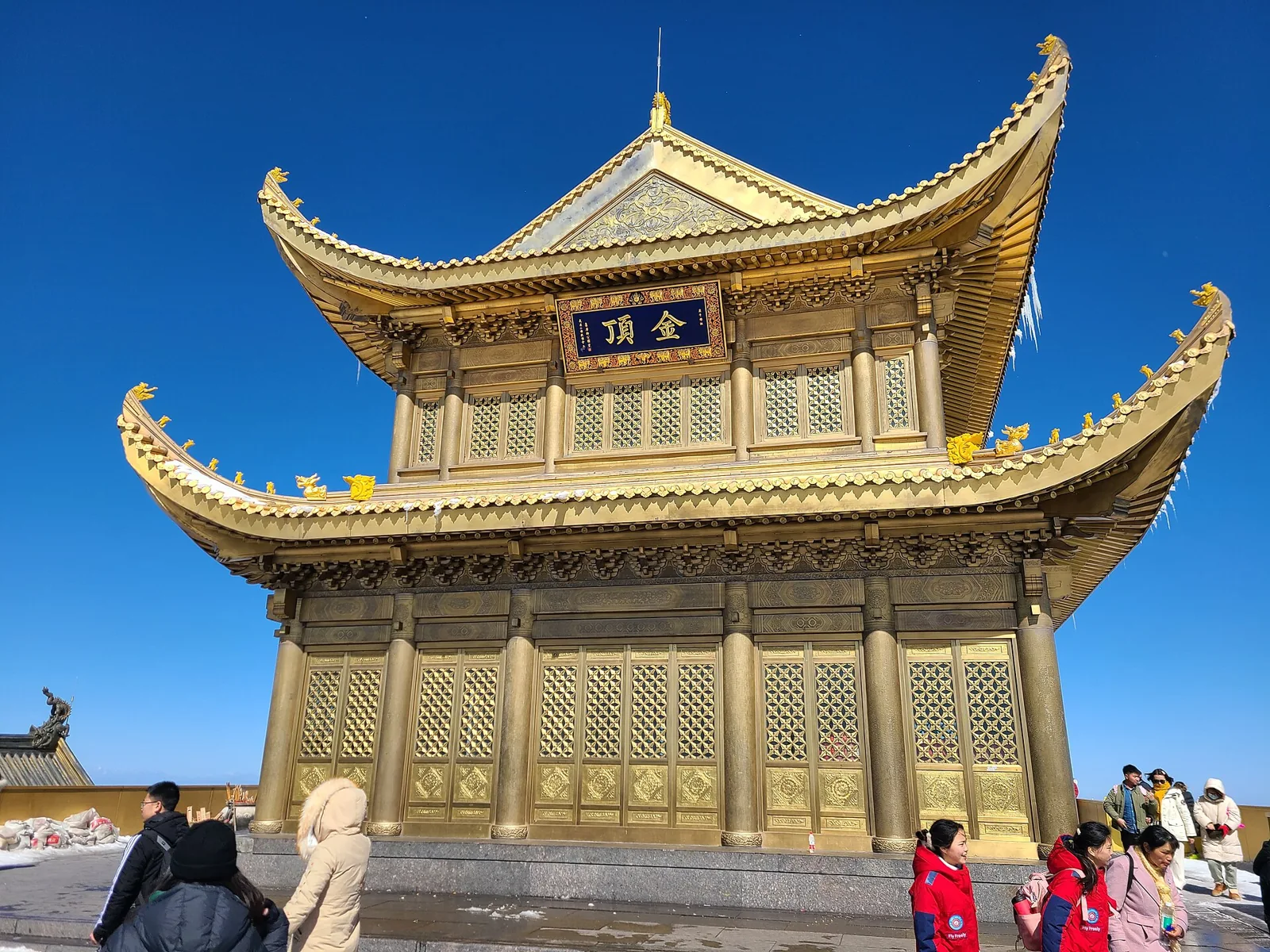
At Golden Summit, identify the **Ten-Direction Samantabhadra image · 十方普贤圣像** and **Huazang Temple · 华藏寺** as distinct elements. **Puxian · 普贤** is Samantabhadra; recognising the name will help you connect signs at the summit with the subject at Wannian Temple.
A June 2026 visit account by the Buddhist institute at Xiyuan Temple describes its actual pilgrimage to the summit and the image's multiple faces and white-elephant setting. It also describes temple reception, giving context for religious use. This was their visit, not ours, and does not establish public access to every room or the availability of a special reception for ordinary tourists.
From permitted areas, observe how the large image relates to the surrounding buildings and circulation. Ask which element you are looking at before attaching one historical date to the entire setting. An ancient temple tradition and a monumental outdoor image need not be the same age.
If a clear view is available, use it to understand how high the ceremonial setting sits above the lower wooded mountain. If it is not, spend time with the architecture and interpretation instead of treating clouds as a reason to cross a barrier. Sunrise, a sea of cloud and distant visibility are possibilities, not products that your admission purchases.
Wannian Temple: the bronze and its brick shelter deserve time
The ICOMOS evaluation identifies Wannian's major bronze image of Puxian, cast in the tenth century, and the later **Beamless Brick Hall · 无梁砖殿** as significant cultural works. The June 2026 Buddhist institute account also describes seeing the bronze image riding a six-tusked white elephant in the hall.
Look first at the image's parts: religious figure, lotus seating and animal below. Then compare their combined scale with the enclosure. The image and hall have different dates and different material problems; do not assume the hall was built at the same time as its central bronze.
For the building, identify the shaped masonry enclosure and domed interior where visible. Compare it with a conventional timber hall elsewhere on your visit. The useful architectural question is how the space is enclosed and supported, not simply whether the decoration looks old. Follow photography and worship restrictions rather than using flash to inspect darker details.
Allow time to stand back after reading the label. Ask how the hall's shape frames the image and where visitors and worshippers move around it. A good temple visit includes that relationship between object, enclosure and use. It need not become a hurried set of photographs before another long transport leg.
The temple's early foundation, bronze, brick hall and other buildings should be read separately. Historic descriptions do not prove that every treasured object is currently on display, and a temple visit does not imply access to its storage or private religious areas.
Qingyin or lower temples can be the main visit
ICOMOS describes **Qingyin Pavilion · 清音阁** as an ensemble integrated with streams and the hillside. If choosing a middle-mountain walk, ask staff to mark an open route from your actual vehicle stop to Qingyin and the return. Do not infer a short level connection because a map places two names close together.
For a lower-area religious visit, investigate **Baoguo Temple · 报国寺** and **Fuhu Temple · 伏虎寺** as specific destinations. The Buddhist institute's 2026 account documents both and their active religious setting. Choose the temple that fits your interest and walking capacity; a lower visit is a complete choice, not necessarily a failed summit attempt.
A summit ticket is not a seat on the high-mountain vehicle
The 9 March 2026 vehicle notice, effective 10 March, establishes timed reservations for vehicles heading to **Leidongping · 雷洞坪**, the upper transfer area for Golden Summit. Use **峨眉山景区** official WeChat, **峨眉山旅游官方平台** mini-program or an authorised seller named by the notice.
The rules permit booking up to **15 days ahead** and one vehicle slot per person per date. At the boarding point, pre-check takes place during your reserved slot using the **same original document, including passport**, entered in the booking. Early arrival means waiting; it does not move you into an earlier slot automatically.
Confirm both summit-area admission and the vehicle reservation you actually need. A ticket for a different area or a general entry record is not proof of a seat to Leidongping. For a package, inspect whether both entitlements are included and confirmed, rather than relying on a single payment total.
If you miss the slot, the notice allows changing to a later slot with stock. If later slots have no remaining availability, it describes checking in after **14:00** that day. That fallback is not a recommendation to start a complete summit visit late; verify remaining cableway, walking and descent time before using it.
Unused vehicle tickets can be refunded through their original channel, cancelling the reservation slot. An unused vehicle refund does not automatically cancel or refund a separately bought admission, cableway or hotel. Track each order and its conditions.
Trace the route from the valley stop to the summit and back
A summit day should have four clearly marked stages: **your valley boarding point → Leidongping → the Golden Summit cableway station → the upper visitor setting**. The connecting walks matter even when you buy the vehicle and cableway. Ask the day's staff map to identify those connections and any temporary arrangements.
A vehicle to Leidongping does not deliver you directly into Huazang Temple. A cableway also does not make every platform, temple threshold and staircase suitable for a wheelchair. Ask about gradients, steps, assistance and a practical stopping point for the exact route you intend to follow.
The May construction notice moves the old Leidongping station's boarding and waiting functions to a **temporary area**, determined on site. It specifically says the old station building cannot provide **nighttime staying or resting services**. Do not rely on an old plan to sleep there while waiting for sunrise.
Before ascending, obtain the current last descent and vehicle departure, and ask where the descending queue and temporary return boarding point are. During construction, schedules may change with demand. Work backward from your return train or accommodation; the last cableway is only one of the deadlines.
An overnight sunrise plan requires legitimate accommodation, its location and a verified early-morning route. A valley hotel is not a summit hotel, and a hotel called “Emei” may be far from the departure you need. If no suitable overnight arrangement is confirmed, make a daylight plan instead of treating the station or a closed temple as shelter.
Downward cableway reservation is another operation
A separate September 2025 official trial notice describes timed **downward** reservations for **Golden Summit No. 2 cableway · 金顶2号索道**, after buying a downward ticket and reaching the upper zone. Confirm whether this arrangement is operating on your date, especially during the 2026 construction.
The notice's reservation system opens **09:30–17:30** for same-day **12:00–18:00** descent slots, subject to maintenance exceptions. It names the WeChat reservation mini-program and local ticket-number machines. A downward cableway ticket and its timed booking are distinct records; neither is the morning high-mountain vehicle slot.
For verification, the trial notice names a Chinese second-generation ID or a **paper ticket**. Foreign-passport visitors should ask staff how their original order is exchanged or verified; do not assume the passport will scan at a machine designed for a different credential.
When the trial's No. 2 reservation is full or unsuccessful, the notice directs visitors to queue for **No. 1 cableway**. Ask about the current arrangement and available time. Do not promise yourself an immediate descent because you bought a return ticket; queueing and the temporary vehicle connection still follow.
Calculate the components instead of treating CNY 160 as the whole day
The management committee's January 2026 fee directory publishes separate admission, vehicle and cableway charges. It does not define the season-change dates in that table; confirm the date-specific product before selecting a rate.
| Component | Published charge | Useful comparison |
|---|---|---|
| Scenic admission | Peak CNY 160; off-peak CNY 110 | Identify which area your current product admits |
| Full vehicle return route from Baoguo/Huangwan through Leidongping | CNY 90 | Different from a middle-area vehicle product |
| Middle-area return vehicle from Baoguo/Huangwan | CNY 40 | Does not imply travel to Leidongping |
| Golden Summit cableway | Peak up CNY 65, down CNY 55; off-peak up CNY 30, down CNY 20 | Return totals CNY 120 or CNY 50 |
| Wannian cableway | Peak up CNY 65, down CNY 45; off-peak up CNY 30, down CNY 20 | A separate cableway for a different destination |
Swipe to see the full comparison
For an ordinary full-price adult taking admission, the published CNY 90 vehicle and both Golden Summit cableway directions, the arithmetic is **CNY 370 at peak rates** or **CNY 250 at off-peak rates**. This is a component comparison, not a bookable package or guarantee of current stock. Station transfer, meals, accommodation and any additional product are extra.
Do not add both Golden Summit and Wannian cableways by default. Decide which destination you actually intend to reach and whether a combined day is realistic before paying. Ask about foreign-document concessions individually; a domestic eligibility list does not settle your passport's status.
A January 2026 announcement by the Emei Buddhist Association, reproduced by Beijing Daily, removes temple **xianghuaquan · 香花券** admission charges, including at Baoguo, Wannian and Fuhu, for domestic and overseas visitors. That temple-charge change does not abolish scenic-area admission, vehicles or cableways. Follow each temple's opening and visitor rules; free temple entry does not open private areas.
If the summit plan cannot be completed, change the destination consciously
If no high-mountain admission or vehicle slot is available, consider a confirmed middle-area or lower-temple visit. The May notice said middle-area-specific products would follow; check today's actual listing rather than treating that announcement as a guarantee that a particular discounted ticket exists now.
If weather or transport restrictions affect the summit after booking, ask the original seller about the unused entitlements. Before buying another area, check its access and travel connection. A new destination can be worthwhile, but it should be a chosen visit rather than an improvised assumption that all mountain tickets are interchangeable.
For wet or cold conditions, choose a route you can finish with appropriate clothing, footwear and time. The bus and cableway are useful assistance, not a substitute for assessing the walking still required. Follow current staff restrictions and use the designated paths; do not enter construction areas to shorten a connection.
Save the reservation documents, actual boarding location, current descent arrangement and **400-8196-333** ticket-service number from the vehicle notice. With those practical pieces resolved, give the cultural visit room: a clear summit outlook if available, a careful reading of Puxian at Wannian, or an unhurried lower temple setting can each justify the day.
Sources and editorial note
Individual original mountain-choice article based on actually rendered March2026 reservation and May2026 construction notices and Jan2026 government fee table; September2025 downward-trial rules labelled; UNESCO/ICOMOS cultural account and Buddhist institute's own June2026 temple pilgrimage record. Primary association announcement reproduced by BeijingDaily. No personal pilgrimage, transaction or tested passport machine.
Current construction schedules and cableway trial operation require date confirmation. Season boundaries absent from tariff not invented. Paper-ticket descent verification needs staff resolution for overseas passports. No current allareas/specialdiscount promise, weather guarantee, personal field experience or medicine advice.
- https://www.leshan.gov.cn/lsswszf/gsgg/92337833/781992631300165.html
- https://www.leshan.gov.cn/lsswszf/gsgg/90053490/808058894643269.html
- https://www.leshan.gov.cn/lsswszf/zzzqgsgg/760644150124613.html
- https://www.leshan.gov.cn/lsswszf/zzzqgsgg/bc5ef1c2b2d24f36a92f68081.html
- https://whc.unesco.org/en/list/779/
- https://whc.unesco.org/document/154252
- https://www.jcedu.org/202606/36745.html
- https://news.bjd.com.cn/2026/01/02/11500354.shtml