

On this page
Choose the mountain entrance before booking the train or ticket
For a first visit focused on Daoist history, choose **Qingcheng Front Mountain · 青城前山**. For streams, wooded paths and a walking day starting around Tai'an, investigate **Qingcheng Back Mountain · 青城后山**. They are separate visitor destinations. Buying front-mountain admission does not give you a simple walking connection to every back-mountain sight.
The practical distinction is the subject of the day. On the front mountain, stop to understand a temple courtyard and its religious setting. On the back mountain, decide how far along a stream or valley path you can walk and still return comfortably. Neither choice should be sold as an effortless stroll just because cableways exist.
| Your priority | More suitable starting choice | What to settle before departure |
|---|---|---|
| Daoist temples and their relationship to the wooded slope | Front Mountain | Which temples you will prioritise and how you will descend |
| A stream-and-forest walking day | Back Mountain | Current open paths, turnaround point and transport back from Tai'an |
| Avoiding sustained steps | A deliberately limited visit, following staff advice | An exact usable route; a cableway ticket alone does not establish accessibility |
| Seeing both Qingcheng and the Dujiangyan waterworks | One modest mountain visit plus a separately timed transfer | Which experience you are willing to shorten; separate admission and entrances |
Swipe to see the full comparison
This is an editorial choice guide, not a claim that all listed paths or temple interiors are open. Check local controls before entering. A Front Mountain photograph and a Back Mountain itinerary can both be labelled “Qingchengshan” online; that broad name is insufficient for a ticket or driver.
What makes the Front Mountain more than another green climb
UNESCO's heritage account associates Qingcheng with Zhang Ling and the formation of religious Daoism in the second century CE. Its value includes a continuing temple tradition and western Sichuan building forms. That is a different reason to visit from pursuing a summit panorama.
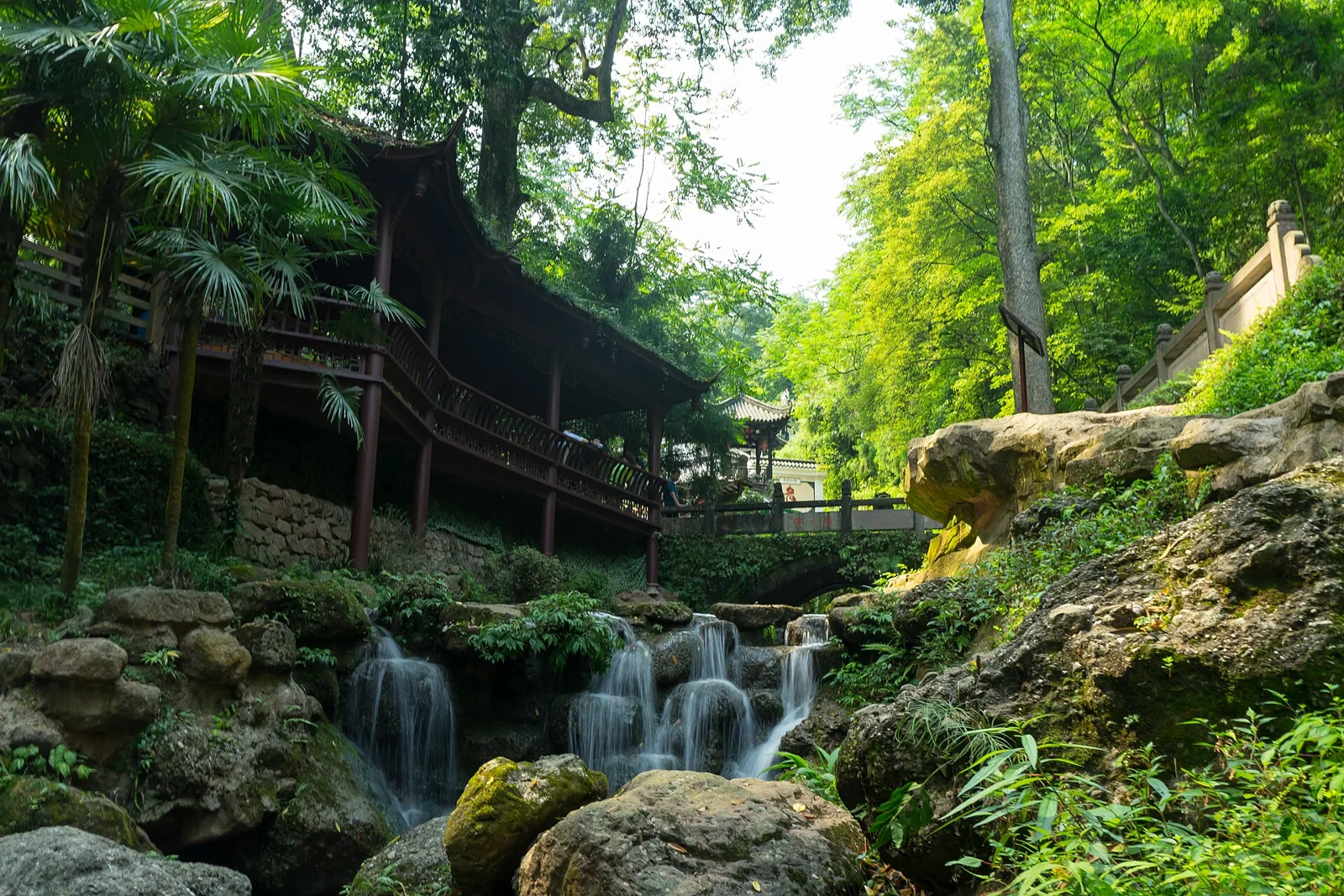
Read the mountain as a sequence of settings rather than a collection of identical shrines. A building at the foot introduces the religious landscape; a courtyard enclosed by trees creates a pause on the climb; a higher temple gives a different relationship between roof, slope and sky. You can have a worthwhile visit without reaching every high point.
The same heritage account records damage to some shrines in the 2008 earthquake and subsequent repair. An ancient foundation does not mean every visible beam or painted surface survives from that foundation date. Look for dated interpretation of rebuilding and conservation. This makes the visit more accurate, not less interesting: the place has remained important through repeated work and use.
Tianshi Dong: identify a temple complex, not just a cave photograph
**Tianshi Dong · 天师洞**, also associated with **Changdao Guan · 常道观**, is a central religious stop. “Celestial Master's Cave” can suggest a small geological detour, but the significant experience includes halls, courtyards, inscriptions and the landscape around them.
A historical cultural account from the Hunan Forestry Department describes images of Zhang Daoling and the later Celestial Master Xu Jing, alongside old trees and inscriptions. Its 2004 text is useful background, not proof of today's access or a current transport schedule.
If the relevant areas are open, take time to distinguish a founder's image from that of a later religious figure. Read the name beside each before assuming every robed figure depicts the same person. At an inscription, find the date and whether the display identifies an original, copy or later commemoration. The difference between a religious lineage, an architectural rebuilding and a modern interpretation panel is part of the story.
For the trees, notice how roots, paving and buildings occupy the same limited space. Keep outside protective barriers. A story that a founder planted a tree is a tradition associated with the site; it is not something a visitor can verify from the trunk's size. You do not need to turn a legend into a documented event to appreciate its role in the place.
Shangqing Gong: make the upper temple a destination of its own
**Shangqing Gong · 上清宫** is another useful name to recognise before climbing. The forestry account distinguishes its early foundation from later surviving buildings and describes inscriptions around the upper setting. Use that distinction when reading a sign that begins with a very old date.
On arrival, look at how the approach brings you into the courtyard and how the surrounding slope affects sightlines. Compare this setting with Tianshi Dong instead of taking the same doorway photograph twice. Where worship is taking place, leave circulation space and follow photography restrictions. This is a religious site with visitors, not an exhibition in which every room is available for inspection.
Continuing toward **Laojun Ge · 老君阁** is an additional climb. Decide whether the higher viewpoint is the purpose of your day or an optional extension. If clouds remove the view, the temple visit still has a subject; chasing elevation late in the day may add effort without improving what you came to understand.
Plan around the walking that remains after the cableway
Before paying for a ride, ask staff to mark **your current position, both cableway stations, the intended temple and your return gate** on the current map. Those four points are more informative than the phrase “take the cable car up.”
A cableway moves you between stations. The walks to a station, from the upper station to a temple, onward to a pavilion and back toward the exit remain separate. A downhill route can still involve long stair sections. If knees, balance or fatigue are a concern, evaluate the descent as carefully as the ascent.
For a temple-led visit, identify one principal stop and one possible extension. Tianshi Dong and Shangqing Gong need not become a compulsory checklist if reaching both would exhaust the group. Ask which approach is open and suitable, then let the extra stop depend on actual progress. For a summit-led visit, obtain the latest return-ride and exit deadlines before starting upward.
A manageable plan might finish after a meaningful lower or middle temple visit. A broader plan can include an upper temple and viewpoint, with an earlier start and more walking capacity. These are planning choices rather than guaranteed two-hour or four-hour circuits. Queues, wet steps and time spent reading a hall change the pace considerably.
The ticket portal excludes vehicles, cableway, boat, sedan-chair and guiding from Front Mountain admission. Ask which direction each extra covers and what happens if a ride stops. We have not established a current authoritative tariff for all these extras, so the familiar prices repeated in old itineraries should not be treated as a complete current budget.
Front Mountain admission with a foreign passport
The portal publishes **CNY 80 ordinary admission and CNY 40 student admission**. Its specific foreign-visitor clause permits a half-price concession for eligible full-time undergraduate-level or lower students; other foreign visitors pay full price. Confirm supporting documents for a foreign student rather than assuming a domestic age or senior rule applies to an overseas passport.
Choose passport or foreign residence documentation in a supported booking product, take the original document and use a staffed verification channel. The portal also allows document presentation at the on-site ticket window and links an English-facing **Trip.com Mount Qingcheng** product. Confirm that it is the Front Mountain attraction you intend to enter.
If the screen demands a Chinese identity-card number without a document selector, you have not yet found a suitable workflow. Ask the channel's support or the window about passport purchase. Do not borrow a number or assume a payment screenshot will resolve an identity mismatch at the entrance.
Treat an order as confirmed only after its attraction, visit date, traveller details and admission status are clear. Retain the booking record and the seller's support route. For a failed payment, first check for an existing order so that repeated attempts do not create duplicate bookings.
The original document matters even when a confirmation is on the phone. Keep both available for verification; save the return transport details separately so the day's exit does not depend on finding a message inside a ticket application.
Back Mountain: establish the path and exit before attempting a loop
The Amap place record places the Back Mountain visitor destination at **112 Yidao Street, Tai'an Ancient Town · 泰安古镇驿道街112号**. Use the specific Chinese name **青城后山** when arranging transport. A driver dropping you at the Front Mountain because the message merely says “Qingcheng” has not delivered you to the same starting point.
Trip.com's own Back Mountain listing describes a distinct stream-and-forest destination around Tai'an and lists seasonal hours. Its main information can help identify the attraction; user reviews below it are not official route or fare instructions. Verify the actual Back Mountain ticket product and passport conditions separately from the Front Mountain portal.
Before selecting a circular walk, locate the currently open stream paths, crossings and return options on the day's map. Ask specifically about **Wulong Gou · 五龙沟** or another named valley you intend to use. A loop shown in an old trip report may depend on a walkway, crossing or transport service that is unavailable today.
An out-and-back on an approved path gives you an earlier decision point: turn while you still have energy for the return. A loop commits you to a different exit and potentially more climbing. If you choose it, establish where it rejoins Tai'an and whether the last connection to your station is still available. Never treat a privately offered lift to a hillside village as a verified public path or guaranteed escape from a difficult descent.
Keep away from restricted streams and follow barriers even if someone else's photograph shows people in the water. After heavy rain, ask about the specific path's status before entry. If staff restrict a section, change the route rather than looking for an unofficial way around it. The value of a walking day comes from an appropriate route, not proving that you completed a large loop from a social-media map.
Departure time is a separate deadline from gate opening
The Front Mountain portal gives **summer 08:00–17:30 and other seasons 08:30–17:00**, without defining the seasonal change dates on that page. Confirm the schedule for your visit. Trip.com's Back Mountain listing gives **April–October 08:00–18:00 and November–March 08:30–17:30**, with winter sales stopping at 16:30; check that separately with the Back Mountain product.
Neither schedule tells you when to begin a long climb. Obtain the last cableway boarding, any earlier temple closing, the gate's clearance time and the road connection you require. Work backward from the earliest relevant deadline. Leave time for walking between them, rather than planning to arrive at a station at its closing minute.
Search rail booking for **Qingchengshan · 青城山站**, then add the road connection to your chosen mountain entrance. Confirm the actual Chengdu departure station. The train ride is one segment; urban travel, waiting and the mountain-side transfer also belong in the day. We do not promise a universal fare or door-to-gate journey time.
If also visiting Dujiangyan's waterworks, decide which visit deserves the longer daylight period. A full Back Mountain walk plus a thoughtful waterworks visit is a different undertaking from a limited temple stop followed by a road transfer. The shared World Heritage name does not make them adjacent rooms of one attraction.
For cancellation, read your own seller's terms. The portal's unused-ticket WeChat cancellation deadline is the day after the visit at 23:59; it separately describes an offline request through **028-96526** within 30 days. These are channel-specific provisions, not a promise that a used admission or independently purchased cableway will be refunded.
Leave with a precise next action: choose front or back, identify the correct document-supported admission product, settle the manageable walking route and book a return connection from its actual exit. That sequence prevents the most consequential Qingcheng mistakes before you reach the mountain.
Sources and editorial note
Individually researched and written Front-versus-Back choice guide. Actual rendered local tourism portal, UNESCO cultural inscription and earthquake repair account, dated forestry cultural description, first-party Amap Back Mountain entry and Trip.com operator listing. Original temple-reading exercises and four-point cableway/return map decisions. No personally completed visit or booking, no route continuity or fare invented.
Named temple interiors, summit extension, Back Mountain loops and cableway operations require current site confirmation. Seller listing is not a tested passport transaction. Legends separated from established history; old foundations not equated with original surviving fabric. No universal step-free route or combined front/back ticket assumed.
- https://www.djy517.com/online.html?channelCode=mpyd
- https://whc.unesco.org/en/list/1001/
- https://lyj.hunan.gov.cn/lyj/tslm_71206/lykp/syjs/201512/t20151227_2618005.html
- https://www.amap.com/place/B001C7X564
- https://you.ctrip.com/sight/dujiangyan911/62961.html