

On this page
First secure the visit; then choose a question for the galleries
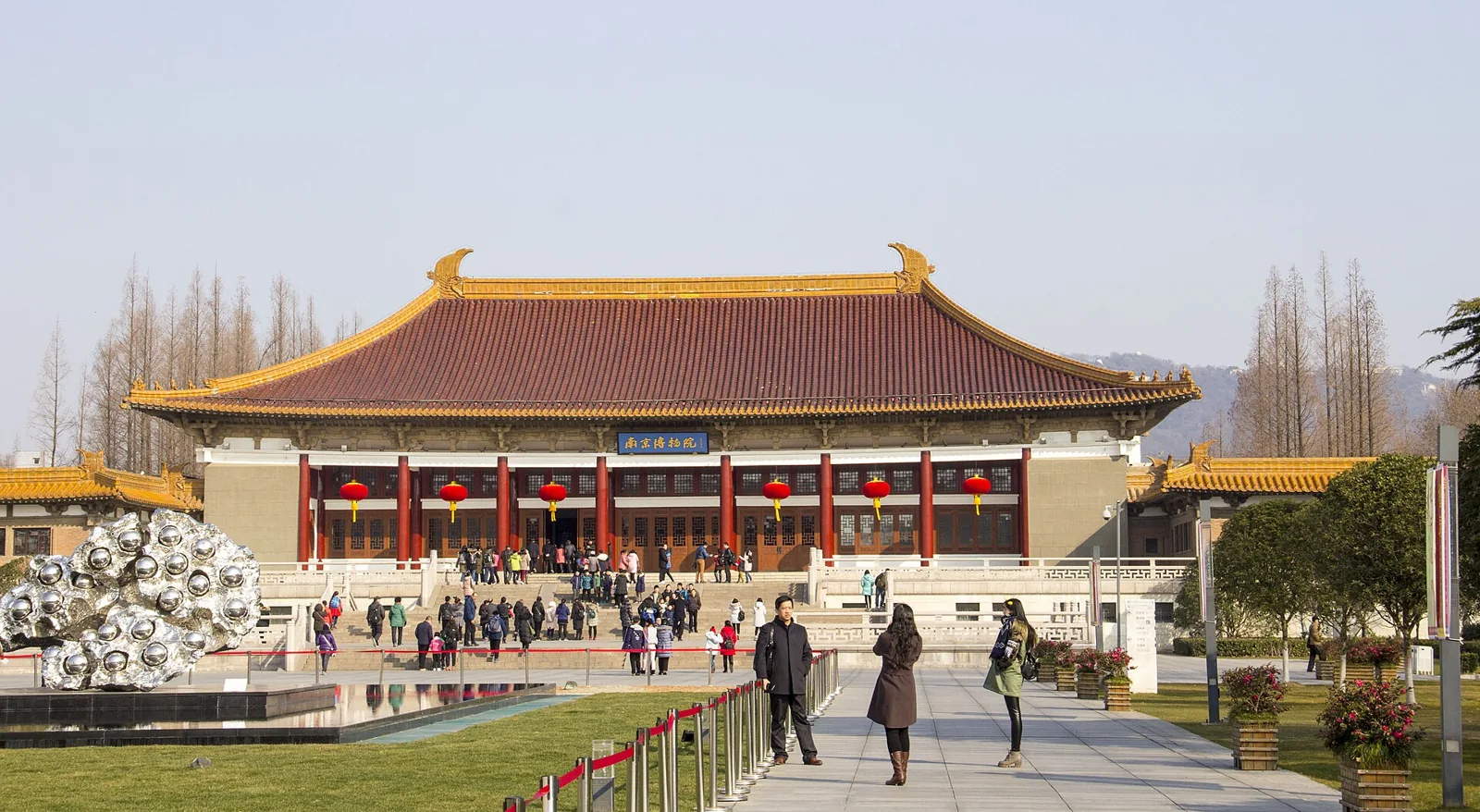
Nanjing Museum — **南京博物院** — uses an advance reservation system. Ordinary permanent displays and collection-based exhibitions are free, but free admission does not mean unrestricted walk-in entry, and some separately marketed exhibitions or performances can charge. For a foreign passport, the museum publishes a specific service-window procedure after a successful reservation.
This is the large museum on Zhongshan East Road, not the Nanjing Massacre Memorial and not every institution whose English name contains “Nanjing museum.” Check the Chinese name in your booking and navigation before you travel. A reservation for another museum does not transfer here.
For a first visit, choose a main line of interest and one additional exhibition. Our suggested main line is **how objects were constructed to communicate, serve or display status**: a brick image assembled across many pieces, an intricately layered imperial vase, and lacquered objects understood in groups. You can follow that question without trying to photograph every celebrated object in the collection.
We have read the actual rendered official rules and current exhibition pages. We have not submitted a reservation, completed a passport check-in or visited the galleries for this guide.
The published passport procedure is more specific than “bring ID”
The museum releases reservations at **18:00 Beijing time**, for dates up to **seven days ahead, excluding the current day**, through its official WeChat mini-program. Morning entry is **09:00–13:00** and afternoon entry **12:00–16:00**. Your selected entry period matters even though the two windows overlap.
After reserving, foreign-passport holders must take the **original booked document and successful-reservation evidence** to the **service centre's green-channel service window** to complete the entry formalities. This published process does not require you to pretend to have a mainland identity card or rely on the domestic face-comparison gate.
Prepare your booking in this order:
- Open the reservation channel from the museum's current official website and confirm the mini-program is 南京博物院. The desktop personal-reservation link directs users toward a WeChat QR-code route.
- Check your date and entry period before making other inflexible arrangements. Set any reminder in Beijing time; convert it to your location rather than assuming 18:00 means your own local evening.
- Enter the traveler under the correct document type. If a name, passport field or account verification fails, stop and ask the museum how to resolve that exact problem. Do not fill an identity-card field with an invented domestic number.
- Save the successful confirmation and check that its document, date and period match your plan.
- On the day, carry the same original passport and allow time for the published service-window step before proceeding to the entrance.
The museum gives **025-84807923** for reservation questions. A useful question includes the document nationality/type, the field that failed, the intended date and whether you already have a confirmed reservation. Asking only “Can foreigners enter?” may leave the actual booking obstacle unresolved.
Do not treat a private paid booking service as the source of the museum's free inventory. If someone offers assistance, distinguish their fee from museum admission and obtain the actual issued confirmation. Buying a separate exhibition also does not automatically prove general admission: the museum's own responses direct visitors to the specific product's entry conditions.
Protect the entry period and the single-entry visit
Normal opening is **09:00–17:00, with inspection ending at 16:00**, Tuesday through Sunday. Monday is normally closed, with holiday and seasonal exceptions governed by notices. Do not carry a summer extension into an ordinary October visit without checking the current calendar.
The official rules allow a document one entry/exit on the day and refuse entry after the reserved period. Plan to keep your main visit together rather than leaving for a long lunch and assuming your morning confirmation lets you return. Decide what you need to carry and what you can do before admission.
The family rules group children **14 and under** with an adult's parent-child reservation, up to three children per adult, with joint verification. Do not make an independent child reservation just because an English booking summary says “under 14” and misses the inclusive boundary. For a mixed party, check every traveler's confirmation before leaving the hotel.
The rules also restrict repeated bookings and non-fulfilment, including cancellations. Read those current terms before reserving several speculative dates or asking different people to book the same traveler. If your plan changes, deal with the existing booking rather than assuming duplicate reservations improve your chances.
If you miss a period or cannot obtain a confirmed reservation, contact the museum about the actual situation. Do not plan a journey on the assumption that the green-channel window is an unrestricted passport walk-in lane. Its published foreign-passport procedure starts with a successful reservation.
Check what is open before choosing a six-hall itinerary
The museum organizes its exhibitions among History, Special Exhibition, Art, Republican-era, Digital and Intangible Heritage halls. Their names suggest different approaches, but a list of six halls does not establish that all six are fully open today.
An **August 31, 2026 notice** says the Intangible Heritage Hall continues exhibition improvements and that reopening will be announced separately. At this guide's review, the visit page still listed that notice. Do not make a performance or that hall the essential purpose of the visit without a later confirmation. A different museum activity or a resident-project selection notice is not automatically a reopening notice.
The current exhibition page also separates current displays, virtual exhibitions, past exhibitions and exhibitions sent elsewhere. Read that category before you travel for a particular work. A collection entry, a virtual model or a past loan is useful for learning; it is not identical to finding the original in a local case today.
Two current official entries offer concrete choices:
| Interest | Exhibition listed at review | Published location and period |
|---|---|---|
| Layered craftsmanship and imperial imagery | Qianlong “Imperial Hunt” rotating lidded vase | Special Exhibition Hall, second floor, Gallery 9; opened February 2026, no closing date stated on the detail page |
| Objects as an ensemble rather than isolated treasures | Western Han Guangling lacquer and wooden objects, 云飞扬 | Special Exhibition Hall, third floor, Gallery 11; August 15–November 15, 2026 |
Swipe to see the full comparison
Both detail pages list these exhibitions as free. Recheck dates and availability for your visit rather than treating the table as a permanent itinerary. The November end date matters if you are researching a later trip.
The brick image: notice how many pieces make one composition
The museum's catalogue describes **Seven Sages of the Bamboo Grove and Rong Qiqi**, a Southern Dynasties brick image excavated from the Gongshan tomb at Xishanqiao in Nanjing. It was arranged on two tomb walls, each assembled from nearly 300 bricks. The seven sages belong to the Wei–Jin period, while Rong Qiqi is associated with a much earlier period. The image should not be read as a literal photograph of eight contemporaries meeting together.
The catalogue identifies seated figures with different actions and trees separating them. If the work is available on your visit, start at a distance where you can see the rhythm across the composition. Then look more closely for a name, an instrument or a hand gesture. Finally look at the brick joints. You are studying an image that had to be manufactured, assembled and fitted into an architectural setting.
Choose two figures to compare rather than trying to memorize all eight names. Are their hands occupied? Do they face another figure or seem absorbed in their own action? How does a tree create a pause without dividing the scene into wholly unrelated pictures? These are observations you can make from the displayed work even before you understand every cultural reference.
Read the display label's account of excavation, assembly and presentation. Separate what is preserved from any reconstruction or interpretive diagram. A drawing showing the original tomb layout helps explain context; it does not mean the museum case reproduces every condition of that tomb.
The catalogue links the work with the Six Dynasties/Sui–Tang display. Confirm its current location with staff or the day's map; catalogue association alone is not a guarantee of access. If it is unavailable, use the museum's digital resources and choose another open object that lets you compare an overall image with its assembled parts.
The rotating vase: look through the outer design
The museum's 2026 exhibition explains that the Qianlong “Imperial Hunt” vase has nested layers, connecting an openwork outer part to an inner rotating part through a carefully fitted structure. The interior scene depicts an early imperial hunting journey. It brings together ceramic construction, decoration and imagery, rather than relying solely on a painted exterior.
Look first at the outline and outer ornament. Then identify an opening and ask what it lets you see behind the surface. Does your viewing position reveal the whole interior scene or only a fragment? Can a diagram or museum video explain how that fragment changes when the inner component moves?
Do not expect staff to rotate the original for you, and do not infer that the object is mechanically demonstrated throughout the day. The exhibition's account of the mechanism explains its design; the current display method is another question. If the case gives only a limited view, use the explanatory material rather than leaning, touching or obstructing others to find a hidden angle.
The useful comparison with the brick image is scale and assembly. One is a large composition made from repeated architectural units; the other is a layered object containing a changing image. Both reward moving your attention between the complete form and the way its parts work together. This is our suggested viewing exercise, not a claim that the museum presents them as a paired exhibition.
Lacquer and wood: ask what belongs together
The Guangling exhibition describes Western Han lacquer and wooden finds from Jiangsu, emphasizing **functions and relationships among objects**, as well as their patterned decoration. This gives you a different task from looking for the largest or most valuable item.
Choose one group in an open gallery and read its context before isolating a favorite piece. What does the label say the objects did? Which dimensions, shapes or fittings support that explanation? Are they grouped because they were excavated together, shared a use, or illustrate a curator's comparison? Those are different reasons for displaying objects side by side.
Next choose one patterned surface. Follow a line across it and notice how decoration responds to the object's shape rather than treating the motif as a flat image. Compare a second object only after you have looked carefully at the first. The aim is to leave with one relationship you understand, not a phone full of unlabelled close-ups.
If you visit after the advertised closing date, preserve the question and change the exhibition. Another collection-based display may let you investigate a set, a function or the relationship between an object and its context. Check the museum's current programme rather than following an expired gallery recommendation.
Make the visit physically manageable
The published metro approach is **Line 2, Minggugong station, Exit 1, then east toward the museum**. Save 南京博物院 as the destination, along with the booked entry period. For a traveler requiring a step-free approach, ask about the station exit and continuous route; an exit number alone is not an accessibility confirmation.
The museum directs large luggage to storage on the **right side of the main entrance before inspection**. If you are between trains, resolve the bag situation first, leaving time for both storage and passport formalities. Do not assume a suitcase can go through the museum simply because your reservation is valid.
For a short visit, secure the passport check-in, choose one main display and one additional object, and keep a margin for moving between halls. For a longer visit, add rest time before adding another gallery. A museum plan that requires rushing past labels defeats the purpose of choosing these particular works.
Use your photographs as notes: capture the label where permitted, then the object detail that answers your question. The museum prohibits flash and specified commercial photographic equipment; follow the actual gallery instructions. A digital close-up can supplement an observation, but a photograph does not record the object's scale, your viewing distance or all of its context.
Before leaving, identify one thing you can now explain: why a tomb image spans many bricks, how an inner scene relates to an openwork vase, or how a group of lacquered objects acquires meaning through its use. That is a more durable result than completing a list of famous collection names whose current display you never checked.
Sources and editorial note
Independent museum/objects guide. Actually rendered current official visit rules,18release7daycalendar/passportgreenwindow/oneentry/family14inclusive; museumowncollection465 and2026general1348/1368 loaded/read,Aug31heritagehallclosure read. No reservation submitted or field visit.
Passport transaction, continuous step-free approach and current availability of individual objects not tested. Individual/special marketed exhibition conditions differ; private booking service fee not ordinary admission.
- https://www.njmuseum.org.cn/zh/visitIndex
- https://ticket.njmuseum.com.cn/reservation/userOut/outSingle/toSingleIndex.do
- https://www.njmuseum.org.cn/zh/exhibitionIndex
- https://www.njmuseum.org.cn/zh/generalDetails?id=1348
- https://www.njmuseum.org.cn/zh/generalDetails?id=1368
- https://www.njmuseum.org.cn/zh/collectionDetails?id=465
- https://www.njmuseum.org.cn/zh/newsDetails?id=381200
- https://vr.njmuseum.org.cn/