

On this page
Choose Tiger Hill for a landscape with several kinds of evidence
Tiger Hill, **虎丘**, offers more than the familiar photograph of a leaning pagoda. It brings together a small hill, exposed rock, springs, stone inscriptions and architecture. Choose it when that combination appeals; choose a more contained garden visit if your priority is a short comparison of waterside pavilions. Being inside Suzhou does not make every route flat or equally manageable.
For a first visit, a useful core is the approach landscape, selected inscriptions around Sword Pond and an exterior view of Yunyan Pagoda. Decide whether the group can manage the ascent and return before adding more sights. The garden authority’s site account describes temple buildings following the hill and places Sword Pond among its important landscape features. It identifies the pagoda as part of the Grand Canal World Heritage property, rather than one of the nine Classical Gardens of Suzhou.
There are three different questions worth keeping apart: what the stone or building visibly shows, what a dated record says about it, and what a local story associates with it. All can contribute to the visit, but they do not supply the same kind of proof.
Do not buy ordinary admission expecting an upper-floor tower climb
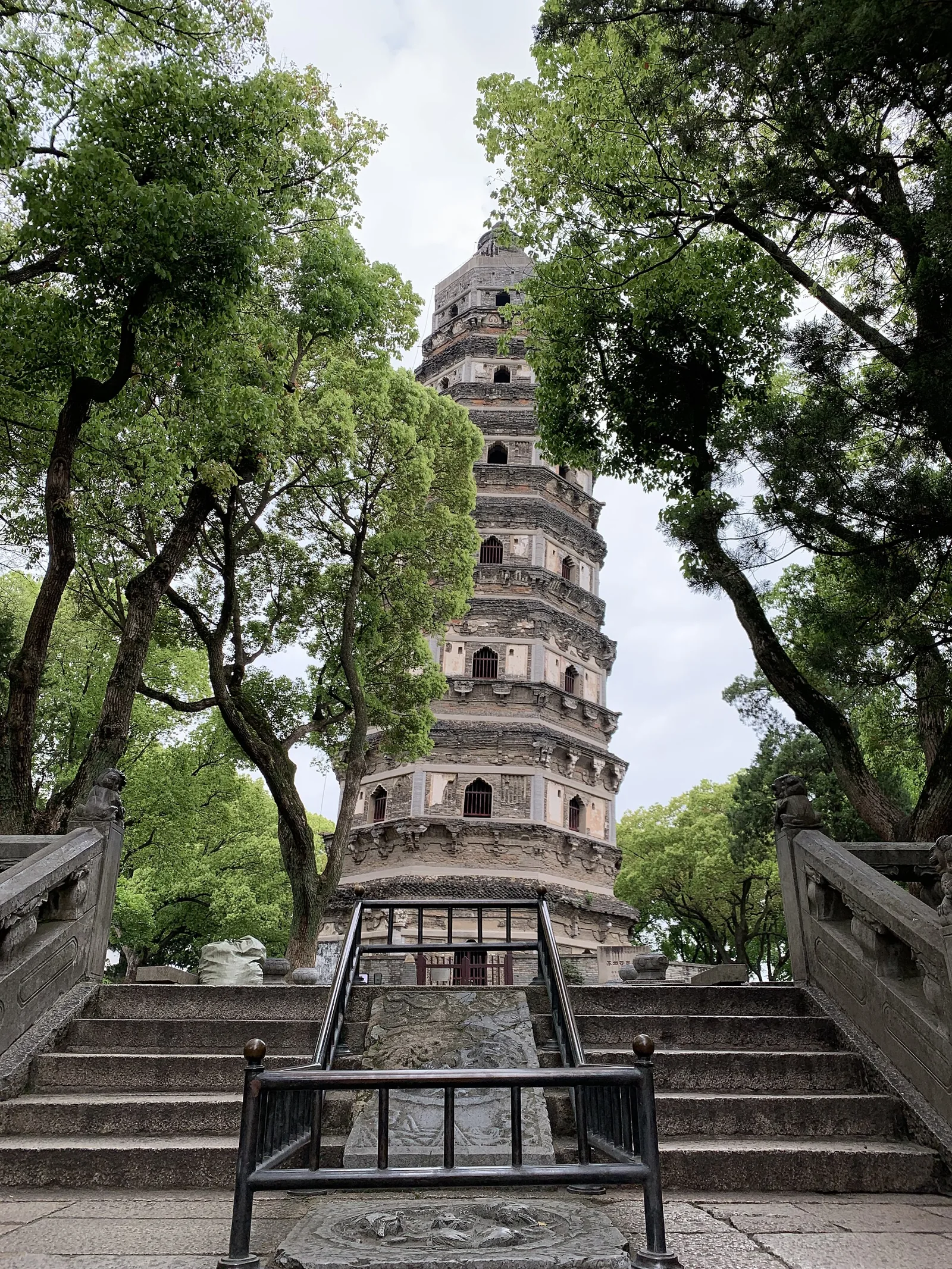
The pagoda is called **Yunyan Temple Pagoda, 云岩寺塔**, as well as Tiger Hill Pagoda. The authority’s architectural account dates its construction to 959–961 and describes seven levels, eight sides and brick forms imitating timber architecture. You can study those relationships from permitted exterior viewpoints.
Tower **interior access** needs separate verification. An old statement that the tower never opens is insufficient: Jiangsu City Channel’s September 2022 original report records a controlled reopening of the **first level**, with separate limited sessions and a guided product excluding the scenic-area ticket. That historical reopening is not evidence of an unrestricted climb through seven levels. Its trial price and daily quota should not be treated as current October 2026 terms.
If the interior is the reason for your visit, ask the operator these concrete questions before buying:
- Is a first-level interior session currently operating on my date?
- Is it a separate reservation or product, and does it include ordinary hill admission?
- Which level is accessible, where does the group meet, and what language is the commentary?
- What original document, timing and cancellation terms apply to this specific session?
Unless those points are confirmed, plan around the exterior. That plan remains worthwhile: the tower’s repeated brick details and its position above the landscape can be examined without an interior appointment. We did not obtain a current tower-interior reservation and do not promise one.
Look at repeated details before photographing the lean
From an authorised position, find one level’s corner, opening and roof projection. Then compare it with the next visible level. Where are the repetitions, and where does the relationship change? Brickwork imitating timber forms makes this a question about architectural representation as well as construction material.
Next, choose a wider view that includes the tower and nearby ground or trees. The tower becomes a landmark within a landscape rather than an isolated tilted object. If you change position, keep the viewpoint on the visitor route; a supposedly perfect angle does not justify moving beyond a barrier.
A photograph is poor evidence for calculating today’s lean. A wide-angle lens, a tilted camera or an uneven foreground can alter how verticals look. Record the impression if you wish, but leave structural measurement and condition assessment to the responsible conservation team. Seeing a tower stand is not a guarantee that all its internal areas can bear unrestricted visitor use.
Avoid the shortcut “China’s Pisa” as your only explanation. It may communicate that the tower leans, but it does not explain its eight-sided plan, material or history. Describing one repeated feature in your own words will give you more to remember than repeating a comparison with a different building.
Sword Pond’s stories and its physical setting are separate subjects
The authority’s Sword Pond interpretation records several explanations for its name, including stories involving King Helü’s burial and swords, excavation and sword-quenching. The text itself preserves alternatives. Treat those as traditions and interpretations, not a verified announcement that a royal tomb and its weapons are available to inspect beneath the water.
At an open viewing position, start with what you can see: water confined by rock, the edges of the hollow, an overhead crossing and the transition from a broader visitor space into a more enclosed one. How does the scale feel different from the nearby open rock area? The contrast can help explain why this place attracted poetic and legendary associations without requiring every association to be a geological description.
If a guide tells one version, a useful follow-up is “Is that a recorded tradition, an excavated finding, or an interpretation of the site?” This is not an invitation to argue with a story. It is a way to understand the kind of account being offered and ask for the corresponding evidence.
Do not approach the edge to look for a supposed entrance, or enter a closed passage seeking to confirm a legend. A photograph of dark water cannot settle what lies beneath it; an imaginative reconstruction is not an excavated plan.
The large inscription contains a repair history
The four characters **虎丘剑池** are also worth considering as an object with a history of its own. The authority publishes He Jieli’s investigation of Ma Zhijun and the Sword Pond inscription. It reproduces a dated explanatory inscription associated with the 1614 repair and discusses the recutting of 虎丘 by the stone carver Zhang Zhongyu. The familiar distinction between repaired Tiger Hill characters and older Sword Pond characters refers to this conservation history.
Use the reading to change what you look for. Compare the two pairs as visible forms: their relative scale, spacing, stone surfaces and relationship to neighbouring smaller writing. You need not identify every stroke. The important question is how a repaired monumental inscription can preserve an older text while its material history becomes more complex.
A smaller explanation can be more informative than the largest lettering. Ask a guide to identify the repair account or use the authority’s published transcription afterward. Do not copy the researcher’s historical description of climbing and wetting the stone as a visitor activity. Stay on permitted ground and do not apply water, make a rubbing or touch the carving to improve legibility.
The authority’s separate Sword Pond entry also records alternative calligraphic attributions. Consequently, avoid presenting a photograph alone as proof that every present stroke is a surviving autograph by one named ancient calligrapher. Attribution, later copying and recutting are related but different questions.
The rock deserves attention without the sword legend
A 2013 field report from the Chinese Academy of Sciences’ Nanjing Institute of Geology and Palaeontology describes Tiger Hill’s volcanic fragmental rocks, a visible sequence through named rock sights, joints at the Thousand People Seat area and springs associated with water-conducting fractures. This is an account of a geological field investigation, not a current visitor route certification.
It gives you a second way to look at a rock often encountered only through a story. From a legal standing position, notice breaks or joint patterns and whether they continue across an exposed surface. Compare that with an obviously shaped or inscribed stone nearby. Ask what appears to be a natural feature, what records human intervention, and what cannot be decided without specialist knowledge.
Do not confidently assign a geological age or rock type to every loose fragment on the path. The field report identifies specific exposures; it does not make every decorative stone on the site the same material. Nor should a spring’s relationship with fractures be turned into a promise about its flow or drinking-water quality today.
The value of this comparison is that the hill becomes more than scenery behind the tower. Natural material, constructed form and cultural interpretation can be read beside one another without collapsing them into one explanation.
Connect the tower to Suzhou Museum without promising today’s display
The city’s 2021 canal-landscape account connects the tower with the Yue-kiln lotus bowl held by Suzhou Museum, recovered from an upper-level deposit. A tower can therefore be considered as a place that held objects as well as a landmark visible from outside.
That creates a useful pairing with the Suzhou Museum guide: the hill supplies the physical setting; the museum can supply object labels, material and research history. Check whether the object is currently displayed before promising it as the next stop. Ownership, historical recovery and today’s exhibition inventory are different facts.
If you visit both, ask what information is lost when an object is separated from its original setting, and what becomes easier to study in a museum. It is a question about context, rather than a claim that every object recovered in the tower must remain there or that all museum objects are visible every day.
Buying the hill visit: ordinary prices and dated operating limits
The September 20, 2026 municipal tourism page identifies **虎丘山门内8号**, lists RMB70 for April–May and July–October, and directs buyers to Suzhou Garden Tourism and Jun Dao Suzhou. It also describes staffed or self-service ticket sales at the scenic hall. The page’s summer evening extension explicitly covered July 1–August 31; its September publication date does not extend that event into autumn.
The authority’s July 2024 seasonal price table lists RMB60 for the other months. Use the selected date’s actual product as the purchase reference and keep any optional interior or commentary charge separate. A cheaper city-pass advertisement is not evidence that foreign visitors are eligible or that it includes a tower session.
Its January 2025 hours table gives 07:30–18:00 in May–October, last verification 17:30; November–April is 07:30–17:30, last verification 17:00. Check a later notice for your date. Do not plan an ordinary October visit around the expired 21:00 summer closing.
The city’s June 2024 reservation policy retained real-name ticket reservation for Tiger Hill while removing it from many other sites. On-site ticket channels do not mean capacity or document checks disappear. We could not read the current dedicated ticket page because it returned an access block; this guide does not claim a completed passport checkout or carry over another garden’s refund terms.
For document-specific help, the authority lists the Tiger Hill management unit at **0512-67232305**. Ask whether your passport can be booked on the chosen channel, which voucher the gate accepts, and whether your group must enter together. Resolve that before committing to a tight connection.
Reach the right Tiger Hill, then decide how far to continue
The city’s April 2026 Suzhou railway-station guide directs travellers from Suzhou Station to line 4 toward Longdaobang, changing at Sujin for line 6 toward Suzhou Xinqu Railway Station, then Huqiu station exit 3. It separately describes **Huqiu Wetland Park** on line 8. These are different destinations. Save 虎丘山风景名胜区 and the chosen entrance, rather than navigating to any result containing Huqiu.
Confirm the current route and an appropriate exit if stairs are an issue. The entrance-to-viewpoint journey and the return still need time after the metro ride. Ask staff about the specific slope, steps and resting places to Sword Pond or the tower exterior; do not infer a step-free circuit from the hill’s modest elevation.
Before beginning the ascent, agree on a shorter finish if one person cannot continue. Before adding another Suzhou attraction, look at the remaining return and meal time. A complete visit can consist of one clear exterior tower comparison, one repair-history insight and one distinction between legend and physical evidence. It does not require an unverified tower climb or another rushed entrance ticket.
Sources and editorial note
Individually researched architecture/epigraphy/geology and ticket guide. Primary management landscape and architectural descriptions, HeJieli actual2019inscription-repair investigation, CAS own2013fieldwork read. OriginalJiangsuCityChannel2022firstfloor reopening report date-qualified notcurrenttrialprice. 2026Septembertourismticket/expiredsummer and Aprilrail guidance read. Dedicatedlotsmall product blocked notbypassed.
Current towerinterior product and passport checkout notcompleted; lotsmallblocked. No currentstructural measurements/stepscertification or allartifactsdisplayed claims. Legend not archaeologicalverification. No geologycollecting or inscriptiontouching advised.
- https://ylj.suzhou.gov.cn/szsylj/fjmsq/201912/3ee3f5ee803240e0b2ae2feafa95173e.shtml
- https://ylj.suzhou.gov.cn/szsylj/ylwh/201604/f3f52d3ee502486b8a4873c36b0d24e0.shtml
- https://ylj.suzhou.gov.cn/szsylj/ylwh/201604/582187de18ce45638e03e1c37b67ddd1.shtml
- https://ylj.suzhou.gov.cn/szsylj/ryyl/201801/6190946313174fa79fbf1fa9f0215f1e.shtml
- https://nigpas.cas.cn/djwh/gzdt/201304/t20130415_6485364.html
- https://www.ourjiangsu.com/a/20220910/1662801400972.shtml
- https://www.suzhou.gov.cn/szwgjyhsj/yhsjjbgk/202110/560fc6c80c7746b98704ecd6fc24e5f0.shtml
- https://wglj.suzhou.gov.cn/szwhgdhlyj/yeying/202609/b0dd60242a1e4db4a9e86f8c31eaf5f4.shtml
- https://ylj.suzhou.gov.cn/szsylj/mpjg/wztt.shtml
- https://ylj.suzhou.gov.cn/szsylj/kfsj/wztt.shtml
- https://www.suzhou.gov.cn/szsrmzf/szyw/202406/40f954ccaae94c33b74a5a4aa08bf968.shtml
- https://www.suzhou.gov.cn/szsrmzf/mszx/202604/568a4eac0636443c968cfc195b9a3e29.shtml
- https://ylj.suzhou.gov.cn/szsylj/yljjgsz/202110/c349edcc89844cbea0da2a26cf88b9f0.shtml