

On this page
You can visit the town without buying a sightseeing pass
The town operator's FAQ says **the ancient-town scenic area has no general admission charge**. The paid sightseeing products cover particular interiors. Choose your outing first: a walk among waterways and streets, a garden-and-gallery visit, or a boat ride. You do not need all three for a worthwhile day.
Zhujiajiao lies in Qingpu, west of central Shanghai. Treat it as a substantial outing, allowing roughly **three to five hours in the town plus travel**, rather than slipping it between Pudong attractions. That is our planning estimate. A slow bridge-and-street visit can work without a pass; a heritage-interior visit requires attention to admission and ticket collection; a boat adds a route and a charging unit you need to understand.
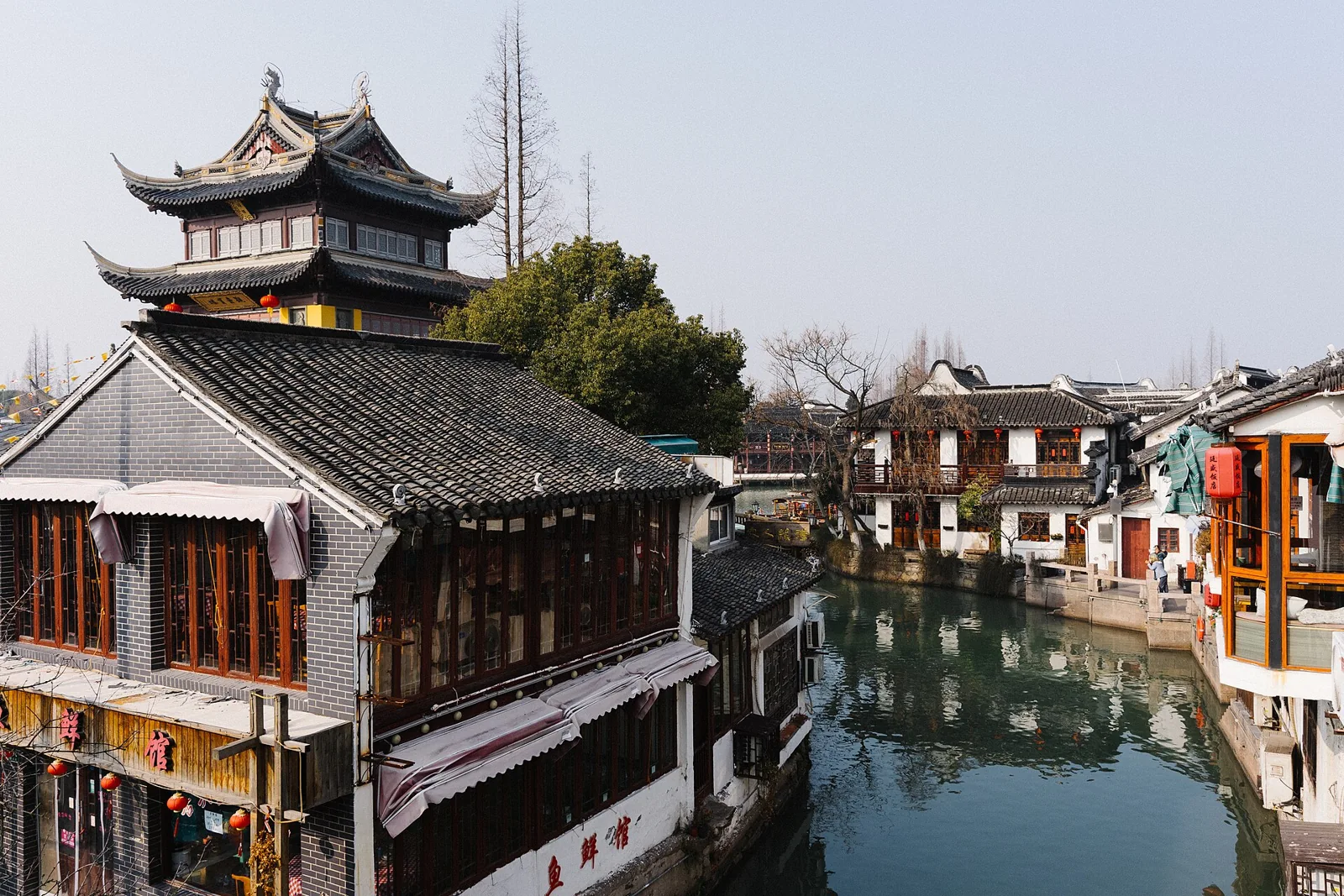
The town is also a lived and worked-in place. Cafes, shops and restaurants are part of its current character, not proof that everything you see is ancient. Look for what waterways, bridge crossings and street patterns tell you about how this settlement functioned, while respecting doorways and residential areas that are not visitor attractions.
Reach the town, not merely the metro station
The operator's transport page identifies **Line 17, Zhujiajiao station, exit 1**, with last-leg options to the tourist area. A journey from central Shanghai typically involves reaching **Hongqiao Railway Station** for Line 17; check the actual route from your accommodation rather than assuming the town is on a direct downtown line.
For the posted bus connection, **1510** links the station-side **Zhuxi Road/Huqingping Highway stop** with the **Zhuhu Road/Kezhiyuan Road stop** near the visitor center. The operator publishes intervals around 15–30 minutes depending on time of day. Allow for waiting and the remaining walk; stepping off the train does not put you inside Kezhi Garden.
Save these names for navigation:
| Purpose | Chinese name and location |
|---|---|
| Metro arrival | 朱家角站, 地铁17号线 |
| Main visitor center and online pass collection | 朱家角古镇游客中心, 课植园路555号 |
| Town visitor-information station | 朱家角古镇游客咨询服务站, 新风路172号 |
| Landmark for the river walk | 放生桥, Fangsheng Bridge |
Swipe to see the full comparison
The operator's FAQ also identifies a **station-to-Fangsheng Bridge electric-boat connection at RMB40 per ticket**. That transport boat is different from chartering a hand-rowed sightseeing boat within the town. Before choosing it, establish where you board and whether the direction serves your intended first stop. Operator FAQ.
For a return after dinner, check current metro and connection times for your full journey. The operator's English transport page and Chinese FAQ disagree slightly on the final 1510 departure. Do not build the evening around an exact last bus from either copy; confirm the stop's actual timetable and have another way to reach the station if you stay late.
Buy only the interiors you will actually visit
The official pass page, read in the browser, offers **RMB60 per person for three sights**: **Kezhi Garden, Hexin Garden and Shanghai Helong Art Museum**. Its online process requires booking by **08:00 on visit day**, then collecting **paper tickets from 555 Kezhiyuan Road between 08:30 and 15:00**. The posted sightseeing window is **08:30–17:00**. Tickets are valid that day for one admission; repeat entry requires another purchase.
The FAQ posts separate rates: **Kezhi RMB20, Hexin RMB30, Helong RMB20**. It identifies on-site purchase at the visitor center, information station and paid-sight entrances. Verify the live price and inclusions where you buy, especially if the online booking cutoff has passed.
That creates a useful comparison. All three separately total **RMB70**, so the posted RMB60 combination saves RMB10 if you use all three. **Kezhi alone at RMB20** is cheaper if a garden is your only planned interior. Buying the pass for its nominal saving makes little sense if it forces you to hurry through a museum you did not want to see.
For the online pass, collect first and wander afterward. An order confirmation is not the paper ticket the page tells you to present at each sight. Arriving at 15:30 with an unused order can be a different problem from arriving at a garden with an already collected ticket. Keep the collection address and deadline beside your reservation, not somewhere in a separate screenshot.
The pass page posts child and senior concessions with document verification at the visitor-service window. Bring original passport and any student or other eligibility proof; ask how an overseas document is handled before relying on a reduced rate. We inspected the published process, not a passport concession purchase or an online payment.
Three paid sights, three different reasons to stop
Kezhi Garden: learning and cultivation in one estate
The operator's Kezhi description places it on Xijing Street and dates construction to **1912–1927**. The name connects study with cultivation; the account distinguishes the family's halls and reading spaces from the agricultural part, only some of which survives. It also identifies a mixture of Chinese and Western elements and inspiration drawn from other Jiangnan gardens.
That makes Kezhi a different historical experience from Shanghai's Ming-origin Yu Garden. Avoid labeling it a preserved Ming garden simply because the surrounding town flourished in that period. The estate's later date helps explain why you may encounter elements with different architectural backgrounds.
Our suggested viewing question is **how the owner combined social status, education and productive land**. Compare the sequence of halls and courtyards with the garden and surviving cultivation references. Read the interpretation before treating every open patch as a purely decorative landscape. Where the label identifies a Western-influenced detail, compare it with the neighboring Chinese spatial arrangement rather than assuming the whole estate follows one stylistic rule.
A family can simplify this into finding a place for receiving visitors, a place for study and a place connected with growing things. These are our observation exercises, not a promised guided activity or access to every historical room.
Hexin Garden: distinguish the setting from the age of its objects
The operator dates Hexin Garden's establishment to 2007, while linking its name to an older pavilion and describing displays of Ming and Qing objects. That distinction matters. An older object in a garden does not make the whole visitor setting the same age as the object.
Choose Hexin if you want another garden-and-object experience, then read labels for the source and function of individual displays. Ask what is original, what has been assembled and what the current garden is intended to communicate. This is a more useful comparison with Kezhi than calling both “ancient private gardens” and leaving their different histories unexplained.
Helong: the local exhibition venue, not the original museum elsewhere
The operator identifies the **Zhujiajiao Helong exhibition space at 222 North Street**, distinct from its original location in Baihe. It describes exhibitions and activities associated with Chinese painting and Shanghai artistic culture. Helong description.
Check what is on display before deciding whether it is worth your remaining time. A museum's general mission does not establish a particular artist's work is currently present. For an art-focused traveler it can be a meaningful stop; for a visitor interested chiefly in waterways, an additional gallery need not be compulsory merely because a pass includes it.
Boats: per vessel, per passenger and one-way are different
The **rendered operator boat page** supplies more specific information than a generic recommendation to “take a gondola.” It posts these hand-rowed routes, **maximum six passengers per boat**:
| Starting landing | Route via Fangsheng Bridge | One-way price |
|---|---|---|
| Kezhi Garden | To North Street | RMB200 per boat |
| Kezhi Garden | To City God Temple | RMB300 per boat |
| City God Temple | To North Street | RMB200 per boat |
| City God Temple | To Kezhi Garden | RMB300 per boat |
| North Street | To Kezhi Garden or City God Temple | RMB200 per boat |
Swipe to see the full comparison
The page posts an additional **RMB100 per boat to return to the original landing**, approximate durations of **15 minutes for RMB200 routes** and **20 minutes for RMB300 routes**, and counts **infants in the six-person capacity**. Operator boat page.
For four people on a RMB200 one-way boat, the hire works out to **RMB50 each**; adding the stated return component makes RMB300, or RMB75 each. That is arithmetic on the posted vessel rate, not a promise of a shared per-person ticket. A party of six adults plus a baby exceeds the posted six-passenger limit.
Name the destination before paying. If you want to continue walking from the next landing, a one-way trip may improve the route. If you must return for a stored item or rendezvous, the return cost and arrangement matter. Do not compare a RMB40 station-connection ticket with a RMB200 charter as though they sold the same service.
The station boat's timetable needs a specific check
The boat page posts the electric connection at **08:30–17:00**, whereas the operator FAQ gives **09:00–16:20** for the same station/Fangsheng service. These pages agree on the RMB40 fare but not the operating window. Ask the landing staff for the day's last departure; do not depend on the later 17:00 claim for a tight return.
If service stops for conditions or capacity, retain a land route. Before boarding, ask staff about steps into the boat, the landing at the other end and whether that transfer works for anyone with limited mobility. Being a short water trip does not establish easy boarding or an accessible dock.
Read the bridges and streets as evidence of a working water town
Shanghai's heritage-block description connects Zhujiajiao's growth to trade, textile production and later commercial activity. It identifies **Fangsheng Bridge** and buildings along the **Caogang River** as important parts of the setting.
Our suggested walk uses those relationships rather than an exact minute-by-minute loop. Find a safe bridge-side viewpoint, notice how a crossing connects two streets, then follow an open river-edge segment to see how buildings face water and land. The waterway was part of transport and commerce; it is more than a decorative backdrop for boat photographs.
Where a bridge's steps make the full crossing unsuitable, choose a shore view and another authorized connection. Do not infer a continuous step-free route from the fact that a street or garden lies nearby on a map. The same landscape can be understood from several positions without completing every crossing.
The municipality's 2024 town itinerary identifies the historic post office as dating to **1903** and discusses tea houses and traditional performance. Those are useful cultural pointers, but its proposed 06:30, 08:30 or 19:30 activities are not a newly confirmed timetable for your visit. Check a venue's actual hours or program before assigning it a slot.
For the same reason, the municipal July–September 2026 arts program is a dated event, not proof of free performances through October. If storytelling or opera is your priority, ask for a current performance calendar, venue, language and ticket conditions before traveling.
A comfortable day has a collection deadline and a return plan
If you choose the three-sight pass, visit the center and collect it before discretionary wandering. Give Kezhi or your principal interior the strongest block of time, then decide whether the other included stops genuinely interest you. Put the river walk and food around those admission windows. If you choose a free-street visit, build it around bridge views and one or two breaks rather than spending the morning looking for a ticket you do not require.
The visitor-service page lists maps, charging, drinking water, small-item storage, wheelchair and child-carriage services, and foreign-card payment assistance. It gives the center's number as **+86 21 59280227**. Ask about current availability, equipment terms and what “small-item storage” accommodates; it does not establish space for a large suitcase or an accessible boat circuit.
Before returning to Shanghai, check the next transport leg while you are still able to choose an alternative. A meal, an evening performance and a boat trip all add time beyond the street walk. If you have an onward railway or flight, calculate the return through that actual terminal and its required arrival buffer, not just the length of Line 17's ride.
A good Zhujiajiao visit can be a considered walk, one garden and a boat that takes you somewhere useful. The decisions that make it work are specific: **which interiors, whether the pass saves you money, when to collect it, what the boat charges for and how you return**.
Sources and editorial note
Individually researched the actual rendered operator ticket, boat and Kezhi pages; separate FAQ and English transit versions expose operating-time conflicts. Individual Hexin and Helong descriptions distinguish historical setting, object age and exhibition location. Municipal heritage and dated arts accounts used for context only. AI-assisted desk research; no ticket/payment, field visit or boat boarding claimed.
Posted prices and collection rules are not completed transactions. No foreign phone/concession/card success, guaranteed boat timetable, suitcase storage capacity or step-free bridge-and-dock circuit is asserted. Dated performance programs do not promise present sessions; viewing exercises are editorial suggestions.
- https://www.zhujiajiao.com/cn/questions/
- https://www.zhujiajiao.com/cn/ticket/
- https://www.zhujiajiao.com/cn/boad/
- https://www.zhujiajiao.com/en/traffic/
- https://www.zhujiajiao.com/cn/service/
- https://www.zhujiajiao.com/cn/scenic/spot/59_78_224.html
- https://www.zhujiajiao.com/cn/scenic/spot/59_14_864.html
- https://www.zhujiajiao.com/cn/scenic/spot/59_217_493.html
- https://english.shanghai.gov.cn/en-HeritageZones/20240827/66903de4b44047a5aeb1284a2148fc09.html
- https://english.shanghai.gov.cn/en-CityTour/20240925/6a29a3c41f3947cfbb6538390b9f033d.html
- https://english.shanghai.gov.cn/en-Events/20260729/fbb4c2c4d51b437a9943b44f522685d8.html